Wednesday, May 30, 2007

Exposing Idolatry*

As a dutiful Christian, I feel it is my sacred responsibility to call out and condemn the new Creation Museum for blatant and hell-worthy idolatry. As any True Believer will see from even a cursory glance through the website, corruption and evil abound in this Showcase of Sin. Here are just a few examples.

What's in a name? First of all, look at the what this place is called: "Creation Museum" Let's take this name apart and see what evil it reveals.
  • Creation - the dictionary lists no less than eight different definitions for this suspiciously slippery word, with "the original bringing into existence of the universe by God" ranking a shameful number four. Among the others are, "the act of producing or causing to exist; the act of creating; engendering," "something that is or has been created," and "a specially designed dress, hat, or other article of women's clothing."

  • Museum - the dictionary defines this word as "a building or place where works of art, scientific specimens, or other objects of permanent value are kept and displayed." It goes on to note that the word comes from the Latin and Greek words for a "place sacred to the Muses, building devoted to learning or the arts." Nothing wrong with that, right?

WRONG! Think about this for a moment, if you will: what other objects of permanent value are kept and put on display, so that regular people can come to see them whenever they want and feel justified in their faith? THAT'S RIGHT, IDOLS. This new building is nothing more than a new temple for the worship of "created things" (dinosaur animatronics and plastic-wrapped sugary treats the least harmless among them)! Need more proof? Check out the "Grand Circle" entryway to the museum, where a huge idol of the world, complete with golden continents, welcomes a hapless public into the arms of debased reveling. If this museum were really about worshipping God, wouldn't there be a nice, big golden statue of Him out front?

Plus, look at where the word "museum" comes from! "A place sacred to the Muses"... and who were these "Muses," exactly? Why, they were lascivious Greek whore-'goddesses', of course! And it gets worse! Not only is a "museum" a place dedicated to evil heathen gods, but the Muses were Greek goddesses of art and learning! That's right! ART--just another word for the flashy idols created by the hands of man--and LEARNING, the lustful and hateful acquisition of KNOWLEDGE. Like every good Christian, I don't need "knowledge" to support my faith--in fact, I detest knowledge because it undermines and subverts faith. After all, IF I KNOW SOMETHING IS TRUE, I DON'T NEED TO HAVE FAITH IN IT. Even the Bible tells us so: Eve, that degraded bitch of a wife and mother, brings sin into the world by eating from the tree of KNOWLEDGE of good and evil! The Creation Museum even features the TREE OF KNOWLEDGE as one of its exhibits!

Need I go on? As one Christian to another, I warn you: Do not bring your children to this museum! In fact, it's probably best if you keep your children away from all museums, universities and libraries. If they hang around such places too long, they might get the idea that it's okay to think and ask questions as long as they stay safely within the bounds of the "right answers". Pretty soon, they won't be satisfied with only the right answers--they'll want to know what the WRONG ANSWERS are, too, and why OTHER PEOPLE think DIFFERENTLY than they do. How long do you think your "just because, God made everything and He made them wrong" explanation will satisfy them? I'd even go so far as to say real Christians shouldn't teach children to read--you can just set the Bible up on a table in your living room and kneel before it to pray each evening as a family (try painting it a pretty gold color to grab the kids' attention!)

The most important thing to remember is that Satan is a master of disguise. Sometimes even the most "cool" and fun things can be TRULY EVIL. One minute, your children are playing innocently in the "Just for Kids" section of the Creation Museum, and the next they're on the slippery slope that leads to the evils of knowledge and the rejection of faith, not to mention a sense of humor and those crappy handicrafts "God's Eye" dream-catchers.

Remember the 6 C's & V : Christ, Conformity, Complacency, Complicity, Control, Constipation, and Vindication


* This post is a parody. It is not meant to be taken as a literal condemnation of "idolatry" in Christianity or any other religion. It is satirical and ironic, intentionally taking certain arguments to ridiculous extremes in order to better elucidate some of their contradictions and inconsistencies.
Scholarship and Discipleship

For the past few months now, I have been working through the correspondence course for the Bardic Grade of the Order of Bards, Ovates and Druids, in addition to my work in the First Degree of the Ancient Order of Druids in America. I wanted to experience the different approaches and flavors that each of these Orders has to offer, and to take advantage of the public forums and tutoring programs that each provide. Recently, my OBOD tutor asked me an interesting question, and this evening, having finished a letter in reply, I wanted to share some of my thoughts here.

Are you going through this course to broaden your knowledge of 'pagan theology' or are you doing it from a deep seated spiritual path that resonates with you on a personal level?
I've been considering this question a lot recently, and to be honest, I'm not entirely sure. Firstly, I am definitely approaching Druidry from a deep, spiritual urge that stirs with a thrill of recognition whenever I read books or essays on modern Druidry. There are aspects of my life that seem to fit perfectly with Druidry--such as my devotion to poetry and music, my love of and fascination with nature, and my desire for a supportive spiritual community which accepts, encourages and inspires mystic and experiential paths to Spirit. In principle (if not in fact), the Catholicism of my childhood incorporated all of these things, and so for a long time I studied Christian theology and mythology, especially as they've been interpreted and utilized by various saints and mystics, trying to find connections to my own personal spiritual life. Eventually, I began to realize that most of these inspired and inspiring mystics, venerated posthumously as saints, were often persecuted and harassed by the Church while they were alive; furthermore, while the modern Church didn't necessarily forbid a reverence for nature, poetry and ecstatic seeking, it certainly didn't encourage or even much acknowledge them.

So I feel like I am of two minds at the moment. On the one hand, Druidry speaks to certain needs that I've had as a spiritual being ever since I can remember. When I was a little girl, I had an imaginary friend who was a Native American girl I named Little Deer, to whom I wrote letters and poems. I would imagine her living secretly in the woods by my house, singing to the trees and conversing with the birds, playing hide and seek with the local foxes; meanwhile, I imagined myself to be a like-soul, explaining to her my own heritage, more literary and scholarly, perhaps, and flavored and influenced by my father's Irish heritage, but still wild and in tune with the local landscape, the streams and fields and woods. Though I did not know of them at the time, looking back I would say I imagined myself as a daughter of Druids, the shamanic nature priests from across the ocean. As an adult, I feel that at the heart of Druidry are those very things which have seemed marginalized, if not downright rejected, by Christianity, and so in that sense, I feel like my work with this course is a highly personal calling.

On the other hand, I know from my academic experience and research in college that Christianity itself is widely varied according to its many historical and cultural settings. I have yet to find anything about my personal spirituality which technically conflicts with the "theology" of Catholicism, and indeed, I feel very moved by ideas of the Trinity and the mystical Logos and "waters of life" found in particular in the Gospel of John. Although I would consider myself a panentheist, rather than a monotheist, it seems to me that the idea of Christ as an incarnate Divine figure embraces the notion that Spirit both transcends and is immanent within the world (not to mention Jesus' many parables about the natural world).

As an academic, I have always tried to approach other religions with the attitude best summed up by the question, "What if this were true?" I try to study other religious systems not just from an external, analytical perspective that recognizes patterns and relationships, but by imagining what it would be like to be a "believer" or practitioner. I ask myself, "What would it mean if this were true about the nature of reality? How would it influence the way I live and understand my life? What would it take for me, as a human being, to believe this thing, or behave in this way?" Asking these questions has allowed me to be sympathetic to other spiritual traditions even when I don't personally agree with them, and to better understand ideas or practices that my fellow students dismiss as merely baffling or strange. For instance, when I studied the Aztecs during one semester, I tried to imagine myself as a member of a society that performed ritual sacrifice, and through that "thought experiment" I came to understand a little better what it might be like to live in a jungle teeming with wild and exuberant life, in which human communities were only one small and fragile part, and how in such a setting, harsh or fickle deities might seem the natural expressions of sacred experience. This understanding of the fragility of a person and her community has stayed with me, even though I don't believe in the Aztec deities or subscribe to the idea of human sacrifice (or any kind of deliberate violence, for that matter). So in that way, I am very much interested in broadening my knowledge of "pagan theology" and the Celtic pantheon, because even this apparently distanced and abstract approach has proved personally relevant and meaningful for me in the past.

All of that said, I want to keep open the possibility that a pagan/polytheistic theology may someday have more immediate and personal meaning for me. I continue to read various collections of Celtic myths and stories with this in mind. Recently, I even felt a strange tug of connection when reading the story of Aengus Og and the swan maiden, Caer Ibormeith. Later that week at work, during a particularly stressful dinner rush I was on the edge of breaking down in frustration, when one of my coworkers walked by carrying a strawberry pie, topped with dabs of whipped cream that looked, to me, startlingly like swans. All at once, I was reminded of the story of Caer, and her self-possession and poise, transforming effortlessly between swan and human form as she willed. A new sense of calm and self-confidence washed over me, as I felt a kind of ugly-duckling inner conviction about my own self transcending what is otherwise an often degrading and frustrating job.

Because of that experience, I want to explore this particular Celtic figure more, perhaps begin to work with her on a personal spiritual level. But I'm not sure how to begin or where to start. Do you have any suggestions for "making contact" with mythological figures or deities, or advice or experiences about how to work with gods or goddesses? Other than building an elaborate swan altar, I haven't a clue. I don't really know how neophytes to Paganism go about finding and establishing a relationship with their first patron deity, and so I don't know if such a path would be right for me or not.

Sunday, May 27, 2007

Witness to the Ordinary

I've set myself the challenge of writing a few byte-sized prose poems each day as part of my new poetry project, Aortography, on Twitter. It's amazing just how difficult this has become after only a few days. The 140-character limit for each post seemed, at first, to be a restriction; now I find it hard to pull together even 100 characters worth of purposeful, thoughtful or evocative words. Can it be that so much in our lives is needless chatter? Do we say so little that has real meaning? What is everyone so busy saying?

As a writer firstly, and furthermore as a Druid, I like to think I make an effort to be aware of the many minute details of life (as 'they' say, "God is in the details," or perhaps more precisely, the Divine manifests itself through the wonders of the unique and multifaceted microcosm)(what a mouthful!). Still, so much that occurs throughout the day I must take in and let go again as a matter of necessity, my mind busy with other things. The ebb and flow of experience itself becomes a kind of current that I ride, peak and trough, and it is easy to equate "life" with the ride, rather than the graceful and sustaining fluidity of interaction that carries me along.

But when I sit still for a moment, it comes rushing in and pools in my immediate memory, in my mind's third eye. I can recall the faces of the two older women as they listened to a coworker tell me about the most recent gang-related violence in our city. I can hear the voice of the man who answered my "How are you doing--do you need any refills?" with an honest and sincere inquiry into how I was holding up over the busy holiday weekend (he left me eight dollars and change as tip). I can remember the sticky-sweet juice of the cantaloupe and honeydew melon as I cut them for a fruit cup for three young girls to share. I can smell that peculiar baby smell wafting from the infant in pink kicking her legs in her highchair, and wince at the pair of lungs on her that she worked up into a scream louder than any my adult lungs could manage these days (how could such a tiny thing be so loud--did she have a lot of practice in the womb, as if it were a dark little sound-proof music room in the basement with the dusty piano-forte that no one ever plays?)...

So, there it is. When I sit still, there are so many memories of moments that seemed important over the course of the day, windows into utterly ordinary revelation. If I do not make the effort to recall them, if I do not somehow record them somewhere, do they still have meaning? Or do they become just the background static of my "real" life, while that life suffers a myopic crunch in perspective? Do these memories go somewhere as I forget them? Do they accumulate on my aura or in my karma, layer upon layer that I will have to reconcile some day? Or, if I acknowledge them now, as they occur, and learn to let them pass away again, does my awareness of them--even only a passing awareness--change me, or transform the moments themselves into a kind of blessing or movement in the soul of the world?

Things to think about. For now, at least, I see again just how much I have to say, and how I've underestimated the daily minutiae of simply living life.

Thursday, May 24, 2007

PUBLICATION : On-Going Twitter Project

Aortography
That scarlet path burned white--devoted animal
etched on glass--teach me to be still
between this coming and going.


a·or·tog·ra·phy (n.) The radiographic visualization of the aorta and its branches by injection of a radiopaque substance.

A new poetry project experimenting with the 140-character limit for post length via Twitter. Receive updates on your cell phone or online.

Wednesday, May 23, 2007

Pantheism, Suffering & Satire

Reading Ronald Hutton's latest book, The Druids: A History the other night, I came across this passage:

In 1880 a scientist called John Eliot Howard lectured to the Philosophical Society of Great Britain that Druidry has consisted of pantheism, the unity of all nature with deity, which seemed to him 'the highest effort of the natural mind in religion'. [...] On the one hand, he suggested that, unlike Christianity, 'it had no remedial feature for the hour of adversity, no consolation against the darkness of the grave.' On the other, he admitted that he so far shared the Druids' attitudes that 'I should prefer the breezy air of the Wiltshire downs to the atmosphere of Westminster Abbey'.

Hutton, Druids, p. 88, emphasis added

This statement strikes me as very intriguing, in particular the comment about the "hour of adversity," for which Druidry in particular, and pantheism in general, seem to give no obvious comfort.

Strict pantheism is, I think, a difficult outlook to maintain. You find very few people--even Pagans--who are truly and purely pantheistic. Polytheism has its multiple gods, goddesses, elementals and other spirits, inhabiting a sacred natural world but also maintaining distinct personalities within it. A local river god, no matter how closely identified with the river, is not just the river, but conceived as "something more," as possessing some quality of character or personality, some human-like attributes with which we, as human beings, can communicate and interact. Certain monotheistic religions go to the other extreme, conceiving of deity in purely transcendent terms, inherently separate from the "created" world. Usually modern critiques of each of these belief systems focus on the extent to which they deny or imbue sacredness in the natural world. Examples from past cultures show us that polytheism can degenerate into petty bickering among fallible and narrowly anthropomorphized deities, whose capriciousness no longer points to the mysteries of a shifting natural environment but has become entirely self-referential and melodramatic. Likewise, religions based on transcendent conceptions of deity come to rely heavily on abstract revelation (often supposedly only available to religious or political leaders) rather than personal experience of a sacred world, and even the extreme view that nature is inherently "evil" or degraded and must be rejected and escaped.

Why, then, aren't there more people who are strict pantheists? Given the obvious drawbacks of identifying the Divine as somehow external to or beyond the "world"--and our increasing ability to discover awe and mystery within the material world itself through modern science--why shouldn't all reasonable people subscribe to a pantheist view, seeking the Holy in the natural world alone? I think the reason has something to do with the quote at the beginning of this post--the "hour of adversity" that each individual faces, whether through personal crisis or community conflict, or simply the fact that, no matter what your beliefs regarding the afterlife, your body itself will, inevitably, die and decay. This "darkness of the grave" is inescapable, and while other spiritualities allow an escape route--into a transcendent "heaven" or through the reincarnation as a new distinct being, "spirit," guide or even god--pantheism offers no such comfort. Indeed, pantheism embraces death and decay as essential aspects of the natural world, making no claims to a continued sense of "self" separate from the corpse that slowly disintegrates and rejoins the flux and flow of nature.

Pantheism sometimes seems to arise effortlessly in us, as the optimism and joy of a child playing in the green, sunlit field and relishing the "breezy air" as it rushes by, unconcerned with forms and names, in touch with the sacredness of life just as it is; but it can also be just as difficult to hold onto as the wind. When our easy optimism runs up against the violence, pain and suffering which is also a reality of nature, without a kind of "faith" in something beyond the immediacy of the painful moment, our spirituality may seem to abandon us altogether. This is an issue I brought up in response to Jeff Lilly's excellent post about the role of faith in Druidry. Many New Age and Pagan spiritual traditions today want to insist that faith is unnecessary, that it has no role and has been replaced, rightfully so, by one's direct experience of the sacred. New Agers in particular seem eager to insist that such experiences are always positive and full of "light and love," and that suffering is an illusion; but such an insistence can lead to unhealthy denial and repression, a willful disjoint from a reality that is not always loving and supportive.

Hutton argues that we know very little about who the "Druids" actually were, and that almost everything written or said about them has been more a reflection of historical trends within the society making the commentary. Druids-as-pantheists, for instance, was only one conception in a series, later giving way to the belief that the Druids were polytheists, and eventually opening up to a revival of Druidic religion in a modern form (which, as we all know, is widely varied in its conception of deity, among other things). But what if the Druids did have strong pantheistic leanings? Is there anything in the Celtic mythology and folk tradition that might address this problem of adversity, and which might be relevant to modern pantheists, animists, panentheists, and people who just find it difficult merely to maintain a blind belief in the eventual justification for their suffering?

I think there is, specifically: satire. Recently, Erik wrote an interesting post about the concept of "sacred play" and its role in various religious cultures, its personal relevance as well as its political implications. I've seen a great deal of satire in regards to modern politics (my favorite television show, The Daily Show, could not exist without it). I think it's no mere coincidence that satire seems to increase and become particularly potent in times when cynicism, doubt, uncertainty, fear, and violence are rampant, almost as if satire is rushing in to fill the sudden lacuna of "faith" in one's leaders and community. In Celtic mythology, there are numerous tales of bards performing satires against kings who have wronged them, causing blights and blemishes on the king's person and/or undermining his rule by composing amusing subversive verse which become wildly popular among the people. This use of satire to address (and redress) a lack of "faith" in political authority may also have some importance in the realm of spirituality.

After all, the crisis that a political satirist responds to is the possibility that there is no transcendent authority or power capable of correcting the course of a community, of protecting it from hardships and conflicts, external or internal. The satirist takes on the possibility that we really are just a jumble of individuals, that the supposed "leaders" are incompetent, ineffectual or even dangerous. What is left, without an assumed beneficent authority? Nothing but the immediate jumble of people themselves and the emergent patterns of their behavior. This is the same difficulty that pantheism faces--denying an external, transcendent deity or deities capable of influencing the world, what is left is the jumbled community of life itself, with its births and deaths, its food chain, symbioses and natural selection, its constant flux, its good days and its bad days. In coping with this conception of the world, satire can function spiritually in a way similar to its political function, by embracing a messy existence, by choosing affirmation of reality over the comforts of an imposed, inappropriate pattern. "Sacred play" can not only revel in the chaotic joviality, it can emphasize both creativity and humility in the face of seemingly desperate odds, and by doing so, it can transform those moments of adversity themselves into moments of sacredness. Erik quoted from Terry Pratchett's and Neil Gaiman's book, Good Omens, and I'll repeat that quote here:

“…God moves in extremely mysterious, not to say, circuitous ways. God does not play dice with the universe; He plays an ineffable game of His own devising, which might be compared, from the perspective of any of the other players (i.e., everybody), to being involved in an obscure and complex version of poker in a pitch-dark room, with blank cards, for infinite stakes, with a Dealer who won’t tell you the rules, and who smiles all the time.”

The "God" of this passage seems strikingly similar to the satirized leaders who, if they are in control at all, seem ineffably obscure in their aims and not necessarily benevolent or trustworthy. And yet, the "other players" in the game--those left in the dark and unsure of the rules--find a certain camaraderie, comfort and kindness in realizing that they are all bumbling along together.

Saturday, May 19, 2007

Writing as Art and Craft

Well, I've gotten hooked on this LibraryThing.com discussion board thread about what the aims and concerns of "serious writing" can or should be, and if "serious writing" is even taken seriously anymore (the answer is, apparently, a resounding NO! IT'S ELITIST TO WANT TO WRITE SERIOUSLY ABOUT SUBJECTS THAT MATTER). Sigh.

But I've collected some excerpts from my posts in this thread and posted them in my poetry blog, since I thought they were interesting and, even if no one agrees with me or even likes me or thinks I'm a decent human being, writing such posts has helped me to clarify my own thoughts and ideas about the subject. If you want to check it out, the post is here: "Is Anything Poetry? (Part 2 : The Problem of Value)".

Wednesday, May 16, 2007

Swimming the Sunlight.

I feel the wake of your coming. The slight swell riding the wind just beyond you, the current of your approach rippling in thick waves of sunlight and storm. We meet before we meet. We move the day, and the day gives way before us.
I walked a good hour through the woods before coming to my sitting rock. The more familiar paths, closest to the park entrance a few blocks from my apartment, are thick with undergrowth and brush. I know my way through them only after weeks of exploring, recalling this fallen log here or the protruding rocks and a tangle of hanging moss that veils that next turn. Now they feel almost too familiar, the closeness of the brush hiding the cars and houses only a few yards away, but not quite masking the noise of the city which still rises above the trees. And so, I moved deeper.

Deeper into the park, the woods opens up again, the paths are fewer and steeper along the northern side of the ravine, and the sound of the small stream at the bottom of the hillside is the only sound except for the occasional airplane overhead or the gently mercurial jingling of a dog collar, the murmur or call of the owner almost musical in the quiet air.

I walked for a good hour through this part of the woods, imagining how different it is from the urban and suburban landscapes I've grown so used to. In the city, all obstacles are opaque--the stark, bricked walls of tall buildings, the tinted glass windows of cars and restaurant windows, the rusted metal and dulled plastic of trash bins and streetsigns--but what seems to be a clear path, is. The streets and alleyways might curve sharply or end abruptly, but as long as you can see where you're going, you can usually get there.

The woods is different--its overlapping and intricate weave of branches and shadow, of stray spiderwebs and the silk or burrs of loose, drifting seeds. I kept to the narrow footpath along one ridge on the south-facing embankment, but my eyes, themselves like seeds released into the warm air, drifted among the trees, far away across the seemingly open spaces that live within the forest, unencumbered by the roots and twigs that would have snagged and snared my body. So strange, I thought, to be in the kind of place where my eyes might travel where my body cannot follow. And for a moment, I felt a wave of vertigo, as you might feel on a high bridge, or when gazing up into the night sky--when obstacles themselves are those things which are invisible, and the urge to step out into space surges from the soles of your feet up along your spine and pools in that center of gravity just above your wayward eyes.

Here is the rock, jutting out precariously into space as the side of the ravine slopes down into the damp belly of the forest below. Here is the rock of my body, heavy with gravity. The fingers of the wind are on my waist, wrapping me with the sounds of birds and the scents of spring blossoms, playing me like a maypole, swaying me like a sapling. Here are my palms, fingers gently spread and holding up the sky--the sunlight collects in the recesses of my body, hot dew seeping into my upturned palms with an aching burn, sliding down my temples, beaded like jewels along my collarbone. Here is the rock of my body, heavy with sunlight. I open my eyes on a world of misted blue, I walk across the open spaces of the afternoon air, where my body cannot follow.
As I walked home, the city blocks felt transformed--the air no longer transparent and taken for granted, the hard obstacles of buildings and moving cars alive and buzzing like fragile hives. With every movement, my sluggish and sun-soaked body seemed to lag behind, and in that brief moment between, spirit rippled forward to meet Spirit and broke gently, like a lapping wave, on the shore of the World.

Tuesday, May 15, 2007

For Readers

I'd like to share two nifty new interweb toys I have discovered recently which I think regular readers of this blog might appreciate.

First, as you will note in my sidebar, I have created an account at Blogarithm.com. Clicking the "subscribe" button in my sidebar will take you to a page where you can sign up to receive email updates about new posts on this blog. The really cool thing is that this service allows you to subscribe to any blogs--or any webpages, for the matter--even if they do not already have an account. To test the service out, I subscribed to all of the blogs in my "Druid Blogs" sidebar list. Now I receive one handy email from Blogarithm that includes titles, short excerpts and links to the posts for any blogs updated that day. It's quite convenient, especially for someone like me, who doesn't know much about RSS and Atom feeds.

Second, I have stumbled upon LibraryThing.com, which is heaven online for a book nerd like me. The basic idea is an online catalogue of the books you own, which allows you to tag works according to subject/topic, and compare your personal library with those of other users in the database. I could go on for hours about all the different tools, toys and networking possibilities (you can see the neat widgets in my sidebar, displaying a random selection of my books and allowing you to search my personal library by title or subject), but I'd suggest you check it out for yourself. If you decide to create an account, and you're interested in Druidry, I've created a Druidry group that you might be interested in joining.

Sunday, May 13, 2007

Local School Book Banning

Image and video hosting by TinyPicI will normally refrain from getting too specific on political issues in this blog (not because I think political concerns are inconsistent with spiritual ones--on the contrary, I think the distinction between the two is a modern quirk, and perhaps not an especially helpful one--but more on this in a later post). On this occasion, however, I find myself giving into the urge to be very goddamn specific, because this issue touches me personally in a number of ways.

First of all, the article: "School Board Pulls Books", which is about the high school I attended, in the town where I was born and spent my whole childhood, banning two books--Maya Angelou's autobiographical novel, I Know Why the Caged Bird Sings, and Barbara Kingsolver's Animal Dreams.

I am feeling a little overwhelmed at the moment, so please forgive me if my thoughts are a little scattered. Yes, it is a temporary ban, and the books will be returned to the syllabus after a public forum is held, during which teachers and the school board will have a chance to explain the merits (there are many) of each book. Still, this hits very close to home for me.

I grew up in this town. I was a child--a young woman--in this community, and furthermore, I was a driven and intelligent young woman. I know the Mr. Adams mentioned in the article (and I have to say, my opinion of him after reading this is lower than ever). It has been only just over ten years since I was a high school freshman (before these two books were introduced into the curriculum), but I still feel stung, as if it is my library and my liberty being threatened.

There are a number of issues that make me flinch. First, both of these books were written by women, who already have such scant representation in the average high school curriculum across the U.S. Speaking as a young woman myself who, as a little girl, longed to be a writer with every bone in my body and wrote thousands (yes, thousands) of pages of journals, poetry and short stories (which, sentimental as I am, I still have pack in several large boxes in the back of a closet in my parents' house)... well, you can understand why it is discouraging and painful to find the works of women I so admired and looked up to as a young writer being banned for the very reasons I loved them so much. Maya Angelou, furthermore, also represents a minority within a minority--I seem to recall a college professor of mine, also a black woman poet, talking about how amidst all the righteousness of the "black man's struggle" against racism and oppression, little is said about the struggles of the black woman. These are voices that need to be heard--strong, intelligent, articulate women writing about the complex and sometimes harsh realities from the underbelly of this culture, and about the alternatives.

Also, the reasons for the book ban are weak and small-minded, at best. While Mr. Adams apparently thinks Native American spirituality, ecology, and balanced political knowledge of the American government's less seemly dealings are "extreme views," parents themselves are apparently more concerned about the sexual content of these two texts.

Singer said concerns about "Caged Bird" came to light in the fall, when a parent read aloud at a school board meeting a passage that described Angelou's rape.

"I was embarrassed by it," he said. "Sitting at a public meeting, I was just thinking to myself, man, I wish this wasn't going on right now."
You were embarrassed, sir? Embarrassed? So I suppose young people shouldn't read books which challenge them, force them to confront difficult issues or cause them any discomfort? I suppose young men should not have to read passages about the painful details and emotional trauma that sexual abuse causes, and young women should be reintroduced to the idea that it is "embarrassing" and taboo to be honest about sexuality and sexism? I suppose young people's only examples of dealing with such serious topics should be the movies, television shows, music videos and video games which treat sex as a consumer product at best (and a bad misogynistic joke at worst), and all mature or psychologically complex treatments of such topics should be stricken, for fear that they might give students (*gasp*) some perspective?

Slow down, Ali, you're ranting.

My first reaction is to demand, "What the hell?! Is school now about pleasing the P.C. parents, who have grown to be better censors of their children's thoughts and better obstacles to their children's maturation than the government could have ever dreamed of being?" (When we censor ourselves, who needs a Big Brother--or, as Ani sings it, "The freedom of the press is meaningless if nobody ever asks a question. I mean, causation by definition is such a complex compilation of factors that to even try to say why is to oversimplify, but that's a far cry, isn't it dear? from acting like you're the only one here...")

My cynical self responds, "Now, Ali, remember--you were reading the unabridged version of Hugo's Les Miserables when you were in sixth grade, before you'd even learned about the French Revolution in history class, before you knew how to pronounce the word 'whore' and had to ask your mother what it meant while sitting on the sidelines at your brother's soccer game--though that didn't stop you from realizing that 'whore' meant degradation, disease, starvation and grief. Kids these days are growing up thinking 'bitches an' hoes' are just collective nouns for the young, sexy women draped across the latest rapstar's shoulders like a fashionable dead animal fur. And remember, Ali--public education was always about making good citizens. And while that used to mean educated citizens capable of reasoned decision making for the good of the community, it now means people comfortable with the status quo, it means assimilation into consumerism. And just because you grew up on Star Trek, thinking 'assimilation' was something the Borg did that must be resisted, even if it was futile, not everyone was a nerd. Not everyone is afraid of machine enhanced bodies and skin pale from long hours 'plugged in' to the mainframe."

Ah, cynical self.... I know what breaks you down, I know what you and I agree on.

It is that climactic scene in the movie, Magnolia (which was as heart-wrenching as it was dull--that is to say, very), as the frogs fall with rain from the sky and the little boy looks up from his encyclopedia to say, "This happens. This is something that happens." Confusion, embarrassment, uncertainty, struggle, racism, sexism, sexuality, growth, questioning, what these books are about--these are things that happen.

And that, friends, is the point. It is important--perhaps the most important, the most vital thing of all--that young people have a chance to feel that recognition, that connection, to find themselves suddenly in touch with something that reminds them that they, too, are part of the human condition. That others have gone through it, have overcome it, have become stronger for it. Without that connection to the struggles and sufferings and confusing, sometimes painful but often joyful complexities of the rest of humanity, what are we raising but a generation of isolated and ignorant consumer-drones who never want to grow old or fall in love?

Thursday, May 10, 2007

Choice & Decision

While hillwalking in the woods today, I stumbled upon a philosophical puzzle-of-sorts. It's about a slight distinction that I never noticed until today: What is the difference between choosing, and deciding? Between making a choice, and making a decision?

A great deal of my spirituality boils down to two distinct trends, which could be called the path of love, and the path of choice. For instance, communion with the Divine, communication and honesty with other individuals, the integrity of the self and of one's community: these all relate back to love--the idea of union, of interconnection--in one way or another. Likewise, creativity, inspiration, participation, the celebration of diversity, freedom of the individual will: all of these have to do with choice, the manifestation and exercise of an individual's uniqueness. The core tension at the heart of my spiritual life is the tension between love, and choice. One urges a surrendering or sacrificing of the ego-self to a greater Whole, whether through a communion which seems to overwhelm any sense of separation, or the mundane risk of being honest with others and making that leap into trust. The other emphasizes the unique expression of the individual self, it celebrates that uniqueness, its freedom and the distinction of that self from the "other," acknowledging both self and other as necessary for the joys and diverse beauties of the manifest world.

I talk a great deal about the relationship between love and choice. Love, I believe, must be a choice--in that it must be a unique expression of a creative individual. Union itself must celebrate and elevate the particular, rather than destroying or subsuming it. Emerson wrote, in his first book, Nature, "A leaf, a drop, a crystal, a moment of time is related to the whole, and partakes of the perfection of the whole. Each particle is a microcosm, and faithfully renders the likeness of the world." Love and choice are related in this way--choice reveals love--individuality reveals community--creative freedom reveals honesty and integrity. Furthermore, choice must be founded in and informed by love--the immediacy of union, the here-now of direct experience. We make choices based on our connection and interrelation, understanding the complex matrix of response and responsibility (response-ability).

But where in all of this is decision-making?

Political satirists make fun of President Bush for declaring himself "The Decider." Why is this (painfully) laughable? Clearly, we have an unspoken understanding that "decisions" can be made regardless of reality--we can make bad decisions, decisions based on faulty or scanty information, decisions which we stubbornly adhere to even in the face of circumstances which shift and change. Decisions can be made long before the fact. They can be abstract or idealistic, and they can be rendered irrelevant.

But choice--I think choice is something different. Choice is always about responding to the present, not only choosing "the lesser of two evils," but choosing to respond creatively to a difficult situation, acting on the freedom to seek out and articulate alternatives. I might make the decision to be a loving person--a loving Christian, even--but if I do not make the daily choice to respond to each individual with love and respect, what relevance or value does that decision retain? In romance, I might decide never to allow a person to hurt me the way I have been hurt in the past, and so I might behave a certain way in order to safe-guard myself (a person might ask for some "space," for example, and I may decide that such a move has always been manipulative and hurtful in the past, so I break it off immediately and decide never to give that person a chance again). But this is not a choice to respond to this particular individual in the here and now as a unique person--it is an abstract decision that ignores the specifics and closes me off to the potential for connection.

This is what I thought about as I walked in the woods this morning. How much do I allow my life to be governed by my decisions about how the world and how people "ought to be," and how I "ought to behave"? How open am I to making real choices, on a daily basis, facing up to the potential within every single moment to integrate love and free will, and to respond to the diversity and interconnection of an ever-shifting and always surprising reality? How long can the false safety of my decisions hold up, and will I be strong enough to choose love when every theory and moral code falls away?

Tuesday, May 8, 2007

Why Druidry?

There are several questions that always seem to come up when I talk with others about my spirituality: Why not be a pagan Druid? Why not be a "normal" Christian? Why not be a Witch, or Wiccan? Why not do away with labels altogether?

It is this second-to-last question that I want to address today (I'll leave the rest for another time). The question of why I have felt such a sudden and strong pull towards Druidry is perhaps all the more confusing because I first started my explorations into magic and mysticism through witchcraft. I have always been reluctant to jump from one spiritual path to another--to become a "window-shopper" of religions or to approach religions with a buffet-style pick-and-choose attitude. I believe that spiritual traditions have an integrity and internal consistency of their own, and that it is often more fruitful to explore a single tradition deeply, than to abandon any belief or practice that seems, on the surface, to be difficult or unappealing. Why, then, have I changed the focus and structure of my path to reflect that of modern Druidry, rather than continuing to identify my work as "witchcraft"? Why Druidry? Why not Wicca?

I am the daughter of Earth and Water,
And the nursling of the Sky:
I pass through the pores of the ocean and shores;
I change, but I cannot die.

- Shelley, from "The Cloud"
I'm not sure exactly why I feel more drawn to Druidry than to Wicca, though both I think are equally open to Christian or Christo-pagan perspectives. When I first became interested in the Craft and more occult topics, I began my explorations with witchcraft, and I often heard people talk about how it felt like "coming home." I often envied that feeling because, in some ways, it never quite felt that way to me. Then, on a whim one day, I picked up a book about Druidry--a collection of essays under the title The Rebirth of Druidry, edited by Philip Carr-Gomm. Many of the essays sparked my interest, but the one that really spoke to something deep within me that I hadn't known before was the one titled, "Druids and Witches: History, Archetype and Identity," by Dr. Christina Oakley. In this essay, Oakley explores the roots of the archetypal identities that shape that Druidic and Wiccan movements, and explore why they "feel" so different even though they share a lot in common.

One difference that I realized has always been important to me is how I consider myself in relation to the rest of society. The history--both the literal history and the idealized tradition--of Druidry is based on the idea that the Druids were not only priests, but the scholars, judges, advisers, poets and historians of their societies. They were integral to the healthy functioning of their community, and their wisdom was respected, celebrated and utilized openly. On the other hand, the dominant narrative about historical identity for most modern Witches and Wiccans is the story of the Witch Trials. Although we now know that many women who were killed were in no way associated with witchcraft, there is still the general idea at the heart of many witchcraft traditions that wisdom and power--especially that of women--is feared and rejected by society, that this is "just how it is" because society "can't handle it." The identity archetype of the "witch" remains the young seductress or old wise-woman living on the outskirts of the village, ostracized and misunderstood even when the community does covertly desire her or utilize her wisdom and influence. Personally, I was never comfortable with this latter archetype--I did not see it as something desirable and I never truly thought it was inevitable. While I could relate to and appreciate those in history who had been persecuted, and I know that the struggle for equality, integrity and acceptance is on-going, I could not bring myself to identify with that archetype. The ideal that spoke deeply to me was of the community in which spirituality and "wild wisdom" was integrated in a healthy and sacred way--and, even if this is not yet fully realized or even realistic, it is the ideal that rests at the heart of Druidry, even though modern Druids are just as likely to be bitter, anarchist or counterculture as any Witch these days. In the end, I felt that Druidry incorporated both: the revolutionary, and the stability of the leadership that a community needs once the revolution is over--just as it incorporates both solar and lunar cosmologies, and just as it is just as comfortable with private rites by moonlight, or large, joyful rituals by day in the light of the public eye.

Another thing that became clear to me as I read Oakley's essay, and the other essays in the book, was the different spiritual focus that Druidry incorporated. Wicca is highly and unabashedly agricultural. That is certainly okay, but I found that it did not speak to my personal situation and the root of my own spirituality as I had known it all my life. I have never been very good with or inspired by handicrafts, home-making and farming--although I adore animals, plants and nature and feel very strongly connected to them in a slightly different way. My personality treads the line between (and integrates both) the more philosophical and ecstatic traditions. I am not a farmer, but an artist at heart, with all of the risks and uncertainty that both philosophy and creativity involve. What I experience in nature is not the tamed farmlands and their warm sustaining embrace that the agriculturist knows, but the wild thralls and deep ponderings of the poet, the dangers of the dark woods and the mysteries of the ocean meeting the horizon, who often seem utterly unconcerned with the merely human. Druidry incorporates both, and individuals within Druidry are just as likely to be stuffy old professors of forgotten languages and obscure alchemical systems, or wild-haired and wide-eyed beatnik artists, as they are to be Martha-Stewarts brimming with the light of goddess worship.

In short, though, it's really just that I feel more at home. Every time I discover a new book on Druidry, I snatch it up and feel that thrill of familiarity. I still consider it a craft, and a form of nature spirituality, but I also feel that it opens up opportunities for me--both in terms of art and philosophy, and in how I conceive of my role within society--that Wicca never quite helped me to access. It's a personal calling, really... Maybe someday I'll understand it better than I do now.

Sunday, May 6, 2007

The Butterfly Effect, Reversed.

Image and video hosting by TinyPicWhat follows is an excerpt from a letter I wrote this evening to my best friend. We had just parted after having dinner, over which we discussed how I am unhappy with my personal relationship situation at the moment, but how I feel reluctant to resort to old bad habits in seduction and melodrama in order to alleviate my loneliness. My best friend asked me why I am such a pessimist in this one aspect of my life, when I am so optimistic in so many other areas. The letter that follows is my response, after I had time to think a little longer on the question--about why my struggle is an expression of the same spiritual commitment to the principle of love that leads me towards optimism in other, more impersonal things.

I think it is akin to the butterfly effect, only in reverse. We are used to thinking about interconnection in terms of how something as small, innocent and pretty as a butterfly can lead to something as huge, frightening and potentially damaging as a hurricane on the other side of the world. But perhaps, it also works in the opposite direction: so that when we acknowledge and embrace something which is painful and difficult, a suffering which may seem unbearable, if we accept such pain for the sake of love, perhaps we may help to create something which is beautiful and innocent and good, even if it seems small. The question I ask myself is, am I willing to bear what feels like a hurricane of loneliness, rather than to alleviate it with selfish behavior, if I truly believe that, somewhere, someday, the world might be blessed by the gentle brush of even one more butterfly?

Note: The lines in quotes below are mostly from songs from Tool's album, Lateralus, except for the closing lines, which are from Ani DiFranco's song, "Joyful Girl," from her album, Dilate.

R-,

Thinking about our conversation on the walk home, I realized something: you're wrong. ;)

Seriously, though, here's the thing. I was also in a situation all through high school where I was in love with a person who didn't want to be with me--that was the situation with me and C-, who constantly talked to me about his ex-girlfriend. And back then, I didn't have such elaborate and thorough principles that I tried to live by consistently, as I do now. I mostly just wanted to be happy. So I pursued other people, I made that effort, I did all of that stuff that you are recommending to me now. But mostly what it did (besides landing me with guy after guy who wasn't right for me or who bored me or whatever) was that it taught me to choose not-love over love based on some grass-is-greener notion. And that habit was hard to break--it's what ruined my relationship with E-, and it's what ended my latest relationship, in some ways. So when I say, now, that I am not happy with my life, what I mean is that I am not happy that I am, once again, in a situation where I am supposed to choose not-love because it seems sensible and pragmatic. I wanted to be, by this point in my life, in a situation where every day, I could make the choice to love and to be committed, where that choice was reciprocated and rewarded and could be built upon and turn into a home and a family and a whole life based on that love and that choice to love. Instead, I am back in a situation where the very thing that will seem to lead to a new relationship would also reinforce the old habits that undermine those things I truly want, and doing so would be untrue to my better self and what my better self truly feels. I never wanted to be in that situation again. But I am, and so I'm dealing with it.

So maybe it seems pessimistic, but I am trying to be true to those very ideals that count as "optimism" in all those other areas of my life. I am faced with a choice, and I am choosing love. Not because it is easy or because it makes me happy on a personal level, but because I honestly believe that it is the right thing to do, that it is the choice I must make. There don't seem, at the moment, to be any "rewards to reap," and there certainly isn't any "loving embrace to see me through;" there isn't any-body who "makes me feel eternal," or that "all this pain is an illusion." Still, I am choosing to be here, right now, even though it is painful and I can't conveniently wish it away with optimism (it is easy, after all, to choose to be "in the moment" when the moment is pleasurable). My optimism has a longer range--I make that choice for that choice's sake alone, not because of the fringe benefits but because I honestly believe that choosing love will make a difference, even if the difference isn't one of personal happiness for me. I can hope that someday, the two will coincide (that there will be someone who loves me because I love so much and so indiscriminately)--but that isn't up to me. That is beyond my control. The best I can do is to choose to live my life according to a principle of love, and to be true to the love that I have for others, and if things don't ever work out, then it wasn't for my lack of trying.

So I do appreciate you trying to give me advice, and I know you're trying to help. I want you to understand where I'm coming from. I'm tired of making the same mistakes. And if I learned my lesson only too late, well... I'm willing to pay that price. I'm not some hypocrite like St. Augustine, crying out, "Lord, give me chastity and constancy--but not yet!" Once I understand the path of love, I'll be damned if I put off walking it for even one more minute (even if walking it sometimes means holding still and waiting). Because I am, at heart, an optimist, and I think it's worth the pain and the loneliness. It is painful because I do believe so strongly in love and its potential--the pain is real, it is not an illusion, because the lack is real. There really is something missing from my personal life, just as there really is something missing from the politics and the religions and the pastimes of this culture, and it's all the same thing: love. I am under no delusions of grandeur that my personal choice to love can fill that gap, whether in politics or in my personal life, but I don't do it because I think I can fix it all up on my own. I do it because it is the right thing to do, because if I must choose to perpetuate self-concern or to live (or die) by love, I will still choose love, if only so that next time someone else may find that choice easier to make.

"I do it for the joy it brings,
because I am a joyful girl.
Because the world owes me nothing,
and we owe each other the world.
I do it 'cuz it's the least I can do.
I do it 'cuz I learned it from you."

Love,
Ali

Friday, May 4, 2007

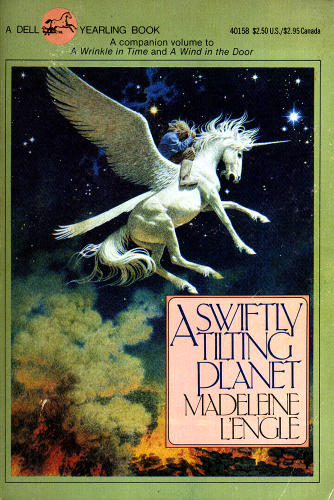
A Swiftly Tilting Planet

I have been thinking recently about war. The children of my generation, our parents... their childhoods were dominated by the ever-looming threat of nuclear war. I am reading Madeline L'Engle's book, A Swiftly Tilting Planet, and its opening pages are rife with this fear. The fear of utter annihilation, of complete destruction, of the death of the human race. "One madman can push a button and it will destroy civilization." I began rereading this book this evening because it is about how a few people might tip the balance, might make some small difference in the world in favor of life, in favor of love and creation, in favor of harmony. The book, written in the late '70s, plays with time and narrative in a mind-bending way. The past is not past, and "as long as the future hasn't happened, there's a chance it may not happen." I began rereading this book tonight because I need reassurance, sometimes, I need to believe in the possibility of goodness. The possibility of peace.

But the world is a very different place now.

Once upon a time, this country used nuclear weapons as a deterrent--at least in theory. Once its citizens feared nuclear war as the very real and very close end days of the human race. Now, we have been living for two generations with the fact that we are the only country in the history of the world to have actually used a nuclear weapon against a civilian population. There were no consequences for us, safe on this side of the ocean, and American citizens have begun to forget the devastation, the sickening and useless destruction that war can cause. When we feel threatened, the average Joe cries out, "Nuke 'em till they glow and them shoot 'em in the dark!" We continue to build our arsenal, and the itch to use it, to show it off, is ever-present and worsening.

We mourn the "massacre" of thirty people in a senseless killing spree perpetuated by a single, deranged individual--and yet in not a few countries across the world, that many people and more die every day, from violence, from starvation, from disease. We rant on about the barbarity of suicide bombers and ponder, peripherally mystified out of the corner of our eyes, what could drive them to such heinous acts. What we really cannot grasp is how they can involve themselves so personally in the killing of innocents, how they can violate the fundamental sense of self as a member of the human community, how they can confront their own violence so directly. It is not the killing of innocents we cannot bare, but this warped selfhood that destroys itself by destroying its community. We kill innocents, but we do so mechanically, in a sanitary manner. We make vague political threats and formulate theoretical dreams of a time when "war is peace," and a bomb falls thousands of miles away. We cannot hear it. We do not see it. We are, as individuals, uninvolved. We are clean, we are innocent. We are isolated. We are the living dead who have forgotten death. We have become the madmen who press the buttons, without thought to the consequences.

I talk with people my age, and sometimes I am astounded by what we say. At work the other day, a customer was celebrating her 86th birthday with her close friends. "I hope I never live that long," said one of my coworkers. "Really!?" I asked, amazed. "You would rather die sooner than later? You don't want to live to see your grandchildren, and maybe even your great-grandchildren? You don't want to grow old with the people you love?" My coworker shrugged and said, "I just don't want to get senile." Something within me ached... The senility of youth, to want to always be young! To never want to deepen, to age, to slow down... Is there so little we love about this place, that we would rather die quickly once we have used it up, used ourselves up? We are the living dead, who have forgotten life and so have forgotten that death, too, is life. Life transformed. Life changed. We bring death to others and we wish it on ourselves, but we do not understand it. We wish death to be mere oblivion--in war, so that the dead we make cannot reproach us; and in ourselves, so that we might not lose ourselves to the flux of time.

We wish it secretly and fervently, but wishing cannot make it true.

I do not know how to talk sense into the madness we take these days for reason. I do not know how to restrain the hand that rests steadily on the button. It is not my hand. It is the invisible hand of the market, it is the hand of the "selfish gene," it is the suicidal hand of a culture that has lost sight of the value of living in its diseased and obsessive pursuit of unlimited life.

But it is not my hand.

Wednesday, May 2, 2007

Magic, Prayer & Props

This is a repost from my old blog, Pulse Like Water, which I first wrote on March 15, 2005. I thought I would repost it here because it continues to be an important subject--for me as well as for people within the Pagan and occult community whom I've talked with about the matter. In fact, I was reminded of this just the other day when chatting briefly with a new Druid friend. As she asked me how I blended Christianity and Druidry, our conversation turned towards a discussion of magic and spellwork, and how it is distinct from the idea of communion or mystical dialogue with the Divine. Both of our spiritual paths have led us more towards the latter, but I also find that as I walk that path, I find it harder to separate the two. I was reminded of this post, in which I first began to distinguish the one from the other--what I have come to call "magic" and "prayer" to be most general--and to explore their relationship. I was also reminded of a well-known quote from the highly influential Druid, Ross Nichols, which I months, if not a year, after first writing this post. And so, I think I will share this again, as it continues to remain relevant and helpful (at least to me, and I hope also to others).
"Ritual is poetry in the realm of acts."
- Ross Nichols, founder of OBOD

Is magic simply "prayer with props"? After much thought on the matter (though I may very well change my mind after further thought in the future!), right now I'd have to say, no. It seems to me that there is a fundamental difference between "prayer" and "magic."

Let's start by looking first at the common definitions of these words.

Main Entry: prayer (noun)
  • A reverent petition made to God, a god, or another object of worship.
  • The act of making a reverent petition to God, a god, or another object of worship.
  • An act of communion with God, a god, or another object of worship, such as in devotion, confession, praise, or thanksgiving.
  • A specially worded form used to address God, a god, or another object of worship.

  • Main Entry: magic (noun)
    • The art that purports to control or forecast natural events, effects, or forces by invoking the supernatural.
    • The practice of using charms, spells, or rituals to attempt to produce supernatural effects or control events in nature.
    • The charms, spells, and rituals so used.

    I've quoted only the first and most relevant definitions for each word, though these few uses listed above should give us a general idea to start. Even though the definitions of "prayer" and "magic" reach far beyond these summary definitions, these simplest explanations of each word seem to have little in common. "Prayer" is a kind of petition or, more generally, a communion or communication with God; "magic," on the other hand, has to do with personal will and gaining control over reality.

    Of course, these definitions are limited. Many Christians would be insulted to think of prayer as merely groveling at the feet of the Lord, begging for favors like weak but selfish children. Likewise, many Witches and magicians would object that magic is much less about exerting control over the external world, and much more concerned with working in harmony with the energies and forces that unite the individual with the rest of reality. Furthermore, both prayer and magic are more generally directed at change--either through God's intervention, or by personal will. If we take the broader understanding of "prayer" and "magic" into consideration, we might define prayer as "communion with God through thought and word, aimed at making room for Divine to act in one's life;" and magic as "prayer--that is, communion with the Divine, aimed at making room for its activity--through the use of physical tools and ritual actions in addition to thought and word." While some might be content with these definitions, they're not enough for me. I want to dig more deeply into the subtleties and nuances of each word.

    Prayer : To me, prayer is above all communion and communication with the Divine. This can take the form of centering prayer or meditation, or it can be something we do everyday, like washing dishes or walking the dog. It is a time to "talk" to God, yes, but above all it is a time to listen. Prayer is ideally a way of paying attention to that "still small voice." Often when we pray out loud and spontaneously out of great distress or need, we articulate fears and anxieties we may not even know about consciously. We don't need to tell God what He already knows, but the real benefit of prayer is to listen to ourselves, to find out what we are really asking for and begin to consider if that is what we really need or want. I often find myself saying things during prayer I would never have verbalized otherwise. Other times, I simply break down into overwhelmed murmurs of "I love You so much!" While I feel a bit silly, I'm also reassured because I can say so and mean it. Prayer is a way of bringing oneself into a better awareness of and connection to the Divine. Anything can be prayer--it can be verbalized or silent, motionless or a kind of dancing, or even work itself. When I write poetry, I am praying. When I laugh, I am praying. When I eat, I am praying. Because each of these activities reminds me of my connection with the Divine, and reminds me to listen, to pay attention.

    Magic : Magic goes a step further. Prayer is largely passive, focusing on listening and paying attention (stilling ourselves and our clamoring desires long enough to make room for God's reply). But magic is active. The focus on control and personal will, although somewhat shallow and misdirected, does give us some insight. After all, is our goal as spiritual beings to deny our free will and become mindless robots of God? Or do we accept free will as a gift and exercise it with love and wisdom, bringing personal will into harmony with the Divine Will? God is not a cult-leader; He wants participation, not subordination. Magic is how we participate. It is how we manifest the communion of prayer in the world so that it can change us and change others. Prayer is necessary for magic--we must communicate with God and pay attention in order to be in harmony with the Divine Will. When we act in harmony, we can be creative and free, without being arrogant or cut-off from God.

    While magic in general might be the practice of exerting personal will arbitrarily on the world, sacred magic, informed by prayer (communion and listening), is an act of creation in harmony with Divine Will.

    What do I mean? I'll give you an example. When I free-write a rough draft of a poem, I am praying--I quiet myself down and listen to what that Divine voice within me articulates spontaneously. But, when I return to the poem, revise it, craft it into a work of art that does something and changes the reader and the world, I am performing magic. Writing is the best example of how magic does not need "tools" or "props." Magic is about creation and change, not about what tools you use. A great work of poetry changes the world, and the writer knows that the piece comes not from her, but through her--it has her "flavor," but its ultimate source is something greater. Similarly, other forms of magic change the world, and the individual practitioner, through creative acts. Sacred magic is essentially creative--it brings something new into being and, thus, changes the world. It expresses the Divine Unity in a new, particular and unique way.

    Prayer reminds us of our source; magic is the active participation in the paradox that that source is expressed through particulars. Prayer is the necessary foundation of magic, and magic is the natural fruit of prayer. They have many of the same goals, but they are different. To call magic simply "prayer with props" would be to ignore the active, creative side of our participation in the Divine. The results of magic are, essentially, miracles. But all miracles require human participation--we plunge our staffs into the sea, we anoint the sick with oil, we bless the communion bread.

    We listen, we pray, we contemplate--and then, we act, we create, we participate.

    Tuesday, May 1, 2007

    Beltane & the Forgotten Temple

    I didn't have any big-to-do formal ritual planned for today, Beltane, May Day (I like to save those for the solar festivals, and celebrate the fire festivals more spontaneously and organically). So this morning I headed off to the local park (a large, wooded park--the biggest in the city--only a twenty-minute walk from where I live), with the intention of spending several hours, possibly all day in quiet meditation and hiking about in the woods. When I go on walks like these, I usually just let my intuition guide me, and today I was rewarded more than I ever expected!

    I've been visiting this park fairly regularly over the past two years, ever since I moved to Pittsburgh, and I've gotten used to there always being people around, walking their dogs, jogging, biking, etc. I was convinced that somewhere in the woods, which is criss-crossed with trails, there must be one or two little groves or clearings where I could sit down and not be interrupted. But, like everything else in the city, all of the trails and paths in the park went somewhere, which meant people were always going from point A to point C, and if I stopped at point B along the way, I could count on there being a steady trickle of people going past me.

    Today, I was walking along one such path that skirts a grassy field where people often let their dogs off leash to run after frisbees or other dogs, when it occurred to me that I had never actually walked across the field to the (seemingly) thin bit of woods on the other side. I don't have a dog, so I usually just walk right past this field, but there were no dogs out today because I went at that perfect time when everyone's at their "day jobs." On a whim, I decided to head towards a small bench I could see sitting in the shade of those trees across the way, but when I got to the bench, I realized there was a little path leading into the trees. I decided to follow it, even though I didn't think it led very far. I had gone in about fifty yards or so, twisting and turning along a path that seemed unexpectedly unused, when I came across a tree with a little wooden sign nailed to it which just read: Temple. After that, the path seemed to almost disappear, but I stumbled my way through and, after climbing over a fallen log that was almost too high for me to climb and too big for me to duck under--I came upon a beautiful little clearing! I could well believe that it was a secret temple or grove, though perhaps one that hadn't been used in years.

    I sat down on the edge of the grove in a wonderfully soft patch of grass (it seemed like the whole clearing might have once been grassy but, over time, the woods had crept back in and there were now mostly shrubs, fallen branches and tall reeds and weeds, except here and there). It was a beautiful spot and I ended up sitting there in quiet meditation and communion for several hours. It was so peaceful--I couldn't even hear any traffic, just the birds and the chipmunks and the occasional bee or butterfly (yes, it was so quiet, that when a butterfly fluttered by, I could actually hear its wingbeats!). I really feel as if I've discovered a sacred place--and the strange sign, "Temple," just makes me wonder even more if there isn't a local pagan, Wiccan or maybe even Druid group that perhaps uses (or used to use) the site. All I know is that I finally found a path that leads to nowhere, and so only those seeking to get nowhere ever come down it--just me, the robins, the sunlight and the breeze.