
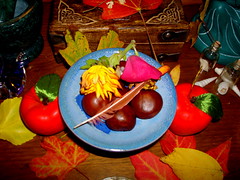
 I'd never written a group ritual before; in fact, I'd never really bothered to write down the rituals I usually did for holy days and other magical work. For the most part, I utilized the basic outline provided by AODA to open the grove — declaring peace to the four quarters, welcoming the energies of the four directions, and reciting the Gorsedd Prayer (also called the "Bond of Druids") — performing the opening from memory and then proceeding to improvise whatever central work I'd intended, often lighting candles and reading poetry, followed by personal meditation and pouring libations. I disliked the AODA's closing of the ritual; the mythological references to Arthur and Excalibur didn't speak very strongly to me, and I found the closing unbalanced and too abrupt, without the appropriate thanking of the directional energies or the necessary time needed to ground back into ordinary mundane consciousness. So eventually, I began supplementing the AODA outline, adding a circle casting with the three elements (calas, gwyar and nwyfre), and repeating, in reverse, a simplified form of the invocations at the close of each ritual. Still, the core substance of each rite, between these two formal bookends of movement and speech, remained fairly quiet and internal. No elaborate gestures, prayers or chants, and only occasionally some overt use of tools to charge or direct energy. For the most part, my personal rituals were a way of creating a nemeton, or spiritual sanctuary, that was within the physical world but also set apart from mundane space-time, a consecrated place in which I could sit in meditation and do inner work with heightened psychological and spiritual potency.
This worked well for me as a basis for private ritual activity, but because so much of the activity was internal and unspoken, I knew it wouldn't serve for group work. Group ritual must, it seems to me, be about acting out the spiritual life together in community, particularly in a way that is aesthetic and powerful. Guided meditations might play some role, to heighten emotional connection and focus attention, but the primary activity of group ritual must be external, visible for all participants to witness together — like a play, dance or musical performance. I knew it would be a challenge to write out as physical acts the kind of meditative work that I usually engaged with in solitary rites. Where I might effectively imagine myself at once in a beautiful inner grove standing before a flowing stream or a flickering bonfire, now I would have to find ways to represent and invoke these experiences with physical objects immediately present in the real, external circle — objects with which all participants could safely interact in ways that were still moving and meaningful. A bowl of water had to become more than just a bowl of water; an altar had to be a place of aesthetic focus and not just a storage place for tools.
It took me about a week and a half to come up with and write out the small group Samhain ritual that Jeff and I ended up performing. The writing itself was an intense experience. There were times when I found myself inadvertently composing in rhyming couplets or stumbling upon phrases that seemed absolutely lovely, simple and satisfyingly concise. Other times, I went back to the same brief prayers and chants over and over, rearranging single words or copy-pasting whole parts of the rite into different orders, struggling to realize some sense of aesthetic balance. Eventually, the rite as a whole began to come into focus; when I could not remove or revise anything more without some adverse effect to the flow and sense of balance, I knew I was finally finished. For a time, I was quite honestly a bit enamored with the ritual I had composed on paper. I would open the file at random to read through it during the day, tweaking or just turning the words over in my mind and imagining the actions and gestures of the presiding priest or priestess. I set about organizing the main roles into a form that could be effectively performed by only two people, and then sent it along to Jeff to begin memorizing.
Jeff has very little experience with writing and performing ritual. The word "none" comes to mind, actually, although this isn't strictly true as he has attended a few small rituals with Hopman's Order of White Oak. Still, as he himself admitted, few rituals had really moved him or meant much to him, perhaps because he was usually more distracted with herding and helping children through the rites. I had not anticipated the effect lack of experience would have on our performance; I thought to myself, well, all the "stage directions" are right there in the script, and the chants are easy enough to memorize with a bit of practice. But on the day that we'd planned to hold the rite, Jeff became increasingly nervous, struggling to remember the order of the prayers, chants and blessings, and lacking the confidence to improvise those invocations and actions he could not remember. I began to realize that, without a solid understanding of the theory behind the rite, it could all seem kind of random and befuddling. I worked to coach him during the last few hours before we began, explaining some of the structure and printing out two decorative scrolls for invocations to Cernunnos and the four directions. In the end, his nervousness and my own feeling of uncertainty kept both of us distracted from really experiencing the ritual as powerfully as I had hoped.
Of course, I failed to anticipate other things as well. In the past, I had performed most of my personal rites indoors, and what few outdoor rituals I'd engaged in had been informal and simple, rarely involving more than a bit of lit incense or, maybe, a candle held close during sitting meditation. Now blessed with a backyard and understanding neighbors, I was excited to be able to perform a formal outdoor rite for the first time. I eagerly incorporated the sprinkling of herbs and water to trace a literal circle upon the ground (already outlined in tiny pumpkins and gourds) to open the grove, and during the one part of the rite I included a dramatic lighting of a cauldron fire in the center of the altar, to symbolize the fire of life springing up and persisting through the dark winter days. What I hadn't anticipated... was wind. It didn't even feel all that windy that night. But, while setting up the altar and decorating it with pressed leaves the children and I had collected earlier that week, the breeze soon swept every single one to the ground, leaving the altar sadly bare. Later, as I sprinkled water around the circle, my fingers quickly became numb, and then painful, with the cold damp.
And best of all — the cauldron refused to light. At first. After Jeff had broken circle to slip inside for matches (after the lighter clicked and clicked without a spark to catch), it took five attempts before the rubbing alcohol in the tiny cauldron finally suffused with a hot blue flame that spread and anchored itself firmly in the dark iron pot. But even then — there was still the wind. And though I'd had practice burning alcohol in this same cauldron before, never had I stood on a windy night, watching the flames leaping dangerously sideways towards the bowl of dried herbs and the mortar full of ground incense, expecting at any moment for the whole thing to go up in flames. Jeff and I stood "in quiet meditation," as the script read, waiting for the flames to eventually die down as a signal to end the rite... but our gasps belied the reality: tension and worry. There was relief, more than anything else, when one final gust of wind blew the fire clean out and I quickly slapped the lid back on and began the ritual closing (thanking Cernunnos, sardonically, for blessing us with his wild presence).
 Jeff insists that this whole experience was entirely appropriate, and it is true that we had sufficient water and blankets to stamp out a fire in case of emergency, but still I would have preferred a safer wildness, or a less dangerous symbolic center for the rite. On the other hand, it certainly proves that, no matter how many books on ritual theory you read, nothing compares to attempting the thing in real life and learning just how powerful even a light breeze can be, or just how dark it is, even in a city, before the full moon rises over the horizon. The experience also brings home to me the utmost importance of working up to formal ritual, beginning at the beginning with a thorough understanding of the theory and an established comfort level with the basic structure. As much as I loved writing a full-blown formal ritual to celebrate one of the most important holy days of the Druidic calendar, I have decided to revise my approach in the future, and develop a course of study to gradually introduce elements of ritual to the inexperienced. Jeff has agreed to be my guinea pig for this experiment, and periodically I hope to share these developments and learning experiences for others to read and try on their own.
Meanwhile, dear readers, I would love to hear about some of your experiences with ritual — both private and public, solitary and group. What disaster stories do you have? What lessons have you learned the hard way, and what potential pitfalls have you learned to avoid? How did you learn to write and perform effective ritual, and how might you go about teaching others?
 Well, we're not there yet. But together, Jeff and I have taken the first step and officially announced the formation of an informal study group called Sycamore Circle (the group can be
  Perhaps it's because I came to Druidry through my poetry (which I've been writing since about the age I could first hold a crayon) and I continue to adore Druidry because of its bardic traditions, which embrace and celebrate music, song and the power of words... but I have never understood the kind of response that rejects book learnin' as somehow less important or more dangerous than direct experience. To me, reading and exploring ideas in books has always inspired and sewn in me the seeds of desire: desire to move ideas into the real world and bring their beauty into participatory being, and desire to meet the challenge of articulating my own experiences in meaningful ways that can sew those seeds in others. If it hadn't been for a few incredibly well-written books on Druidry, I wouldn't have ever bothered to begin the real life practice that has given me so much and opened me to so many experiences (I wouldn't even know what a [insert exotic sounding ritual here] was or why it might matter to other people, let alone what it might someday mean to me).
 This past month of blogging has been heavy with abstraction and theory, but that's not all I've been up to. In those moments when I step back and take a look at myself, I'm still a bit stunned at this sudden surge of energy and focus I've had since the winter solstice.
 This kind of nonrational ritual activity--pouring water over a small pile of stones, to soak into the soil beneath--had a strong aesthetic sense that enchanted and inspired me, so I decided to go with it. Rather than organize a new altar around the traditional four elements, I decided to focus instead on the Three Realms of Druidry: earth, sea and sky, represented by the bile (or sacred tree), the sacred fire, and the sacred well.
 I arranged these three items on the circular end table in the corner of my bedroom, rearranged a few chairs and bookcases to open up the space to allow for both standing meditation and sitting cross-legged on a cushioned elevated platform (i.e. a sturdy old wooden kids-sized table from my childhood that has outlasted every piece of brightly-colored plastic junk I ever owned). The altar faces southwest, and I often feel the interplay of fire and water, grounded deeply in the earth, as part of its inspiration and enchantment. During sessions of meditation, I place a small stick of incense to the left of the solar candle, and a pitcher next to the bowl of water. I fill the pitcher with fresh water before hand and, during my meditation, I infuse this with a few drops from the bowl before charging it with intention and gratitude and pouring it gently over the stones.
 This is precisely what I did. The dish of earth set in the north and the bowl of water in the west were complimented by a candle and incense in the south and east, and in the center I placed the solar candle as a focal point. Rather than merely representing the sky realm, as it did on my meditation altar, here it could serve to symbolize all Three Realms together: the candle inside still represented the sky and sacred fire, but now it floated in the jar I had filled with salt-infused water representing the sea, while the pottery itself, sculpted lovingly out of clay, came to represent the realm of earth. This jar full of water, which had felt the warmth of the sacred flame, I would later transfer into the lunar bowl on my meditation altar, where it would eventually blend with fresh waters and bless the soil and stones of the dish of earth. In this way, the energies and intentions at the center of my working altar would circulate in a fluid dynamic among the Three Realms in the sacred space where I quieted myself to meditate and pray, forging and reminding me of the intimate relationship of exchange between my receptive stillness and my active ritual work.
 [d] Regular exercise, after initially leaving Ali expectedly sore in all sorts of flabby places, also has the unexpected result of thawing out her crush-muscle. The crush-muscle, for those of you who aren't already aware, is located in the pit of the stomach and is shaped like a pink-and-white lace Valentine heart with angelic and innocent-looking butterfly wings (these tend to flutter excitedly for no apparent reason). The crush-muscle is often mistake for the heart as the Seat of Love; understandably, as it is indirectly connected to the heart via the brain's frontal lobe, which it must shut down in order to circumvent. Ali's crush-muscle has been frozen stiff for quite a long time. (A long story, involving misdirection, sleight-of-hand, regret and autonomy.)
