As part of my aspirant work with the Druid Order of the Three Realms, I've been experimenting with ways to create a wooden plaque with the DOTR symbol to include on my altar. I had at first thought of doing a combination wood-burning/acrylic paint technique (such as the one I used on my travel altar), but the redesigned and touched-up version of the three realms triquetra/triskele that Christopher did for me was so stunning, I wasn't sure my mediocre talents would be able to do it justice. I was curious to see if there were any techniques that would allow me to transfer the image more directly to the plaque.
After some brief investigating online, I stumbled upon this page over at matsutake, which provides a tutorial on how to transfer inkjet printer images onto wood. I thought to myself, hey, I have an inkjet printer... I have wood... I have Elmer's Glue and Mod Podge... I have a tiny modicum of talent and patience, but most importantly, I have an ass-kickingly beautiful graphic image that might just work. Even if the results weren't as stunning, or the process as easy, as the tutorial implied, I thought I'd give it a shot.

Showing posts with label altar. Show all posts
Showing posts with label altar. Show all posts
Friday, November 12, 2010
Thursday, October 21, 2010
The Three Elements of Druidic Ritual

The sun has set, and twilight settles dark over the autumn landscape. In another half an hour a harvest moon, swelling but not quite full, will rise over the eastern horizon, but for now the grove is thick with gray mist and half-seen shadows. In the center, a thin white altar cloth drapes a low, square stone; the cloth shifts once in a while, ghostly and almost whispering with the silent breeze that barely moves the trees. The altar itself is decorated with gourds, dried pale aster blossoms and pressed fall leaves collected from the local landscape over the past week, bringing out subtle shades of yellow, orange, russet and deep greens that are, nonetheless, difficult to distinguish in the darkness. A small bowl of incense smolders and smokes, its scent mingling with the damp late-night fog, and in the center of the altar a small lidded cauldron sits waiting, the waters of life inside ready to be ignited. When the time is right.
Suddenly, the strike of a match and a flame flares into life, held delicately between the fingers of a white-robed figure. Opening the cauldron, she tosses the match inside and within seconds a column of fire is dancing and leaping upwards as if out of the very womb of darkness, lapping at the round, black lip of the iron pot. Flickering light illuminates the entire grove, revealing other figures standing poised on the threshold of vision, some dressed in white, others in the colors of the elements or of the autumnal season. As the cauldron fire grows stronger, the center figure raises her arms in a gesture of gratitude and exaltation, and those in the surrounding circle do likewise. Together, all begin to chant the familiar words of prayer, the syllables weaving and repeating, their voices cascading over one another in a rising harmony of sound and vibration. The energy is palpable, flowing through each tongue of fire, grounding in the deep earth and arcing towards the celestial realms — and each participant adds their own energy, opening themselves to the awareness of connection moving and dancing through the grove.
This is the cosmos recreated, the three realms meeting in a center which is everywhere at once.
The chanting prayer drops suddenly to a slow-whispered awen, and the grove falls once more into silence, the only sound that of the flames trembling and sizzling on the altar. Everyone waits expectedly, their skin shivering with energy, for the ritual to continue.
Friday, July 30, 2010
Three Realms of Druidry Travel Altar
Handcrafted by Ali herself, this travel altar contains: a decorative carry-all box, three wooden three-realms plaques, three holders for fire, water and earth, a white handkerchief altar cloth, a sachet of herbs and acorns, a tea light candle, an incense holder, several cone incense, small book of matches, a small bag containing peace prayer beads, a miniature heart-shaped compass, stones and tokens representing the three realms.

Visit Meadowsweet & Myrrh's Facebook Page to see more photos.
Visit Meadowsweet & Myrrh's Facebook Page to see more photos.
Monday, November 9, 2009
Writing the Right Rite: Lessons of Experience
Although I've been slowly cultivating a personal practice of meditation and ritual as a solitary Druid for several years now, until last week I'd only ever participated in exactly one Pagan group rite — and then, not even as a Pagan myself, but as an academic, observing and collecting data via field research. But last week, in honor of the founding of Sycamore Circle, Jeff and I celebrated our first "group" ritual — an intimate Samhain rite in the backyard.
 I'd never written a group ritual before; in fact, I'd never really bothered to write down the rituals I usually did for holy days and other magical work. For the most part, I utilized the basic outline provided by AODA to open the grove — declaring peace to the four quarters, welcoming the energies of the four directions, and reciting the Gorsedd Prayer (also called the "Bond of Druids") — performing the opening from memory and then proceeding to improvise whatever central work I'd intended, often lighting candles and reading poetry, followed by personal meditation and pouring libations. I disliked the AODA's closing of the ritual; the mythological references to Arthur and Excalibur didn't speak very strongly to me, and I found the closing unbalanced and too abrupt, without the appropriate thanking of the directional energies or the necessary time needed to ground back into ordinary mundane consciousness. So eventually, I began supplementing the AODA outline, adding a circle casting with the three elements (calas, gwyar and nwyfre), and repeating, in reverse, a simplified form of the invocations at the close of each ritual. Still, the core substance of each rite, between these two formal bookends of movement and speech, remained fairly quiet and internal. No elaborate gestures, prayers or chants, and only occasionally some overt use of tools to charge or direct energy. For the most part, my personal rituals were a way of creating a nemeton, or spiritual sanctuary, that was within the physical world but also set apart from mundane space-time, a consecrated place in which I could sit in meditation and do inner work with heightened psychological and spiritual potency.
This worked well for me as a basis for private ritual activity, but because so much of the activity was internal and unspoken, I knew it wouldn't serve for group work. Group ritual must, it seems to me, be about acting out the spiritual life together in community, particularly in a way that is aesthetic and powerful. Guided meditations might play some role, to heighten emotional connection and focus attention, but the primary activity of group ritual must be external, visible for all participants to witness together — like a play, dance or musical performance. I knew it would be a challenge to write out as physical acts the kind of meditative work that I usually engaged with in solitary rites. Where I might effectively imagine myself at once in a beautiful inner grove standing before a flowing stream or a flickering bonfire, now I would have to find ways to represent and invoke these experiences with physical objects immediately present in the real, external circle — objects with which all participants could safely interact in ways that were still moving and meaningful. A bowl of water had to become more than just a bowl of water; an altar had to be a place of aesthetic focus and not just a storage place for tools.
It took me about a week and a half to come up with and write out the small group Samhain ritual that Jeff and I ended up performing. The writing itself was an intense experience. There were times when I found myself inadvertently composing in rhyming couplets or stumbling upon phrases that seemed absolutely lovely, simple and satisfyingly concise. Other times, I went back to the same brief prayers and chants over and over, rearranging single words or copy-pasting whole parts of the rite into different orders, struggling to realize some sense of aesthetic balance. Eventually, the rite as a whole began to come into focus; when I could not remove or revise anything more without some adverse effect to the flow and sense of balance, I knew I was finally finished. For a time, I was quite honestly a bit enamored with the ritual I had composed on paper. I would open the file at random to read through it during the day, tweaking or just turning the words over in my mind and imagining the actions and gestures of the presiding priest or priestess. I set about organizing the main roles into a form that could be effectively performed by only two people, and then sent it along to Jeff to begin memorizing.
Jeff has very little experience with writing and performing ritual. The word "none" comes to mind, actually, although this isn't strictly true as he has attended a few small rituals with Hopman's Order of White Oak. Still, as he himself admitted, few rituals had really moved him or meant much to him, perhaps because he was usually more distracted with herding and helping children through the rites. I had not anticipated the effect lack of experience would have on our performance; I thought to myself, well, all the "stage directions" are right there in the script, and the chants are easy enough to memorize with a bit of practice. But on the day that we'd planned to hold the rite, Jeff became increasingly nervous, struggling to remember the order of the prayers, chants and blessings, and lacking the confidence to improvise those invocations and actions he could not remember. I began to realize that, without a solid understanding of the theory behind the rite, it could all seem kind of random and befuddling. I worked to coach him during the last few hours before we began, explaining some of the structure and printing out two decorative scrolls for invocations to Cernunnos and the four directions. In the end, his nervousness and my own feeling of uncertainty kept both of us distracted from really experiencing the ritual as powerfully as I had hoped.
Of course, I failed to anticipate other things as well. In the past, I had performed most of my personal rites indoors, and what few outdoor rituals I'd engaged in had been informal and simple, rarely involving more than a bit of lit incense or, maybe, a candle held close during sitting meditation. Now blessed with a backyard and understanding neighbors, I was excited to be able to perform a formal outdoor rite for the first time. I eagerly incorporated the sprinkling of herbs and water to trace a literal circle upon the ground (already outlined in tiny pumpkins and gourds) to open the grove, and during the one part of the rite I included a dramatic lighting of a cauldron fire in the center of the altar, to symbolize the fire of life springing up and persisting through the dark winter days. What I hadn't anticipated... was wind. It didn't even feel all that windy that night. But, while setting up the altar and decorating it with pressed leaves the children and I had collected earlier that week, the breeze soon swept every single one to the ground, leaving the altar sadly bare. Later, as I sprinkled water around the circle, my fingers quickly became numb, and then painful, with the cold damp.
And best of all — the cauldron refused to light. At first. After Jeff had broken circle to slip inside for matches (after the lighter clicked and clicked without a spark to catch), it took five attempts before the rubbing alcohol in the tiny cauldron finally suffused with a hot blue flame that spread and anchored itself firmly in the dark iron pot. But even then — there was still the wind. And though I'd had practice burning alcohol in this same cauldron before, never had I stood on a windy night, watching the flames leaping dangerously sideways towards the bowl of dried herbs and the mortar full of ground incense, expecting at any moment for the whole thing to go up in flames. Jeff and I stood "in quiet meditation," as the script read, waiting for the flames to eventually die down as a signal to end the rite... but our gasps belied the reality: tension and worry. There was relief, more than anything else, when one final gust of wind blew the fire clean out and I quickly slapped the lid back on and began the ritual closing (thanking Cernunnos, sardonically, for blessing us with his wild presence).
 Jeff insists that this whole experience was entirely appropriate, and it is true that we had sufficient water and blankets to stamp out a fire in case of emergency, but still I would have preferred a safer wildness, or a less dangerous symbolic center for the rite. On the other hand, it certainly proves that, no matter how many books on ritual theory you read, nothing compares to attempting the thing in real life and learning just how powerful even a light breeze can be, or just how dark it is, even in a city, before the full moon rises over the horizon. The experience also brings home to me the utmost importance of working up to formal ritual, beginning at the beginning with a thorough understanding of the theory and an established comfort level with the basic structure. As much as I loved writing a full-blown formal ritual to celebrate one of the most important holy days of the Druidic calendar, I have decided to revise my approach in the future, and develop a course of study to gradually introduce elements of ritual to the inexperienced. Jeff has agreed to be my guinea pig for this experiment, and periodically I hope to share these developments and learning experiences for others to read and try on their own.
Meanwhile, dear readers, I would love to hear about some of your experiences with ritual — both private and public, solitary and group. What disaster stories do you have? What lessons have you learned the hard way, and what potential pitfalls have you learned to avoid? How did you learn to write and perform effective ritual, and how might you go about teaching others?
I'd never written a group ritual before; in fact, I'd never really bothered to write down the rituals I usually did for holy days and other magical work. For the most part, I utilized the basic outline provided by AODA to open the grove — declaring peace to the four quarters, welcoming the energies of the four directions, and reciting the Gorsedd Prayer (also called the "Bond of Druids") — performing the opening from memory and then proceeding to improvise whatever central work I'd intended, often lighting candles and reading poetry, followed by personal meditation and pouring libations. I disliked the AODA's closing of the ritual; the mythological references to Arthur and Excalibur didn't speak very strongly to me, and I found the closing unbalanced and too abrupt, without the appropriate thanking of the directional energies or the necessary time needed to ground back into ordinary mundane consciousness. So eventually, I began supplementing the AODA outline, adding a circle casting with the three elements (calas, gwyar and nwyfre), and repeating, in reverse, a simplified form of the invocations at the close of each ritual. Still, the core substance of each rite, between these two formal bookends of movement and speech, remained fairly quiet and internal. No elaborate gestures, prayers or chants, and only occasionally some overt use of tools to charge or direct energy. For the most part, my personal rituals were a way of creating a nemeton, or spiritual sanctuary, that was within the physical world but also set apart from mundane space-time, a consecrated place in which I could sit in meditation and do inner work with heightened psychological and spiritual potency.This worked well for me as a basis for private ritual activity, but because so much of the activity was internal and unspoken, I knew it wouldn't serve for group work. Group ritual must, it seems to me, be about acting out the spiritual life together in community, particularly in a way that is aesthetic and powerful. Guided meditations might play some role, to heighten emotional connection and focus attention, but the primary activity of group ritual must be external, visible for all participants to witness together — like a play, dance or musical performance. I knew it would be a challenge to write out as physical acts the kind of meditative work that I usually engaged with in solitary rites. Where I might effectively imagine myself at once in a beautiful inner grove standing before a flowing stream or a flickering bonfire, now I would have to find ways to represent and invoke these experiences with physical objects immediately present in the real, external circle — objects with which all participants could safely interact in ways that were still moving and meaningful. A bowl of water had to become more than just a bowl of water; an altar had to be a place of aesthetic focus and not just a storage place for tools.
It took me about a week and a half to come up with and write out the small group Samhain ritual that Jeff and I ended up performing. The writing itself was an intense experience. There were times when I found myself inadvertently composing in rhyming couplets or stumbling upon phrases that seemed absolutely lovely, simple and satisfyingly concise. Other times, I went back to the same brief prayers and chants over and over, rearranging single words or copy-pasting whole parts of the rite into different orders, struggling to realize some sense of aesthetic balance. Eventually, the rite as a whole began to come into focus; when I could not remove or revise anything more without some adverse effect to the flow and sense of balance, I knew I was finally finished. For a time, I was quite honestly a bit enamored with the ritual I had composed on paper. I would open the file at random to read through it during the day, tweaking or just turning the words over in my mind and imagining the actions and gestures of the presiding priest or priestess. I set about organizing the main roles into a form that could be effectively performed by only two people, and then sent it along to Jeff to begin memorizing.
Jeff has very little experience with writing and performing ritual. The word "none" comes to mind, actually, although this isn't strictly true as he has attended a few small rituals with Hopman's Order of White Oak. Still, as he himself admitted, few rituals had really moved him or meant much to him, perhaps because he was usually more distracted with herding and helping children through the rites. I had not anticipated the effect lack of experience would have on our performance; I thought to myself, well, all the "stage directions" are right there in the script, and the chants are easy enough to memorize with a bit of practice. But on the day that we'd planned to hold the rite, Jeff became increasingly nervous, struggling to remember the order of the prayers, chants and blessings, and lacking the confidence to improvise those invocations and actions he could not remember. I began to realize that, without a solid understanding of the theory behind the rite, it could all seem kind of random and befuddling. I worked to coach him during the last few hours before we began, explaining some of the structure and printing out two decorative scrolls for invocations to Cernunnos and the four directions. In the end, his nervousness and my own feeling of uncertainty kept both of us distracted from really experiencing the ritual as powerfully as I had hoped.
Of course, I failed to anticipate other things as well. In the past, I had performed most of my personal rites indoors, and what few outdoor rituals I'd engaged in had been informal and simple, rarely involving more than a bit of lit incense or, maybe, a candle held close during sitting meditation. Now blessed with a backyard and understanding neighbors, I was excited to be able to perform a formal outdoor rite for the first time. I eagerly incorporated the sprinkling of herbs and water to trace a literal circle upon the ground (already outlined in tiny pumpkins and gourds) to open the grove, and during the one part of the rite I included a dramatic lighting of a cauldron fire in the center of the altar, to symbolize the fire of life springing up and persisting through the dark winter days. What I hadn't anticipated... was wind. It didn't even feel all that windy that night. But, while setting up the altar and decorating it with pressed leaves the children and I had collected earlier that week, the breeze soon swept every single one to the ground, leaving the altar sadly bare. Later, as I sprinkled water around the circle, my fingers quickly became numb, and then painful, with the cold damp.
And best of all — the cauldron refused to light. At first. After Jeff had broken circle to slip inside for matches (after the lighter clicked and clicked without a spark to catch), it took five attempts before the rubbing alcohol in the tiny cauldron finally suffused with a hot blue flame that spread and anchored itself firmly in the dark iron pot. But even then — there was still the wind. And though I'd had practice burning alcohol in this same cauldron before, never had I stood on a windy night, watching the flames leaping dangerously sideways towards the bowl of dried herbs and the mortar full of ground incense, expecting at any moment for the whole thing to go up in flames. Jeff and I stood "in quiet meditation," as the script read, waiting for the flames to eventually die down as a signal to end the rite... but our gasps belied the reality: tension and worry. There was relief, more than anything else, when one final gust of wind blew the fire clean out and I quickly slapped the lid back on and began the ritual closing (thanking Cernunnos, sardonically, for blessing us with his wild presence).
Jeff insists that this whole experience was entirely appropriate, and it is true that we had sufficient water and blankets to stamp out a fire in case of emergency, but still I would have preferred a safer wildness, or a less dangerous symbolic center for the rite. On the other hand, it certainly proves that, no matter how many books on ritual theory you read, nothing compares to attempting the thing in real life and learning just how powerful even a light breeze can be, or just how dark it is, even in a city, before the full moon rises over the horizon. The experience also brings home to me the utmost importance of working up to formal ritual, beginning at the beginning with a thorough understanding of the theory and an established comfort level with the basic structure. As much as I loved writing a full-blown formal ritual to celebrate one of the most important holy days of the Druidic calendar, I have decided to revise my approach in the future, and develop a course of study to gradually introduce elements of ritual to the inexperienced. Jeff has agreed to be my guinea pig for this experiment, and periodically I hope to share these developments and learning experiences for others to read and try on their own.Meanwhile, dear readers, I would love to hear about some of your experiences with ritual — both private and public, solitary and group. What disaster stories do you have? What lessons have you learned the hard way, and what potential pitfalls have you learned to avoid? How did you learn to write and perform effective ritual, and how might you go about teaching others?
Wednesday, February 4, 2009
Altar Overhaul
 This past month of blogging has been heavy with abstraction and theory, but that's not all I've been up to. In those moments when I step back and take a look at myself, I'm still a bit stunned at this sudden surge of energy and focus I've had since the winter solstice.
It was a little less than a year ago, just after passing my First Degree Exam with AODA, that I decided to cease formal study with the Order for a little while. I didn't perform the ritual self-initiation to enter the first degree of Druid Apprentice at the time, since one aspect of the ritual was to describe what you had learned during your time as a Candidate; while I'd written twenty-seven pages worth of reflection for my exam on this very topic, I wanted to be absolutely sure, to gain some perspective about some of the fundamental ways that Druidry had thus far shaped and changed me, before I committed to formal membership and further study. The following year was quiet and contemplative when it came to my spiritual path. I kept blogging, thinking and spending a great deal of time out in nature. I read a bit of Celtic mythology and other texts that were beyond the "Druidry 101" types I'd been lining my shelf with up until that point. But for the most part I lapsed back into observer-mode, the role I had occupied for several years as a student in college, studying Neopaganism from the outside-in before finally trying my hand at this whacky nature-worship hoopla for myself. For the past year, I've done very little actual spiritual work. I've continued to go on walks and attend to nature, but I haven't prayed, meditated or even done much ritual on the holy days. I just... didn't feel like it.
I'm not sure what exactly changed this Alban Arthan past, but something sure has kicked back into gear. I've felt a sense of renewal and more solidified commitment. Along with the intense serial posts that I've spent a great deal of time working on, I recently determined that it was absolutely essential to address the issue of my altar, which had been bothering me for quite some time. Over the year--especially in the autumn, as a means of coping with some annual bad-memories-relived issues--I had turned my altar area mainly into a kind of shrine to the local landscape of the natural world, scattered with leaves, seeds, nuts and stones I'd collected on my weekly walks. But with this new spurt of energy, and a renewed commitment to regular meditation that I'd already started to make good on, I decided to sit down and work on an "altar overhaul."
Assessing Needs
First, I made a list of the ideal uses that I would like my main altar to serve:
- as a shrine, to display important and/or aesthetic objects (such as candles, statues, paintings, cards, other objects)
- as a space of offering, incorporating objects from nature such as leaves, stones, flowers, shells, seeds, etc., to be placed in an offering dish or among the other ritual items on display
- a focal point for meditation and prayer, with comfortable seating and an aesthetically pleasing balance in design, to draw me naturally and eagerly into the space
I quickly realized that my current altar set-up, in trying to meet all these needs, failed to meet any of them fully. I also noticed that I had no real interest in the kind of "working altar" and its tools that was commonly found in witchcraft and other kinds of magical practices, although this model of functionality (and elemental correspondence, especially) had been the first type I'd been introduced to and was still shaping my expectations in many ways.
Next, I tried to pinpoint some of the biggest problems with my current altar, to give me a clearer picture of what issues I would need to resolve:
- using the top of my bureau as a shrine meant having a mirror as a permanent backdrop; not only did this limit the amount of decorative elements I could incorporate (as well as providing a distracting full-view reflection of myself during ritual), but using the mirror for mundane purposes meant that I had to literally "overlook" the shrine on a daily basis
- a lack of comfortable seating (in particular a floor cushion that would allow me to sit in my preferred cross-legged position) discouraged me from extended or regular use; pulling up a chair required inconvenient furniture rearranging, plus the shape of bureau made sitting close awkward, with no room for my knees
- the shape of the bureau top was flat and long, so that my altar was broken into smaller areas some of which had no organized theme whatsoever; it often felt too long to be practical, and didn't have an aesthetic "flow" or coherence necessary to create an inviting or inspiring space
- at the most basic level, the area was impractical for activities such as burning candles or incense, or lighting small controlled fires in my cauldron; not enough space to allow for ease and comfort, amplified by my worries about wax or burn marks ruining a nice wood finish, provided too many causes for distraction or discomfort
With these problems clearly identified, I soon began to prioritize and scope out my apartment for possible new locations and set-ups for a more practical altar space. I found a corner in my bedroom that had become a kind of random-pile-of-stuff mess, so I buckled down and cleared it out, brought an old round end table up from basement storage, lugged a huge forgotten cushion out of the closet, and followed my instinct.
Over the past month or so, my most pressing priority had become a practical altar for meditation. I'd already begun meditating again before going to bed each night, sitting on my bed in my pajamas working at simple Sphere of Protection visualizations and occasionally going to my inner nemeton or sacred grove. But I wanted something more, something set off from the nightly routine: a candle to light, burning incense to mark the beginning of meditative time and permeate the space with a sense of quiet, sacred stillness. And for some reason, I really wanted to pour water over stones.
Cultivating Enchantment
I can't really explain this last desire--it is essentially nonrational. During family summer vacations in Acadia National Park, ME, in recent years, I'd taken to pouring out small amounts of water onto the ground when I stopped for a drink during long hikes. The huge granite slabs of the coastal mountain peaks, warm with long hours of sunlight, seemed to drink up the offering, glistening and growing darker where the water pooled and trickled between rough patches of lichen, into invisible fractures in the rock. I did it without thinking, as a way of showing my gratitude for the mountains, the earth, the pacing rocky shoreline and the sea racing out to meet endless sky. And now, thinking about my meditative practices and what my ideal altar would include, I found myself imagining the cairns and boulders of Acadia again, and seeing myself in a peaceful grove, kneeling and offering clear, fresh water (or maybe sometimes a bit of mead) to the earth.
 This kind of nonrational ritual activity--pouring water over a small pile of stones, to soak into the soil beneath--had a strong aesthetic sense that enchanted and inspired me, so I decided to go with it. Rather than organize a new altar around the traditional four elements, I decided to focus instead on the Three Realms of Druidry: earth, sea and sky, represented by the bile (or sacred tree), the sacred fire, and the sacred well.
- My mother had given me a beautiful hand-turned clay candle holder for Christmas, a deep gorgeous blue that rippled around a carved image of the sun, so I set to work washing out a small jar in which I could safely burn a tealight; this would be my sacred flame, a symbol of the sky and solar energies.
- Next, I found a small blue bowl I'd bought more than a year ago, collecting dust in my kitchen cabinet. Filling it with sea salt infused water and laying a small mirror on its bottom, over which I scatter a few chips of moonstone and tiny snail shells I'd gathered along the beaches of Acadia, I now had my sacred well, to serve both as a symbol of the sea and of the lunar energies that would compliment and balance those of the sun.
- Finally, I filled a round, green tray (which used to belong to a decorative planters pot) with rich, dark soil and built a small cairn out of river stones and rough pebbles; this would be my symbol for earth, this dish with its tiny axis mundi reaching upwards, circled by decorative green boughs.
 I arranged these three items on the circular end table in the corner of my bedroom, rearranged a few chairs and bookcases to open up the space to allow for both standing meditation and sitting cross-legged on a cushioned elevated platform (i.e. a sturdy old wooden kids-sized table from my childhood that has outlasted every piece of brightly-colored plastic junk I ever owned). The altar faces southwest, and I often feel the interplay of fire and water, grounded deeply in the earth, as part of its inspiration and enchantment. During sessions of meditation, I place a small stick of incense to the left of the solar candle, and a pitcher next to the bowl of water. I fill the pitcher with fresh water before hand and, during my meditation, I infuse this with a few drops from the bowl before charging it with intention and gratitude and pouring it gently over the stones.
Back to Work
Soon after completing the overhaul and set up of my new altar, sewing my new white cotton meditation robes and practicing regularly for a good week and a half, I decided that I was indeed ready to finally commit to AODA's first degree of Druid Apprentice through the formal self-initiation ritual. So, once again, I found myself in need of a "working altar" arrayed with the four elemental cauldrons of the traditional AODA ritual. My meditation altar proved unsuitable for these purposes, and the shrine-like altar on my bureau was utterly impractical as well (not least because it did not allow me to walk circles around it, being up against a wall). Then it dawned on me: I had a perfectly good table already available, the one I had been using as a platform for my seated meditations. I kept it intentionally clear of clutter during the day to minimize the need to shuffle and rearrange objects when setting up my meditative space each evening. How simple it would be to pull this table out into the center of the room, arrange a chair in the south facing north, and set up a temporary "working altar" for practical ritual that could be easily dismantled again after the ceremony had finished.
 This is precisely what I did. The dish of earth set in the north and the bowl of water in the west were complimented by a candle and incense in the south and east, and in the center I placed the solar candle as a focal point. Rather than merely representing the sky realm, as it did on my meditation altar, here it could serve to symbolize all Three Realms together: the candle inside still represented the sky and sacred fire, but now it floated in the jar I had filled with salt-infused water representing the sea, while the pottery itself, sculpted lovingly out of clay, came to represent the realm of earth. This jar full of water, which had felt the warmth of the sacred flame, I would later transfer into the lunar bowl on my meditation altar, where it would eventually blend with fresh waters and bless the soil and stones of the dish of earth. In this way, the energies and intentions at the center of my working altar would circulate in a fluid dynamic among the Three Realms in the sacred space where I quieted myself to meditate and pray, forging and reminding me of the intimate relationship of exchange between my receptive stillness and my active ritual work.
Out of respect for the oath I have sworn to the Order, I cannot go into more details about the nature of the initiation ritual itself, but you can also see on the working altar the symbols of my Druid Apprenticeship: the red cord, the knife, the red stone or "Druid egg" (though some scholars believe the Druid egg, said to have been made from the spittle of a ball of writhing serpents, was actually a bit of coral, not in the literal shape of an egg), and the tiny crane bag. These special objects now, too, sit on my meditation altar when they are not being used for formal ritual, representing my store of potential and the essence of my connection with the Sacred hidden and kept safe within.

Tuesday, September 30, 2008
Autumn Altar
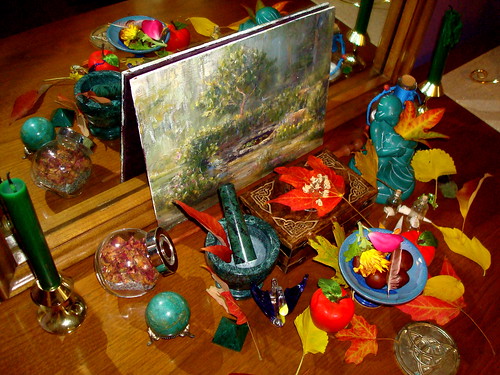
For the time being I've ceased my formal, structured study with Druidry, in order to allow myself to grow a bit more organically along the path for a little while and discover where that leads. (This is one reason I haven't been blogging nearly as much recently.) My bedroom altar has taken on this organic aspect, too, and I find myself often picking up "found objects" on my weekly walks and incorporating them.
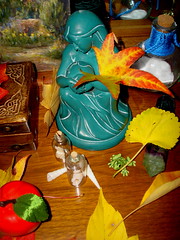 I love this process, because it keeps me in touch with the cycles of nature without having to flip through annoying reference books in search of seasonal correspondences decided upon by other people, correspondences that might not even relate to my own immediate landscape or climate anyway. By ignoring such reference sources and relying instead on the things nature offers to me directly, I find myself slowly learning about my own place in the land. If the leaves are already beginning to change in my local area, then gosh darn it, colorful leaves it is. If the chestnuts are falling but the gardens I walk past on my way to work still have roses in bloom, then I can celebrate both. This process reminds me that the change of the seasons isn't broken up into distinct time periods--it's messy and overlapping and intertwined.
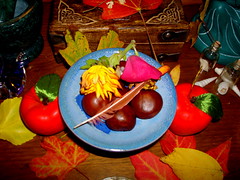
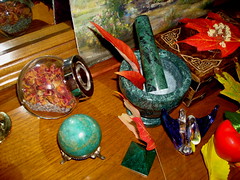 With that in mind, my altar has become a bit more "cluttered" and idiosyncratic, rather than sparse and functional the way it used to be. I no longer use it primarily as a functional altar, but perhaps more as a "shrine" to the external physical landscape of the natural world, and the internal landscape of my own psyche and spiritual needs. Decorating with bits of nature brings that earthy scent into my home, but it also keeps me in tune with the natural turn of the seasons. As the flower blossoms dry out, or the leaves slowly brown and wither, or the gourds grow dusty and the shells of nuts begin to splinter, I can tell it's time to give these things back to the natural world to let them decay--and begin looking for new signs of the season to come. This serves as a subtle reminder to allow my own cycles to ebb and flow according to their natural energies, instead of trying to force order and conformity where they will not suit my own changing needs.Working with my altar this way keeps me grounded in nature, but it also allows me to indulge my natural urge to "gather" beautiful objects that seem to resonate or capture my attention when I'm out walking. I often feel as though these gifts are offerings that the earth places in my path, and it's an important aspect of my spiritual life to feel willing and able to accept them--without getting home, saying, "O, now what am I going to do with all this?" and feeling like I have to just chuck them out before they being to rot and gather dust. A while ago, it occurred to me that the idea of making "offerings" to the gods and to the earth can be a little silly if taken too seriously--after all, what do we have that we have not first been given? I decided that what we have to offer is our intention, our attention, and our love--and incorporating "found objects" into my altar as offerings is my way of acknowledging the many gifts I receive, and transforming them through my intention and imagination into something new that I can give back to the world. Thus, one of the central aspects of my altar is the small blue offering dish. Right now, it holds a few wild local chestnuts I gathered during a walk in the park, a cardinal feather I found in the woods, a few daisy blossoms from a bouquet I bought at the local flower shop, and a striking (and a little out of place) rose petal I found just this afternoon on my way back from lunch, while I was wondering about the persistence and delicacy of love.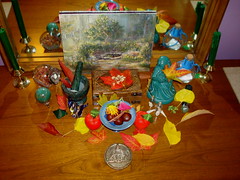
Saturday, July 7, 2007
A Shrine of Books
Some of you may remember a post of mine back in April on Impromptu Book Altars as a unique, bookworm take on the idea of inconspicuous travel altars (with not a little art involved). In case my dear readers had any more doubts about just how far my love of books extends, I now present, for your viewing pleasure, a temporary shrine devoted to the Harry Potter book series, in honor of the publication of the seventh and final book (and, of course, the fifth HP movie coming out in a few days).
This idea was inspired by LibraryThing.com, which occasionally has these neat bookpile contests. Of course, I jumped at the chance to participate in their current Harry Potter BookPile contest, building a temporary "shrine" in my bookcase that incorporated my HP books, along with some "wizard and wizardry books" and magical objects of my own. Just a fun idea, I thought. So here are some photos that I submitted to the contest (I think I made the very first entry!). Check out the Flickr tag page for other entries, and the LibraryThing blog post for information on how to enter the contest for yourself.

I only have a crappy camera-phone, which I guess means I'm sure not to win the contest, but still... I thought it was a cute idea. So here are all my original hardback Harry Potter books, plus some of my other magic books and magical items.

Close-up of the left side, with all the Harry Potter books, plus a leather journal, stone gazing orb, bell, various bottles of herbs, stones and oils, dried flowers in a blue urn, half-burnt candle in candleholder, a small hand-carved wooden box, and of course, my wand (hand-turned rosewood).

Close-up of the right side. Books include: The Spell of the Sensuous, by David Abram; Applied Magic, by Dion Fortune; Practical Solitary Magic, by Nancy B. Watson; Real Magic, by Isaac Bonewits; Taking Up the Runes, by Diane L. Paxson; Exploring Scrying, by Ambrose Hawk; Modern Magick, by Donald M. Kraig; Herbal Rituals, by Judith Berger; and Magical Aromatherapy, and Encyclopedia of Magical Herbs, both by Scott Cunningham. Plus, a bag of mixed herbs and a small statue of a black cat.
This idea was inspired by LibraryThing.com, which occasionally has these neat bookpile contests. Of course, I jumped at the chance to participate in their current Harry Potter BookPile contest, building a temporary "shrine" in my bookcase that incorporated my HP books, along with some "wizard and wizardry books" and magical objects of my own. Just a fun idea, I thought. So here are some photos that I submitted to the contest (I think I made the very first entry!). Check out the Flickr tag page for other entries, and the LibraryThing blog post for information on how to enter the contest for yourself.
I only have a crappy camera-phone, which I guess means I'm sure not to win the contest, but still... I thought it was a cute idea. So here are all my original hardback Harry Potter books, plus some of my other magic books and magical items.
Close-up of the left side, with all the Harry Potter books, plus a leather journal, stone gazing orb, bell, various bottles of herbs, stones and oils, dried flowers in a blue urn, half-burnt candle in candleholder, a small hand-carved wooden box, and of course, my wand (hand-turned rosewood).
Close-up of the right side. Books include: The Spell of the Sensuous, by David Abram; Applied Magic, by Dion Fortune; Practical Solitary Magic, by Nancy B. Watson; Real Magic, by Isaac Bonewits; Taking Up the Runes, by Diane L. Paxson; Exploring Scrying, by Ambrose Hawk; Modern Magick, by Donald M. Kraig; Herbal Rituals, by Judith Berger; and Magical Aromatherapy, and Encyclopedia of Magical Herbs, both by Scott Cunningham. Plus, a bag of mixed herbs and a small statue of a black cat.
Thursday, April 26, 2007
Impromptu Book Altars
I've seen several sites recently about travel altars, which have caught my imagination. Within Druidry there is the idea of the "nemeton," or sacred space, that can be either the space within a cast circle, ritual area or grove, or the "personal space" that naturally surrounds an individual and can be extended and made porous, opening a person to the interconnection of the wider universe. However, there is still something moving and provocative about the physical central altar itself. It provides a focal point, a clear demarcation or frame into which can be placed objects of special meaning.
For this reason, the idea of a "travel altar" that can be set up anywhere, at a moment's notice, and provide such a focus is very appealing to me. On the other hand, it often seems that a "working altar" can be cluttered and clumsy, all the more so if the tools (chalice, cauldron, wand, incense or athame) are of miniature size. I have often found that altars designed along a simplistic and minimalist theme work best in guiding me into a meditative state. And since a mini travel altar is more likely to be used as part of a moment of reflection or devotion, rather than complicated magical workings, I have developed a version of the "travel altar" idea that I call the "impromptu book altar."
This idea came about largely by accident. Because I'm a bookworm and a writer, I always have books with me wherever I go. On several occasions, I have been out in the park, on a walk, or sipping coffee in a local cafe--always with book or journal in hand--when I'll slip into a meditative state, or suddenly find a small object which sends me off into spontaneous prayer or contemplation. On these occasions, I've found that an open book placed on the ground or table in front of me actually becomes a kind of "textual" altar upon which the subject of my meditation can be placed. Even the play of light and shadow on the page, and the text itself, can become objects of focus and contemplation. Best of all, an open book is discreet and not unusual when out in a public place, and a dreamy gaze into the distance that seems the result of a good book is far less likely to be interrupted with questions like, "What exactly are you doing?"
I'll share two examples of how this idea works in practice, first with a notebook, and then with a novel. Last summer, while vacationing on a small island off the coast of Maine, I carried a small, blank notebook and a pen everywhere I went, brainstorming ideas for my current book project. One foggy afternoon, I went for a picnic on a beach, well known for its scenic views of the ocean and its rumbling tides among the rocks. I sat for a time, watching the people wandering along the shore and the birds drifting in and out of view among the mists, as I jotted down pages of notes and free-association ramblings. I had written several pages of notes and ideas when I turned a page and, suddenly feeling overwhelmed by the gentle thrumming of the ocean waves on the fog-strewn, rocky shore. I wrote simply, "Narration is unnecessary." Then, unable to think of anything else to say, I set down the book and pen and just sat in meditation for almost an hour. During this time, the blank pages of the notebook and the untouched pen themselves become meditative objects, an "altar to silence," which helped to reaffirm for me the ineffable and nameless beauty of the depthful ocean and all of creation.
 On another occasion, I was sitting in a local park, reading Ursula K. LeGuin's Tales from Earthsea, when a very similar event occurred. Minding my own business, enjoying a story about young love and the difficulties of romance, suddenly into my lap fell a pear! All right, I was sitting under a pear tree, so I suppose this wasn't all that unexpected--still, it interrupted my reading and gave me pause. I picked the pear up and examined it, feeling its texture, experiencing its smell and feel and, yes, even its quiet song... Eventually, I placed the pear on the open page, then sat quietly and meditated for a while, rolling around ideas about the nature of love, attraction, and self-sacrifice. The pear became, for me, a sacred symbol of how the seed of life and creative generation often surrounds itself in appealing forms, offering itself up to be consumed and digested, literally or figuratively, and providing nourishment and pleasure so that it might also find the nourishing and moist earthiness it needs in order to take root. It also struck me how human relationships, far from being simple and mutually-supportive, are instead confusing, difficult and often painful, as in the story I was reading. After my contemplation was over, I offered the pear back to the grasses, with a larger gratitude.
Both of these times, I made quite effective use of the open book as an altar to thought and focus. The page was transformed from merely a vehicle for text, to a sacred space itself within which objects and ideas took on focus, importance and deeper meaning. The art of Sean Kennan (photographer) and the writings of Jorge Luis Borges, combined in the beautiful and inspiring book, The Secret Books, takes up this subject from a more metaphysical and aesthetic point of view. People interested in the idea of impromptu book altars might want to check it out.
~~~*~~~*~~~
Incidentally, both of those meditative times led to me writing rather long poems, as I later returned to these memories and tried to articulate the ideas I had contemplated. But the pear meditation also gave rise to this quirky quartet:
For this reason, the idea of a "travel altar" that can be set up anywhere, at a moment's notice, and provide such a focus is very appealing to me. On the other hand, it often seems that a "working altar" can be cluttered and clumsy, all the more so if the tools (chalice, cauldron, wand, incense or athame) are of miniature size. I have often found that altars designed along a simplistic and minimalist theme work best in guiding me into a meditative state. And since a mini travel altar is more likely to be used as part of a moment of reflection or devotion, rather than complicated magical workings, I have developed a version of the "travel altar" idea that I call the "impromptu book altar."
This idea came about largely by accident. Because I'm a bookworm and a writer, I always have books with me wherever I go. On several occasions, I have been out in the park, on a walk, or sipping coffee in a local cafe--always with book or journal in hand--when I'll slip into a meditative state, or suddenly find a small object which sends me off into spontaneous prayer or contemplation. On these occasions, I've found that an open book placed on the ground or table in front of me actually becomes a kind of "textual" altar upon which the subject of my meditation can be placed. Even the play of light and shadow on the page, and the text itself, can become objects of focus and contemplation. Best of all, an open book is discreet and not unusual when out in a public place, and a dreamy gaze into the distance that seems the result of a good book is far less likely to be interrupted with questions like, "What exactly are you doing?"
I'll share two examples of how this idea works in practice, first with a notebook, and then with a novel. Last summer, while vacationing on a small island off the coast of Maine, I carried a small, blank notebook and a pen everywhere I went, brainstorming ideas for my current book project. One foggy afternoon, I went for a picnic on a beach, well known for its scenic views of the ocean and its rumbling tides among the rocks. I sat for a time, watching the people wandering along the shore and the birds drifting in and out of view among the mists, as I jotted down pages of notes and free-association ramblings. I had written several pages of notes and ideas when I turned a page and, suddenly feeling overwhelmed by the gentle thrumming of the ocean waves on the fog-strewn, rocky shore. I wrote simply, "Narration is unnecessary." Then, unable to think of anything else to say, I set down the book and pen and just sat in meditation for almost an hour. During this time, the blank pages of the notebook and the untouched pen themselves become meditative objects, an "altar to silence," which helped to reaffirm for me the ineffable and nameless beauty of the depthful ocean and all of creation.
On another occasion, I was sitting in a local park, reading Ursula K. LeGuin's Tales from Earthsea, when a very similar event occurred. Minding my own business, enjoying a story about young love and the difficulties of romance, suddenly into my lap fell a pear! All right, I was sitting under a pear tree, so I suppose this wasn't all that unexpected--still, it interrupted my reading and gave me pause. I picked the pear up and examined it, feeling its texture, experiencing its smell and feel and, yes, even its quiet song... Eventually, I placed the pear on the open page, then sat quietly and meditated for a while, rolling around ideas about the nature of love, attraction, and self-sacrifice. The pear became, for me, a sacred symbol of how the seed of life and creative generation often surrounds itself in appealing forms, offering itself up to be consumed and digested, literally or figuratively, and providing nourishment and pleasure so that it might also find the nourishing and moist earthiness it needs in order to take root. It also struck me how human relationships, far from being simple and mutually-supportive, are instead confusing, difficult and often painful, as in the story I was reading. After my contemplation was over, I offered the pear back to the grasses, with a larger gratitude.Both of these times, I made quite effective use of the open book as an altar to thought and focus. The page was transformed from merely a vehicle for text, to a sacred space itself within which objects and ideas took on focus, importance and deeper meaning. The art of Sean Kennan (photographer) and the writings of Jorge Luis Borges, combined in the beautiful and inspiring book, The Secret Books, takes up this subject from a more metaphysical and aesthetic point of view. People interested in the idea of impromptu book altars might want to check it out.
Incidentally, both of those meditative times led to me writing rather long poems, as I later returned to these memories and tried to articulate the ideas I had contemplated. But the pear meditation also gave rise to this quirky quartet:
Simple Instinct
I wish I were something attracted to pears,
the way burrs are attracted to animal hairs
and particular flowers seduce every bee,
I wish you were something attracted to me.
Subscribe to:
Posts (Atom)