
My ancestors sought the sea as others once sought the desert - that lonely expanse, that drifting horizon, that long voyage to the holy.
I woke up this morning thinking about my ancestors, the Christians who lived in Ireland for hundreds of years before making their way across the ocean to escape famine and disease. They washed up onto these American shores, stumbled their way into the Appalachian Mountains and set to work as coal miners and steelworkers. That is where my father was born and raised, dirt poor, and where much of my family still lives. Every time I travel home to see my parents, I cross those mountains, through the forests and dark valleys and tunnels carved into the rock. The mud and dust of those hills are in my blood, even as the green, soft turf and peat fires of Ireland are in my bones.
Yet there is also deep ambivalence there. The history of coal mining in central Pennsylvania haunts our modern conversations about clean energy and alternative fuels. I see billboards advertising "clean coal" and wince at the lie. And in the same way, I think of the lost history of my pre-Christian ancestors, the stories I will never hear, the art and music I will never know, because of the Christian imperative to evangelize and spread their religion to the ends of the earth.
How are these connected: the abuse of the land, the dangerous work and struggle for livelihood, the dreams and desires of civilization, the silence of the dead, the loneliness of the voyage west across an ocean, unimaginable void dark and churning, dividing the past from the present?
St. Patrick's Day is almost here. Regardless of what others say, I honor the day as a day of sacred ambivalence and the lessons of acceptance and forgiveness. Patrick in the field kneeling on the soft, green turf to pray; Patrick slipping away across the sea to find freedom; Patrick returning to the island where he had been a slave.
If we can't learn these lessons of our ancestors, how can we hope to listen for the stories so much more lost to us than these?
 (
( ). In this book, he not only provides subtle translations of the text, a sound introduction to the history and cultural background of Bedouin/Arabic poetry at the time of the Qur'an's writing, and a thorough discussion of the role of recitation and verbal prayer within Islam — he also provides extensive commentary on each sura, exploring some of the many themes and recurring imagery throughout the text. Below are some excerpts from his translations of the earliest suras, along with my own attempts to paraphrase and expand on some of his commentary.
 , by Terry Pratchett


 Yes... but if the world is shit, if it really is, and no number of rules will bring justice, and no amount of mercy will relieve pain, and nothing you do really matters in the end — then what excuse do you have left? Be beautiful, choose to be beautiful anyway. Choose to be the person you want to be, the best of yourself — choose it not because of the rewards or the consequences, not because of what your beauty will do, but for the beauty itself, for the sake of beauty. Choose to make peace, to create works of art, to laugh and tell stories. Choose to sit in the office and listen to the memories that come bubbling up in grief and worry, and in laughter and affection too, of impoverished life in Haiti, the woman waiting with the pregnant belly, the uncle who drinks, the mother who lectures. Choose to shake his hand before he leaves, and laugh together about the cliché of white clasping black, your small pale hand lost in his huge dark one. Choose to sing the songs you don't remember, and dance your beauty, and call each other nicknames.
 I suppose everyone has been talking recently about the shooting at Fort Hood. It's been difficult for me to wrap my head around. I remember a time, eight years ago when the towers fell, everyone seemed full of rage and fear and thoughts of revenge, and all I could muster was a devastating sadness, a sadness that sank deeply into my bones, a sorrow like liquid in the marrow. Now, I see around me, on the news, in the paper, online, people grieving, mourning, moaning with that same sorrow, the washing tides of grief — and all I can feel is anger. Anger and frustration at having carried such sadness alone for so long, only to see it spewed forth in cathartic forms of patriotism, twisted to serve the purposes of war and control.
 So I've found myself recently plunging into making, plunging my hands into boxes of beads, counting out stones in my palm, twirling thin wire between my fingertips and looping it back and forth, gently, carefully. This is my catharsis; not moralizing or justifying or preaching to the grieving choir. For the past week, I've been coping with crafts. I have been weaving sets of prayer beads, each delicate stone representing one of the three Druidic elements — nwyfre, gwyar, calas; wind, water, stone; breath, blood, bone — or the inspiration of Awen, the life of Spirit, spiraling and deep. The work demands my concentration, a steady eye and a steady hand, and silence. And for a time, these small, intimate, precious things are the only things in the world to me. They are the world, the three realms of earth, sea and sky, woven together with the invisible threads of — of what? I might say love, or peace, or even something like harmony or Song. But the truth is, these are prayer beads, and they are woven together, and bound to each other, with words.
 And as I worked, I thought about my best friend, a musician of incredible talent, who had sent me a letter recently about his own frustrations with his art, and his doubts that music could change the world. What can we do, he asked me, and what right do we have to lecture others when our own efforts seem to be so small and meaningless, our actions so impotent and our intentions always usurped and distorted by systems of violence and fear? And it seemed to me that the answer is, and that it always is: we do what we can. We have to try, we have to allow ourselves that much. Even if our uncertainty shakes us to the soles of our feet, even if our knowledge of the world and its vastness make us feel small and helpless, even if bloated systems of fear and myopic self-interest loom over us, leering and licking their chops — we do what our hearts and minds and hands urge us to do.
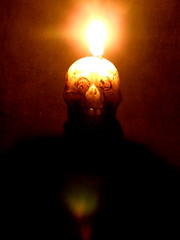


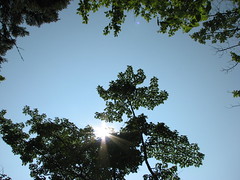
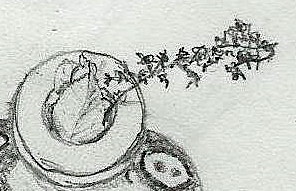 Things continue to happen. I continue to attend and to remember. Life is not lost on me.
 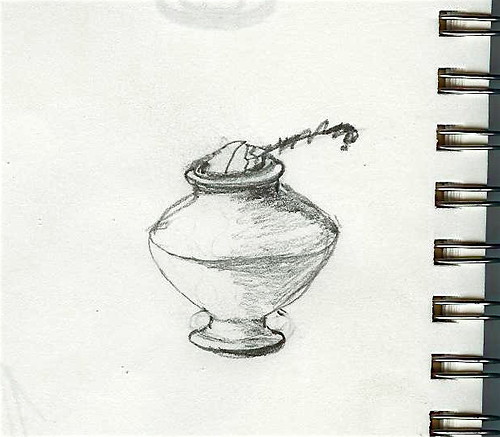 Somewhere in my sunconscious, imaginative brain, there exists an artist who knows what she is doing and might, with practice, make passable sketches of, say, birds and trees and things. Apparently, my conscious attempts at art have stalled at the ten-year-old level, unable to make the leap into cubism and the modern, playful but skilful abandonment of perspective. We must investigate this discrepancy further.