Wednesday, May 28, 2008

The Beauty Bone

Okay, you know the funny bone, that weird little spot on your elbow that tingles something awful when you bump it in just the right way? It has something to do with ligaments and joints, and how muscles and bone and flesh come together in a spot that swings and creaks around a few thin, long nerves.

I think I have some sort of internal tragicomic 'beauty bone' that tingles and tears up whenever something--an idea, an image, a word or memory--strikes me in just the right way. This quote by Terry Pratchett, for example:

As they say in Discworld, we are trying to unravel the Mighty Infinite using a language which was designed to tell one another where the fresh fruit was.


The first time I read it, I smiled and chuckled, yes, isn't that so clever and true... Then I read it again--and I started to cry a little.

There it is, do you see it? The Elbow of Spirit swinging on necessity and longing, nerved words of practical need banging up against the rock-hard ineffable. Do you feel the pinch? Fruit, that is hunger, that is Spirit, that is language, that is fruit.

The other day, I went to see the new Chronicles of Narnia film, Prince Caspian. A pleasant fantasy-adventure movie, with beautiful landscapes and daring sword fights, and a little girl named Lucy who's burdened with an overabundance of faith. All in all, an enjoyable movie, even the fearful battles mitigated by a sense of safe familiarity because, in Narnia, nobody dies, not really. But there was a moment, towards the beginning, when Lucy dreams of the birch trees dancing in the forest, their nymphs coalescing in clouds of blossoms drifting on the breeze--and she wakes to find the grove utterly still, the trees just trees again. She pauses by one, leans against the trunk touching the papery bark lightly with her little fingers, and whispers, "Please wake up..."

Perhaps it's that phrase, the please wake up, that has been whispered in movies and books by so many children to so many dead, the still bodies that look to be only sleeping, that move too limply when shaken--maybe that's what hit the beauty bone this time. As the children's movie rolled on, I suddenly remembered another film, a film about actual war in the actual world, and the old man who sighed deeply in the dark theater as if he didn't know I was there. I remembered how, upon leaving the theater as the credits rolled, I saw him coming out of the bathroom, his eyes red from crying, his jaw set against the embarrassment of being caught in the bright sunlight of the street outside.

There it is--the sighing grief in the dark, and its juxtaposition. A sense of vertigo, when cliché breaks open again and there is the void lurking just beneath it, the sense of loss, layer upon layer, all of us having lost something, all of us whispering, pleading, until the please itself becomes a thin membrane of voice and grief that holds us up. There it is again, the particular breaking open, the bodies of the dead, the pale tree, the single pear, the stem and seeds, that which becomes the bones and soft flesh of a god. The muscles and joints, how the world is put together, how it moves, and the currents of longing and hope and helplessness running through it.

Do you feel the pinch?

Friday, May 23, 2008

Language and Morality

I'm annoyed. This is going to be one of those entries. Be forewarned...

Well, today at work a guy accused me of being judgmental.

He was complaining about our manager giving him an overloaded schedule this week in response to his request to work more hours, and another guy chimed in that maybe he asked her (the manager) while she was PMSing. As I overheard, I remarked casually, "Well now, that's a sexist comment." And the guy jumped down my throat--not the one who'd actually made the comment (who acted apologetic and kind of shrugged it off as a bad joke), but the other one. He asked me why it was sexist, and I responded, "Well, by definition--making an assumption based on a person's gender and treating them as merely a stereotype of a group rather than as an individual... that's sexist by definition."* "You don't think women behave irrationally when they're PMSing?" he challenged. "I think that some individuals will behave irrationally under certain circumstances, like when they're tired or uncomfortable," I explained, "and that others may just be a bit irrational in general--but no, making a statement about an individual based on the assumption that all women are irrational during their periods [a generalized stereotype based on a person's sex] and that they cannot control their irrationality as well as men, who don't 'PMS' [a devaluation of women based on that stereotype, see definition below]... I think that's sexism plain and simple and no, I don't believe it to be true." He then accused me of just trying to force everyone to be "P.C." and of being judgmental because I was "making a judgment about someone else's judgment instead of actually listening to that person."

Language

Okay, firstly--words. Words have power. Let me say that again: words have power. I try to avoid saying things I don't mean, and I try to respect the amazing and beautiful power of words when I do speak (including their ability to communicate subtlety, humor and irony--all of which I'm pretty good at picking up on and I don't call people out on sexist remarks when I can tell they're just trying to be funny and not meaning it seriously--though I also think that kind of humor is a bit distasteful). I'm a writer. I love words. I'm also a feminist (i.e. I believe that men and women are equal) and I believe that it is important to treat people as unique individuals in any circumstance, rather than merely as a member of particular groups, biological, cultural or otherwise. To treat a person merely as a member of a group to which they belong is an act of existential violence against the unique and complex individuality of that person (even if attributing positive qualities to the group, like saying Obama must be good at basketball; and even if that person chooses to be a part of the group through lifestyle, association or activity, like saying all [golfers/cat-lovers/police officers/etc.] behave or think the same way.

Of course, it gets tricky, because often people don't want to count positive stereotypes as a form of racism/sexism/classism/etc., and at the same time plenty of individuals like to associate themselves by choice with particular groups because they want to benefit from the image or ideas that group evokes (think of the teen who dresses "goth" so that her peers will get a particular view of her as a hard-hearted, poetry-reading rebel). All the same, striving to connect with individuals as unique beings is something we owe each other and ourselves, because otherwise we're walking through a shallow world of warped reflection, like a hall of mirrors. By treating people as stereotypes, what we're saying is, "Everything I know about you is just something I know about myself, projected out into the world." If you treat all women as potentially irrational during "that time of the month," then you're acting on your own beliefs and opinions warped to suit a projected "other", rather than learning something about the individual women in your life and responding to their unique realities. In short, you've cut yourself off from actually being present to the real world; you've substituted your assumptions about reality for reality itself.

Of course, I didn't have the opportunity to explain any of this to this particular coworker because he was too busy righteously defending others' right to be "politically incorrect." Now, apparently the term "politically correct" was invented in the 1980s by conservatives trying to undermine liberal efforts to increase awareness of--you guessed it--the power of words (in particular, the power of words in relation to group and social identity). To throw out the accusation of "P.C." at a person was basically a way to shut down any attempt at rational discussion by using a similar circular logic that this coworker today tried to use on me. The argument goes that if you attempt to think carefully about people's word choices and encourage yourself and others to speak with more accuracy, sensitivity and awareness, then you forfeit your right to criticize others' unthinking use of language. Obviously the argument is clearly fallacious when stated in such clear terms, so let me put it the way it's more commonly phrased: if you make judgments about appropriate language, then you're being just as "judgmental" as you're accusing someone else of being, and therefore you have no right to criticize them because you're just as bad.

Judgment

In addition to assuming that the problem with sexist/racist/etc. language is that it is "judgmental" (when it is, in fact, just the opposite--it eschews any actual judgment, accurate or otherwise, in favor of unthinking prejudice), this faulty logic relies on obscuring the multiple meanings of the word "judgment" itself. Since it is an argument in favor of the thoughtless use of words, this actually seems rather fitting.

Being "judgmental" has a strongly negative connotation, because it evokes the sense of imposing our own moral judgment on another person, usually with a verbal condemnation and/or poor treatment. What is the difference, though, between making a moral judgment about a person, and making a "mental judgment"** about a statement or concept? It seems to me that there's a big one, and while the former may be personally, socially or even philosophically offensive, the latter is essential to living a thoughtful, inquisitive life. What P.C. nay-sayers tend to do is confuse the two kinds of judgment, reducing them to one and the same thing, and then badger those of us trying to make thoughtful "mental judgments" into feeling guilty for imposing "moral judgments" on others, when that is precisely what we are trying to avoid. Then there are "mushy-thinking liberals" (a term a friend of mine adopted from, I believe, Chomsky), who focus on the censorship of language, rather than on an investigation of what such language actually communicates. This overly-P.C. crowd is often too greatly worried about hurting people's feelings or coming across as morally "judgmental", but they fall into the very same trap as the conservative anti-P.C. people. Whatever the motivation (attempting to shut down rational discussion as a kind of power-play, or wanting to appear all-accepting of others for the sake of one's personal gratification at the expense of actual thoughtfulness), the end result of such a reductionist definition of "judgment" is the same: it makes thinking itself look like a social and personal flaw.

One way to avoid this is to make a careful distinction between imposing moral judgments on other people, and making mental judgments about "objective" facts. Notice that in the conversation that began this post, I remarked that the comment was sexist, not the person. According to the definition of "sexism" and the nature of the comment itself, this was a fair assessment of objective reality, rather than a projected moral claim. Of course, it is generally agreed in our culture that sexism is more or less "immoral." (Of course, as I've already noted, language also affords the opportunity for satire and irony, for instance by utilizing "immoral" language deliberately and self-consciously to undermine the power of such language. I love Stephen Colbert's humor for this very reason. He has mastered the art of making claims or asserting ideas in such a way that he lays bare their utter absurdity, and his feigned sincerity heightens that ridiculousness while putting us on guard against individuals who actually would assert such claims in all seriousness. If the comment had been made with ironic intent, then my observation that it was sexist would not hav been a moral judgment at all, but rather just stating the obvious, kind of like ruining the punchline of a joke by observing the particular play on words and/or expectations involved.)

Morality

There are many good reasons why sexism, racism and all forms of prejudice are considered inherently immoral (as I've already outlined above). However, once again, there is a difference between claiming a statement is sexist because it is immoral, and claiming that it is immoral because it is sexist. In the first instance, I am imposing my own moral judgment on another person and attempting to censor them based on those moral claims, essentially trying to make them play by my own moral rules. In the second instance, I am observing that a given statement, as an objective entity, fits the established definition of "sexism" and should probably, therefore, be reevaluated for its moral implications. See the difference?

Take another example: the other day, a different (male) coworker called another (female) coworker a fat cow who looks like she spends all her time out drinking instead of home taking care of her kids. My knee-jerk reaction was to criticize him for making such a mean-spirited comment, because to me such maliciousness is never justified even if the observations it attempts to communicate are accurate (which I don't think they were this time, in any case). This is a moral issue on my part, growing out of my belief in loving-kindness and respect for others, and so my attempt to censor his behavior was, in this case, a moral imposition on my part (one that he rightly pointed out I have no real right to make). I wanted him to play by my moral sense of fairness and kindness, but he has the perfect right to be a nasty jerk to another person if he likes, regardless of what I think of his behavior. On the other hand, I do have the right to guide my own actions according to my moral commitments, and since I believe that sharing my beliefs with others in a respectful, open way is also a moral act on my part, I have the right to communicate my opinion of his behavior and explain my reasons behind it.

So is calling out a statement for being "sexist" morally judgmental? Well, in some ways, it is a moral act on my part, since I probably wouldn't have bothered to do it if I didn't think sexism was wrong, offensive and morally damaging to both the person making the comment and the comment's target or object of reference. I feel that it is morally right to point out the harmful or thoughtless behavior of others--in a kind and respectful way--not as a way of condemning them or imposing my beliefs (which would be morally judgmental), but in order to encourage dialogue and discussion--an equal, free exchange of information and ideas for the betterment of all involved. It would appear that, since my coworker took offense to me calling the statement sexist, he too most likely believes that sexism is basically immoral, and so I have no need to impose my own values on him as we already agree about the fundamental moral issue at stake and differ only in its application. (Either that, or he's playing by the social rules that say a person should act offended when they feel a remark is intended as a slight or insult, whether or not the remark actually offends them. I tend not to act offended unless I'm actually offended, which confuses people sometimes, because I laugh off mean-spirited jibes while occasionally being hurt by comments that people intended to be complimentary but are, in fact, not. See below.)

Despondence

The fact that this coworker has three times now suggested that my intelligence is not a desirable quality but rather an unfortunate idiosyncrasy (twice in accusing me of being "judgmental," and once while actually hitting on me(!) by saying I needed to be "relieved" of the thoughtful expression I'd developed while reading an interesting book) has me generally annoyed, but also feeling a bit despondent.*** This last exchange--during what he clearly considered a flirtatious encounter--was obviously meant to be some kind of complimentary come-on, an appeal to my romantic feminine nature. Why I would want to be "relieved" of my thoughtfulness in favor of some frivolous romantic "fun" is beyond me. I find conversation and discussion to be fun, and more than that, fulfilling. I also appreciate levity and joy, though rarely would I characterize such things as mindless or frivolous, at least not in their ideal forms.

So yes, I am discouraged, even gloomy, about the social relationships I often find myself in. It might sound arrogant to say that I am more intelligent than most of the people I know and work with on a daily basis, but the truth is that, intelligence (whatever that is) aside, I am definitely more thoughtful. I have no need to make this claim about myself--they make it for me. But while they seem to think it's an unfortunate side-effect of having no "life" and nothing better to do, I see it as one of my best qualities, something I really love about myself and that I want to share with others. Thus, I often feel drawn to people who exhibit a similar thoughtfulness or at least hint at it through off-handed remarks. Sometimes the very same people who intrigue me with such remarks also come across as being judgmental and kind of rude, for the very reason that they're willing to make controversial statements based on personal convictions. Right now, for instance, I'm crushing on a guy who, I'm pretty sure, thinks I'm just another thoughtless, good-because-the-Bible-says-so kind of girl. The very fact that he might be indifferent to me because of this incorrect perception has me intrigued (unlike those who are indifferent to me because they know I'm not an easy lay, who don't interest me at all, and sadly make up the vast majority of guys I know). But it's also frustrating because I'm afforded so few opportunities to demonstrate my depth and personality, and he has no real reason to give me any, as far as he's concerned. I don't want to make the same mistake with others. Which is why I always try to give people the benefit of the doubt, to engage them in conversation, to explore the reasons behind their actions. I don't want to make the mistake of assuming someone is just silly or shallow when they're just quiet or reserved.

Which is why I agreed to go on a date with someone who has been dropping hints of his interest for, gosh, over a year now, despite my friendly indifference and my interest in this other guy. I had some qualms about it--is it right to go on a date when you have a feeling it's not going to work out? Am I obligated to inform him of my interest in someone else, or would that just be needlessly hurtful? Have I come to treat men as a commodity, waiting for a perfect guy to come along who has all the right "features" (like a compatible morality, similar interests, thoughtful mind, sense of humor, self-control, reserved nature, cute little goatee and a nice smile) instead of focusing on the feelings a person might be able to evoke (or, on the other hand, is it right to allow feelings alone to dictate relationships rather than attempting to engage another person on all levels, mental, emotional, philosophical, etc.)? Sometimes, I admit, I may over think things. I want to do what's right. In the end, though, right or not, I agreed to go on the date.

And I sat here all evening waiting for his call.

And it never came.


Definitions

*sex·ism (noun)
1. attitudes or behavior based on traditional stereotypes of sexual roles.
2. discrimination or devaluation based on a person's sex.


**judg·ment (noun)
1. an act or instance of judging.
2. the ability to judge, make a decision, or form an opinion objectively, authoritatively, and wisely, esp. in matters affecting action; good sense; discretion.
3. the demonstration or exercise of such ability or capacity.
4. the forming of an opinion, estimate, notion, or conclusion, as from circumstances presented to the mind.


***de·spond·ent (adjective)
1. feeling or showing profound hopelessness, dejection, discouragement, or gloom

Thursday, May 22, 2008

Running the Poetry

Today I went on my first run using the techniques from a book I've been reading called ChiRunning, by Danny Dreyer. To be fair, it's been almost two weeks since my last run and it's not like I ever ran regularly to begin with; this was also the first time I bothered walking all the way to the track at the Schenley Oval, so that I'd have a relatively level place to run instead of contending with the hills in my local neighborhood, Squirrel Hill (who saw that coming?)....

...With all those concessions covered, however, the T'ai Chi techniques do seem to make running not only less tiring, but more enjoyable. Again, perhaps it's just because I have no other regular running experience to compare it to, but it still seemed that there was a remarkable difference. I felt much more relaxed and focused during my run, rather than distracted by the Critical Meanie in my mind and her constant stream of insults, put-downs and comparisons to other runners who are much fatter or much older than I am but who could still kick my ass to next Tuesday without breaking a sweat. Instead, during today's run I worked on using the technique Dreyer calls "Body Sensing," which is really as simple as paying attention to the sensations and needs of your body and making incremental adjustments in response. Body Sensing is a method or process of improving the communication between your body and your mind, which is of particular importance to me from a spiritual perspective.

In the first entry of my new ChiRunning Log, I answered some of the book's basic questions to assess my current physical and mental state (in order to identify my goals and develop a program to help me achieve them). One question that I pondered a while is, why do I want to run, anyway?

Among other concerns (like keeping my body healthy and well cared-for, developing a habit of enjoyable exercise as I grow older and lose my natural youthful energy (and metabolism!), and strengthening and toning my muscles), I'm interested in using running as a way to expand my current meditative practices. AODA Druidry, in particular, is big on "movement meditation" as a way of bringing the mind and body into alignment, balance and more open communication and integration with one another. Many members of the Order practice some form of martial arts or yoga, and I've always included hillwalking as part of my spiritual practice. But I've also noticed that sometimes, I just get the urge to run, or to dance, or to express the lightness of being that I sense or receive from Spirit... and usually, my body can't keep up. So really, what I would like is to bring my body up to speed, to make it a better vehicle and vessel for Spirit, and to sustain that kind of joyous expression of the physical being for longer periods of time, whether as a form of worship and prayer, or as a method of inducing trance or other directed ritual work.

I think this book works perfectly with these particular goals, since Dreyer spends a great deal of time discussing some of the basic spiritual principles (though he doesn't use the word "spiritual" but once) of mind/body communication and focus. He emphasizes the idea that when the goal is one and the same with the process, they help to reinforce one another. When the goal is something external--whether competing in a certain race, keeping up with a loved one or family pet, or trying to look good in a swimsuit--then you're more likely to try to rush through the process to reach that end. Sloppiness, stumbling blocks and even injury can result. But if your goal for running is to increase your ability to focus, to relax, to breathe more deeply and to move with greater ease and better posture--then the process is the goal. So every time you go out to run, you're working on the goal itself, and it becomes a continual engaged activity. You run not because running will get you something else, but because running is the end itself, the process whereby you develop and utilize these techniques.

It's similar to the way I think about writing. I don't write merely in order to get a certain number of words down on paper (or online), or to complete any particular essay, poem or book manuscript, or even necessarily to communicate ideas or information to others (no offense, dear reader). I write because I love the process of writing itself. I write because writing helps me focus, relax, breathe more deeply (if only in the metaphorical sense) and move through my life with more awareness, knowledge and ease; writing is both the means by which I learn to and the reason I have to focus, relax, breathe and move. My goals for writing are very similar to my goals for running, in the end, which for me is an encouraging thought. And as Dreyer points out, once you master the particular techniques (the vocabulary) and you learn to incorporate them all together during a run (the syntax), then you can begin the wonderful work of the art of running-- the poetry of it, as he calls it.

But first, there's learning the basics. And I have a feeling that, just like I filled my middle school notebooks with a lot of painfully amateur verse, I'm going to be running a lot of bad poetry over the next few months!

Wednesday, May 21, 2008

The Death of Civilization.

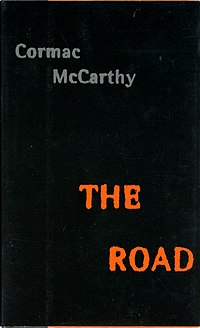
The following is a review of The Road, a novel by Cormac McCarthy, published in 2006. Its film adaptation is set to be released in November, 2008.


If future anthropologists are one day sorting through ancient literature trying to find some insight into today's modern Western culture, they would do well to read this book. Not because it's all that good, but because to understand a culture it's often very useful to look at its worst fears. In this sense, The Road is a perfect artifact, a precise and unself-conscious portrayal of consumer culture's unique nightmare: the end of consumer culture.

As a novel, The Road is rather dull, repetitive and sometimes annoyingly confusing in its basic grammar (for instance, with two main characters, both male and neither named, the masculine third-person pronoun runs rampant, often to the detriment of clarity). There is no real character development per se, and the ending is predictable and sentimental, so that the entire plot feels like what it describes: a slow march towards an inescapable but pointless end. Luckily, unlike the characters in the book, the reader does have a choice, and could easily just put the book down and walk away, to go do something better with her time, maybe work in her garden or learn how to knit.

If, instead, the reader decides to stick with it, what she will find unfolding before her is not the development of interesting characters or intriguing plot, but the characterization of a worldview. Modern consumer culture's worldview, to be precise. In this worldview, nature, ecology, even time itself are irrelevant; the only thing that matters is man's modern conception of civilization. If there is one sentence that could encapsulate the basic mythology at the heart of The Road, it's this: civilization is God. Without civilization, man has no moral center, no sense of self, and is reduced to pure savagery. Because our culture defines man's role as that of a consumer of readily-available products (rather than as cultivator or creator), the apocalypse is the story of man reduced to a scavenger, picking off the remains of civilization's rotting, rusting corpse, moving inanely from one place to another looking for those last few items still left to consume.

Community is beyond the scope of imagination (consumer culture's anxiety-driven individualism deteriorates into simple xenophobia and paranoia), and family bonds are poor shadows of their former ideals, composed of necessity and mere sentimentality. The novel's protagonist lives for his son, not for the son's sake, but because of what the son represents. He refers to his son as a god and as "the son of God"--but what does this mean, other than that he is the son of civilization. The "fire" that the "good guys" carry is merely the vain hope that somehow civilization itself can be rekindled and rebuilt, that the rules of civilized people can be reinstated, that the world can be rendered safe and familiar again. But in the end, basic biology and common sense overtake good guys and bad guys alike. In the end--an end consumer culture has always struggled to reject, avoid and deny--in the end, everybody dies.

All of this, if conceived intentionally by the author, might have made for a fascinating and insightful look into the mythology of our modern culture, an exploration of obsessive consumption and the conclusion to which its basic premises inevitably lead. Unfortunately, it seems quite clear that McCarthy is steeped in this worldview up to his eyeballs, with neither the awareness nor the perspective with which to criticize it. The ubiquitous, unexplained ash that pervades the book and kills off everything except, remarkably, man himself might as well be a symbol for the author's ignorance about ecology and the cycles of the natural world. Because civilization is God, and man is assumed to be the only vehicle of progress and change, when civilization is destroyed, the world itself ceases to turn. Time becomes irrelevant--seasons change, but somehow this entails only a change in temperature, not its consequences; rain falls and winds blow, but these natural processes fail to cause any erosion, even after a decade.

Instead, everything is eerily preserved, an open-air museum of concrete and plastic and mummified corpses, the remnants of the dead civilization morbidly displayed in their uselessness. The Road is the nightmarish landscape of man's presumed untouchability. Even with the end of civilization, the anthropocentrism of consumer culture persists, and its products are portrayed as effectively eternal and largely beyond the influence of the natural world. Indeed, the natural world extends only so far as domesticated dogs and cattle, which (of course, the protagonist tells us) perished without man's intervention and stewardship. No crows, rats or cockroaches--not even microorganisms--speed the decomposition of the dead, no weeds or weather can break up the roads' unflinching macadam.

The world of McCarthy's novel is an unreal one, and therefore an unmoving and even irrelevant one. It is a world built upon the fears of our particular culture, one that cannot see beyond itself or imagine a world that survives its own destruction. It plays by the imaginary rules of a culture unable to recognize man as a part of nature, one that instead sees him as exempt from nature even unto his own demise. A wholly ridiculous notion, and a nightmare that can be laughed at once the sleeper has awakened. The world will not end with humanity, and humanity itself is not trapped in the suicidal and pointless obsession of consumption. When there is nothing left to consume, no products or plastics, man's addiction to consumption will wane, he will learn how to tell a new story about himself and about the world, and maybe he will even remember himself, his self-creating, his ability to become. But the reader who sympathizes too strongly or thrills too easily at the ghost story of The Road is likely to busy herself with the frantic preservation of this current self-deluded way of life, rather than risk what today's culture insists is the only nightmarish alternative.

Tuesday, May 13, 2008

Ambivalence

A really interesting, thoughtful, unique man named Lance recently posted to the AODA online message board about "ambivalence"--his struggle to come to terms with contemporary diversity and tolerance of us paganish people, when only a few decades ago he had to battle against isolation and alienation to construct a sense of "specialness" and self that was integrated with his love of nature. He ended his post by asking if any of the older AODA members remember this struggle themselves, and share in his ambivalence about "how to shed my Bearskins and become human again."

Without thinking, I shot off a response. Perhaps it will go a little ways in explaining my recent absence from the online community. It seems my bitterness always rears its calloused head when spring is at its peak. The bitter and the sweet, dear readers, the bitter and the sweet.

Lance,

Remember it!? I'm struggling through it now. My childhood was, in many ways, the complete opposite of yours: I was a weirdo among weirdos, I had companions and other nature-loving and art-loving geeks to turn to, I had fellow conspirators (con-spirators)... we made up clubs and pursued hare-brained schemes (newsletters, rock bands, art shows, homemade movies). It was wonderful.

Now that I'm an adult, I find myself utterly isolated from all such individuals except through this virtual world of message boards and email. Most of the time I can't even bring myself to keep up with the voluminous postings of this group (not to mention a few others I follow) because I know that once I get sucked in, I'll forget to leave my computer for hours at a time, and in the end I'll still feel dissatisfied and lonely. Where are all of those people I knew as a child? I know full well where they are: they're all here, online! The only people in the woods are joggers and dog-walkers; the only people in coffee shops are businessmen, and students plugged into the WiFi. For all I know, those very same businessmen, students, joggers and dog-walkers go home each night, light a candle to 'Bridget' and post to their tantalizingly counterculture blog--but I'm beginning to despair that it makes any real difference, to the living community in the here-now.

Safe to be 'other'? Safe to be strange? Safe to be a variation, maybe, a new customization, just one more of the many colorful models of the same product (now also in "green")! Safe to be an excuse for people to believe themselves liberally-minded and tolerant of difference without asking them to exert the effort of actually connecting with others, with the existential Other...

Forgive the outburst. I'm learning what you must have learned a long time ago: how to survive by the skin of my skin alone, how to somehow believe that my strangeness, my "specialness", justifies itself and needs no real-life community to engage and transcend it. I'm trying to learn how to make choices in the face of indifference and impotence, rather than outright oppression; how to persist in the stubborn adoration of life and interconnection in a culture whose metaphor for such things is not the forest, but the computer.

And, between you and me, I don't think I'm doing too well at the moment.

--Ali


A second letter to Lance:

Lance,

I'm reminded of the different dystopian worlds of Orwell's 1984 and Huxley's Brave New World. In one, the oppression is overt--the curtailment of civil liberties in the name of the State and its favored class, the repression of free information, thought and expression. In the other, oppression sneaks in through the backdoor and is pandered to the population not in the name of any institution or ruling class, but in the name of the people's own comfort and pleasure. I didn't mean to belittle your own childhood experiences, or to paint mine as somehow idyllic or ideal (a father who beats one moment and hugs the next is still abusive, and no better, I think, than the cold, unloving, emotionally-abusive parent (which I had in the literal sense)). But I think there's something important to note, that many people overlook, in the difference between obvious violence against the individual that can be identified, named and resisted, and the violence against the individual that takes the form of assimilation and commodification, to be sold back as good and desirable for that very individual it most denies and demeans.

Being a human being is hard work. No amount of material, moral, social or spiritual progress will ever make it any easier. I happen to agree with Aristotle that a human being cannot become most-fully-human (cannot work towards virtue, i.e. human excellence) in isolation from the human community. Nature has been a comfort to me, immensely, but it remains inherently inhuman (though not inhumane) in its company. I refuse to believe that the sense of human community I experienced among friends growing up was merely the result of a protected and pampered life, that it somehow spoiled me, made me weaker or incapable of dealing with "the real world." Instead, what I see mostly among my peers these days are people who don't know what they're missing and therefore can't be bothered to work for it. And it does take work, and not all of that work can be done alone in the woods.

That's one reason why I was drawn to Druidry after several years of trying to get comfortable with Witchcraft (and failing). Among practitioners of Witchcraft, it seems that the outcast, the persecuted individualist, is still romanticized and set up as an archetype to be imitated and praised. It perpetuates, in some repsects, the (especially modern) myth that there is an irresolvable conflict between the individual and the community--one must choose either absolute conformity for the good of the community, or unavoidable isolation for the sake of the self. In Druidry, though, the individual's unique gifts (of art, insight, magic, craftsmanship, wisdom, knowledge, etc.) are not rejected by the community, but integrated and celebrated. The tensions between individual and community are not played down or denied, but engaged with and utilized to raise both the individual and the community to higher levels of freedom and meaning.

To buy into the myth that real community among unique individuals is just the pipe-dream of a coddled mind is, to me, unacceptable. I am a human being, not a bear or a tree, not a consumer, nor a mind floating in a vat somewhere. My animal requires certain things in order to become most excellently itself, and the mindful, honest presence of other human beings is one of those things. I refuse to put on any skin but my own, even if it proves too dull for television and too thin for the wilderness.

--Ali

Tuesday, May 6, 2008

Death in Springtime.

You may have noticed, dear reader, my recent lack of regular blogging over the past month or so...

No? O, well then you've probably been suffering from the same blessed spring fever that I've come down with (or gone out with, as the case may be). My thoughts lately have been as lazy and amusing as a rabble of cabbage butterflies. Here, for instance, is the half-hearted attempt at a serious contemplation of death and the afterlife. It soon dissolves into chuckling at my own self-reflection.

"Life is cruel. Why should the afterlife be any different?"

- Davey Jones, PotC: DMC


Interesting question.

On the other hand, I'm not inclined to agree with the premise. Maybe I've just been lucky... quite possible. But somehow I don't think that's all it is--at least, I know plenty of people who seem to have better "luck" but don't do nearly as much with it.

I'm more inclined to believe that life is what you make it with the materials you're given (the material world itself--biology, chemistry, physics--as well as society, individuality, community, personality, etc.). And in that sense, why should the afterlife be any different? We're given different media to work with, perhaps, and different skills to utilize, and we're working and creating from a different perspective...

On the other hand, maybe this view is just a way of denying death. If the afterlife is a transition to a new way of being/becoming, then death is no real tragedy. Yet we grieve deeply over the death of loved ones. Is this grief a mistake, a reaction based in our ignorance of what lies "beyond"? Or is it an accurate reflection of the nature of death as a definite end?

Now I feel like I'm writing the opening voiceover for an episode of X-Files or Medium.

Probably a sign that I should stop.

Thursday, May 1, 2008

Celebrate Spring!


Happy Belteinne, everybody!