Deep calls to deep
at the thunder of thy cataracts;
all thy waves and thy billows
have gone over me.
By day the Lord commands his steadfast love;
and at night his song is with me,
a prayer to the God of my life.
- Psalm 42:7 - 8
Song of Winter's Dark
White edged in gold, the rose of the earth,
as deep calls to deep.
Gentle the night and the star of rebirth,
as deep calls to deep.
Silent, the suffering dark of the tomb,
as deep calls to deep.
Murmuring heart strings, harp of the womb,
as deep calls to deep.
All that is withered, weathered or worn,
as deep calls to deep.
All that through love ever seeks to be born,
as deep calls to deep.
Brilliant and breaking, as deep calls to deep,
So blessed is the waking, so sacred the sleep.
(The above poem is one I wrote last year for my Solstice/Alban Arthuan ceremony.)

Saturday, December 22, 2007
Friday, December 21, 2007
Winter Ember Days
The sun has set on the longest night.
Sitting here in my quiet little living room on the night of the Winter Solstice, Alban Arthuan, I suddenly feel that overwhelming wistfulness of "wanting to go home." This silly old apartment is more my home than any place has been since I was almost too little to remember. I feel very lucky in my life--people come and go, and new people arrive and stir up stress and hope, but somehow I still feel lucky and loved and not so alone. Lonely, though. It's one of those evenings when I really wish I had a cat. I remember my cat--I think maybe she was the same way. No matter how loving and affectionate she could be at times (or tolerant of cuddles in her old age) I think maybe there was a little part of her that was also lonely, always a little lonely after our old dog died. Can an animal have that kind of loneliness?
We spend a lot of energy trying not to be sad these days, trying to avoid the risk of becoming sad. We pursue happiness--after all, that's what this country is built on, isn't it? And when a new insecurity or unforeseen need or desire arises (or someone creates one in us as a way of exercising power over us and earning trust or money from us), we do our best to placate, ameliorate, mitigate.
All I want is to learn to walk through sadness and come out the other side. I want to learn how to live a life that is not hedged in by the fear of sadness or loss. I think I'm getting better at it, at pressing onward, walking through the thick of it, the heavy darkness, dense with grief and the extinction of the grasping ego... but the other side is still lonely. Maybe because so few make it through.
So I'm wistful tonight for the home I left in order to make a new home on the other side of sadness. Maybe this is why birth is really so amazing--that we can make of our very bodies a home for an innocent new being--that, like those physical houses constructed out of sacrificed trees and broken stones, we can build that kind of sanctuary. A warm hearth, a place from which new happiness on this side of loss and hardship can begin again. Even when we have passed through sadness and loneliness, been shaped by them and scarred by them, that we can still become a bridge to the new, to the newly born, to the beginning.
Sitting here in my quiet little living room on the night of the Winter Solstice, Alban Arthuan, I suddenly feel that overwhelming wistfulness of "wanting to go home." This silly old apartment is more my home than any place has been since I was almost too little to remember. I feel very lucky in my life--people come and go, and new people arrive and stir up stress and hope, but somehow I still feel lucky and loved and not so alone. Lonely, though. It's one of those evenings when I really wish I had a cat. I remember my cat--I think maybe she was the same way. No matter how loving and affectionate she could be at times (or tolerant of cuddles in her old age) I think maybe there was a little part of her that was also lonely, always a little lonely after our old dog died. Can an animal have that kind of loneliness?
We spend a lot of energy trying not to be sad these days, trying to avoid the risk of becoming sad. We pursue happiness--after all, that's what this country is built on, isn't it? And when a new insecurity or unforeseen need or desire arises (or someone creates one in us as a way of exercising power over us and earning trust or money from us), we do our best to placate, ameliorate, mitigate.
All I want is to learn to walk through sadness and come out the other side. I want to learn how to live a life that is not hedged in by the fear of sadness or loss. I think I'm getting better at it, at pressing onward, walking through the thick of it, the heavy darkness, dense with grief and the extinction of the grasping ego... but the other side is still lonely. Maybe because so few make it through.
So I'm wistful tonight for the home I left in order to make a new home on the other side of sadness. Maybe this is why birth is really so amazing--that we can make of our very bodies a home for an innocent new being--that, like those physical houses constructed out of sacrificed trees and broken stones, we can build that kind of sanctuary. A warm hearth, a place from which new happiness on this side of loss and hardship can begin again. Even when we have passed through sadness and loneliness, been shaped by them and scarred by them, that we can still become a bridge to the new, to the newly born, to the beginning.
Wednesday, December 19, 2007
Practicing the Daily Simple, Part II
In my last post about practice, I discussed some of the simplest daily ways in which I keep myself grounded and centered. These techniques--with the exception of the most formal form of meditation--can be practiced anywhere, at any time. Over the past year and a half, I've learned to weave them into the fabric of my everyday life, like a thread of silver that every once in a while catches the light and imbues the most ordinary of situations with a bit of enchantment.
These next few practices are more specific. They are less like the daily work of an artist in her craft, than they are like works of art themselves, moments of performance and movement that might be pre-planned or even rehearsed, but which constellate and emerge with intention as particular experiences of creative spiritual activity.
Teahouse Practice
I recently had an article published on WitchVox about this concept of "teahouse practice." This Buddhist concept gets its name from the story of a simple old woman who runs a teahouse on the edge of town. Though she never preaches a word about Buddhism, she embodies the traits of mindfulness and loving-kindness, and townsfolk come regularly to sit her in quiet presence and sip tea, even if they don't realize why, opening themselves to the inspiration of the dharma.
Working as a waitress, I've tried to incorporate this kind of teahouse practice into my interactions. I begin every shift down in the breakroom, taking a few minutes to change into uniform and wash my hands while cleansing and preparing myself mentally for the day. I leave behind whatever anxieties I've been carrying with me, or I find reasons to laugh about them and turn them into amusing stories to share with my coworkers. Cultivating peace and cheerfulness within my own self, I engage customers with intention, performing the somewhat ritualized greeting and serving acts with sincerity and presence. When I wish customers a "nice day" and flash them a smile, I make sure I mean it, always seeking that place within me where I really do wish for happiness for even the rudest of strangers.
The effect this practice has had on my work experience is palpable, with customers as well as coworkers. The diner/family-restaurant where I work is, admittedly, not the most classy or well-managed. Since starting there two years ago, I've climbed my way up to being among the top ten in seniority, simply because so many others have quit out of frustration or financial need. Yet I honestly do look forward to my job most days, I've managed to dance nimbly around melodrama and office politics time after time, and my own sense of inner well-being remains preserved. In the end, I feel grateful to have a job that allows me to interact so directly with people, working in a position of service to provide them with two of their basic needs--food, and company. Teahouse practice transforms the repetitive acts of an industry so often taken for granted, into ever-renewing moments of ritual spiritual work.
Hillwalking
This is the first form of regular spiritual practice that I do entirely for religious purposes, without any "daily grind" aspect--but only because I don't have a dog. If I had a dog, then our daily walks would be the perfect time to practice this particular spiritual work. Instead, I've had to find my own reasons and justifications to go traipsing through the local wooded park, while joggers and dog-walkers pass me on the paths with purpose and necessity in their eyes. The truth is, I am not fulfilling any physical need or family duty in going for long walks in the woods. Sure, it keeps me in shape (though I'm on my feet all day at work, anyway). But really, I go hillwalking because I long to be with nature, to be in nature, and to remember my own nature, before it is too easily usurped and suppressed by television and the internet.
But I'm getting ahead of myself. What exactly is "hillwalking"? It's a practice I first came across in Druidry, particularly in the works of Frank MacEowen, Philip Carr-Gomm and Emma Restall-Orr, although I think over in the UK it's also considered a secular pastime (like hiking, hunting or rock-climbing in the U.S.). In Druidry, hillwalking becomes a kind of movement meditation, in which a person travels through and explores the natural landscape with engaged presence. To hillwalk is to allow the body to interact intuitively and directly with the surrounding natural world, to follow whims and currents within the landscape. To move through the external, physical landscape of the woods, fields and hills as an interactive and revelatory form of exploring the internal landscape of the soul. Like the stillness of traditional meditation, the on-going movement of breath and body in hillwalking helps to blur the boundaries between form, spirit and space, transforming the perception of what was once opaque and solid into that which is fluid, interwoven and sacred.
Some people recommend utilizing this heightened, engaged consciousness to deal with particular problems, both spiritual and mundane. Formulating a question or problem before setting out, a person can "read" various aspects of landscape that they encounter along their path--animals, plants, bodies of water and earth formations, for instance--in the same way they would interpret dream imagery and experiences. Someone struggling with writer's block, for example, might find herself noticing the song of a mockingbird perched above a small pond, and begin to reflect on the relevance this might have for her current situation. I usually forgo this particular method, preferring instead to allow insights to develop organically through an intuitive experience of landscape, allowing whatever emotional or intellectual issues I have to resolve themselves naturally while I concern myself with the physical processes of my moving body.
Occasional Formal Ritual
This form of spiritual practice is probably what most people think of when they hear labels like "witch," "druid" and "pagan" these days--it's the most widely recognized, and yet also the most intimidating and misunderstood aspect of these paths. In my experience, there are a few main ways in which people approach the idea of "ritual" in the modern Pagan tradition. Some enjoy the sensationalized Hollywood versions of spell-casting and Black Masses, the exotic flavor of robes, candles and chanting in a strange tongue. Others are wholly turned off by how "weird" it all seems, confused as to why anyone would need or want such ridiculous and unfamiliar activities to be part of the religious life. For most people in this culture, religion is something passive, a worldview that you hold in the back of your mind and that colors your daily attitudes and behaviors, but which does not manifest overtly in anything more unusual than, perhaps, a weekly social gathering at one's local church. But then, there are those of us who look past the sensationalism and bizarreness of personal ritual, and understand the artistic evocation of beauty and the cultivation of spiritual connection and growth that can occur, and we understand the enchantment and the magic.
When I first started exploring modern witchcraft as a practitioner rather than as a scholar (the change occurred in early 2004, though it seems a lot longer ago!), its main draw for me was not so much its feminism or respect for nature (both of which were included in my liberal Catholic up-bringing) but much more: the chance to incorporate creative, personal ritual into my spiritual practice. Up until that point, my poetry and journal writing were the only forms of active self-expression that my religion included, and even those were frowned upon if they skirted too close to controversy. There have always been those in the Christian tradition who would prefer to keep "religious art" safe and doctrinally correct; but of course, I knew even in high school that trying to put such limits on artistic expression could kill it off quite effectively. Meanwhile, what little ritual that was left within Catholicism was communal and rote, both of which often kept me--a natural bewildered introvert at heart--from entering fully into the work. I longed for the enchantment of quiet solitary moments, lighting candles, burning incense, speaking words of poetry and crafting performances that were beautiful and inspiring (perhaps moreso because no one else was around to watch with critical or bemused eyes). Modern witchcraft seemed to offer this possibility.
I soon discovered, however, that modern witchcraft often has an unfortunate preoccupation with "magick" and spell-casting. Most discussions of ritual focused largely on setting up a sacred space or circle, inside of which the "real work" was done, seeking whatever magickal aims the practitioners desired. Monthly esbats, held on the full and/or new moon, were times to perform divination and various mundane bits of "magick," while the eight festival sabbats of the year were times of communal celebration, with a heavy emphasis on agriculture and often the impressive invocation of nature deities. For someone like myself, less interested in the agricultural than the ecstatic-philosophical spiritual life and with very few insecurities or desires that needed spell-work in order to satisfy, these types of ritual seemed redundant and sometimes even manipulative or selfish. For a long time, I didn't bother about the Craft, I dropped the provocative 'k' from "magick" and contented myself with meditation and simple visualization techniques.
Over the past year and a half, as I've studied the AODA first degree curriculum and worked through the gwersu of the OBOD bardic grade, I've begun to include more and more ritual work into my spiritual practice, though they remain scattered and often spontaneous. I've explored shamanic astral journeying and ritual within my personal "inner grove"; I've practiced techniques such as the AODA Elemental Cross and Sphere of Protection (based on more formal ceremonial magic traditions), as well as nwyfre (life-force) exercises, particularly during seasonal rituals. Most of the time, my personal rituals are simple, minimal and quiet. They're far from the impressive and complicated workings that most people picture when they think of "witchcraft," but they are active and creative nonetheless. Maybe one of these days, I'll go into more detail about the specifics--but for now, this post has gotten long enough, and the cold I'm fighting has suddenly decided to insist I go lay down and suck on a cough drop. When my body objects, I try to listen... Until next time.
These next few practices are more specific. They are less like the daily work of an artist in her craft, than they are like works of art themselves, moments of performance and movement that might be pre-planned or even rehearsed, but which constellate and emerge with intention as particular experiences of creative spiritual activity.
Teahouse Practice
I recently had an article published on WitchVox about this concept of "teahouse practice." This Buddhist concept gets its name from the story of a simple old woman who runs a teahouse on the edge of town. Though she never preaches a word about Buddhism, she embodies the traits of mindfulness and loving-kindness, and townsfolk come regularly to sit her in quiet presence and sip tea, even if they don't realize why, opening themselves to the inspiration of the dharma.
Working as a waitress, I've tried to incorporate this kind of teahouse practice into my interactions. I begin every shift down in the breakroom, taking a few minutes to change into uniform and wash my hands while cleansing and preparing myself mentally for the day. I leave behind whatever anxieties I've been carrying with me, or I find reasons to laugh about them and turn them into amusing stories to share with my coworkers. Cultivating peace and cheerfulness within my own self, I engage customers with intention, performing the somewhat ritualized greeting and serving acts with sincerity and presence. When I wish customers a "nice day" and flash them a smile, I make sure I mean it, always seeking that place within me where I really do wish for happiness for even the rudest of strangers.
The effect this practice has had on my work experience is palpable, with customers as well as coworkers. The diner/family-restaurant where I work is, admittedly, not the most classy or well-managed. Since starting there two years ago, I've climbed my way up to being among the top ten in seniority, simply because so many others have quit out of frustration or financial need. Yet I honestly do look forward to my job most days, I've managed to dance nimbly around melodrama and office politics time after time, and my own sense of inner well-being remains preserved. In the end, I feel grateful to have a job that allows me to interact so directly with people, working in a position of service to provide them with two of their basic needs--food, and company. Teahouse practice transforms the repetitive acts of an industry so often taken for granted, into ever-renewing moments of ritual spiritual work.
Hillwalking
This is the first form of regular spiritual practice that I do entirely for religious purposes, without any "daily grind" aspect--but only because I don't have a dog. If I had a dog, then our daily walks would be the perfect time to practice this particular spiritual work. Instead, I've had to find my own reasons and justifications to go traipsing through the local wooded park, while joggers and dog-walkers pass me on the paths with purpose and necessity in their eyes. The truth is, I am not fulfilling any physical need or family duty in going for long walks in the woods. Sure, it keeps me in shape (though I'm on my feet all day at work, anyway). But really, I go hillwalking because I long to be with nature, to be in nature, and to remember my own nature, before it is too easily usurped and suppressed by television and the internet.
But I'm getting ahead of myself. What exactly is "hillwalking"? It's a practice I first came across in Druidry, particularly in the works of Frank MacEowen, Philip Carr-Gomm and Emma Restall-Orr, although I think over in the UK it's also considered a secular pastime (like hiking, hunting or rock-climbing in the U.S.). In Druidry, hillwalking becomes a kind of movement meditation, in which a person travels through and explores the natural landscape with engaged presence. To hillwalk is to allow the body to interact intuitively and directly with the surrounding natural world, to follow whims and currents within the landscape. To move through the external, physical landscape of the woods, fields and hills as an interactive and revelatory form of exploring the internal landscape of the soul. Like the stillness of traditional meditation, the on-going movement of breath and body in hillwalking helps to blur the boundaries between form, spirit and space, transforming the perception of what was once opaque and solid into that which is fluid, interwoven and sacred.
Some people recommend utilizing this heightened, engaged consciousness to deal with particular problems, both spiritual and mundane. Formulating a question or problem before setting out, a person can "read" various aspects of landscape that they encounter along their path--animals, plants, bodies of water and earth formations, for instance--in the same way they would interpret dream imagery and experiences. Someone struggling with writer's block, for example, might find herself noticing the song of a mockingbird perched above a small pond, and begin to reflect on the relevance this might have for her current situation. I usually forgo this particular method, preferring instead to allow insights to develop organically through an intuitive experience of landscape, allowing whatever emotional or intellectual issues I have to resolve themselves naturally while I concern myself with the physical processes of my moving body.
Occasional Formal Ritual
This form of spiritual practice is probably what most people think of when they hear labels like "witch," "druid" and "pagan" these days--it's the most widely recognized, and yet also the most intimidating and misunderstood aspect of these paths. In my experience, there are a few main ways in which people approach the idea of "ritual" in the modern Pagan tradition. Some enjoy the sensationalized Hollywood versions of spell-casting and Black Masses, the exotic flavor of robes, candles and chanting in a strange tongue. Others are wholly turned off by how "weird" it all seems, confused as to why anyone would need or want such ridiculous and unfamiliar activities to be part of the religious life. For most people in this culture, religion is something passive, a worldview that you hold in the back of your mind and that colors your daily attitudes and behaviors, but which does not manifest overtly in anything more unusual than, perhaps, a weekly social gathering at one's local church. But then, there are those of us who look past the sensationalism and bizarreness of personal ritual, and understand the artistic evocation of beauty and the cultivation of spiritual connection and growth that can occur, and we understand the enchantment and the magic.
When I first started exploring modern witchcraft as a practitioner rather than as a scholar (the change occurred in early 2004, though it seems a lot longer ago!), its main draw for me was not so much its feminism or respect for nature (both of which were included in my liberal Catholic up-bringing) but much more: the chance to incorporate creative, personal ritual into my spiritual practice. Up until that point, my poetry and journal writing were the only forms of active self-expression that my religion included, and even those were frowned upon if they skirted too close to controversy. There have always been those in the Christian tradition who would prefer to keep "religious art" safe and doctrinally correct; but of course, I knew even in high school that trying to put such limits on artistic expression could kill it off quite effectively. Meanwhile, what little ritual that was left within Catholicism was communal and rote, both of which often kept me--a natural bewildered introvert at heart--from entering fully into the work. I longed for the enchantment of quiet solitary moments, lighting candles, burning incense, speaking words of poetry and crafting performances that were beautiful and inspiring (perhaps moreso because no one else was around to watch with critical or bemused eyes). Modern witchcraft seemed to offer this possibility.
I soon discovered, however, that modern witchcraft often has an unfortunate preoccupation with "magick" and spell-casting. Most discussions of ritual focused largely on setting up a sacred space or circle, inside of which the "real work" was done, seeking whatever magickal aims the practitioners desired. Monthly esbats, held on the full and/or new moon, were times to perform divination and various mundane bits of "magick," while the eight festival sabbats of the year were times of communal celebration, with a heavy emphasis on agriculture and often the impressive invocation of nature deities. For someone like myself, less interested in the agricultural than the ecstatic-philosophical spiritual life and with very few insecurities or desires that needed spell-work in order to satisfy, these types of ritual seemed redundant and sometimes even manipulative or selfish. For a long time, I didn't bother about the Craft, I dropped the provocative 'k' from "magick" and contented myself with meditation and simple visualization techniques.
Over the past year and a half, as I've studied the AODA first degree curriculum and worked through the gwersu of the OBOD bardic grade, I've begun to include more and more ritual work into my spiritual practice, though they remain scattered and often spontaneous. I've explored shamanic astral journeying and ritual within my personal "inner grove"; I've practiced techniques such as the AODA Elemental Cross and Sphere of Protection (based on more formal ceremonial magic traditions), as well as nwyfre (life-force) exercises, particularly during seasonal rituals. Most of the time, my personal rituals are simple, minimal and quiet. They're far from the impressive and complicated workings that most people picture when they think of "witchcraft," but they are active and creative nonetheless. Maybe one of these days, I'll go into more detail about the specifics--but for now, this post has gotten long enough, and the cold I'm fighting has suddenly decided to insist I go lay down and suck on a cough drop. When my body objects, I try to listen... Until next time.
Friday, December 14, 2007
Thursday, December 13, 2007
Practicing the Daily Simple, Part I
"I feel as though we've reached a point where we're not really learning how to write better anymore, we're just learning how to talk better about what we've written."
- a friend discussing advanced creative writing college courses
I do a lot of talking in this blog. Sometimes, I worry, a bit too much. I can become caught up in the endless backtracking of self-reference, utilizing my creativity and longing not for the sake of new growth, but for buttressing up old lifestyles and habits of mind. It's easy to forget that any one system can start to seem like the single Truth if you spend too much time within it, and not enough time allowing your body and its natural energies free range to roam.
One conviction that has led me so assuredly onto and along the Druid path is the conviction that no amount of philosophizing and debate can make up for a lack of daily, practical work in the spiritual life. I can hypothesize about the nature of deity, the relationship between free will and destiny, the role of love and grief... and in some ways, this process of writing and thinking is indeed a kind of practical work, too. It does help to clarify, to enlighten, and just as often to frustrate and to reveal the stumbling blocks hiding just beneath the surface. I follow my words like hounds I've set loose on the hunt, never quite knowing where they will lead or what scent will send them howling.
But there is other work to do, as well. I don't always have the energy--or the time!--to go hunting through poetic imagery and the dense tension of metaphor, weaving my way through the lush undergrowth of belief, identity, paradox and process. Sometimes I have to come home to myself, sometimes I have to clean the hearth and feed the dogs.
Engaged Presence
Regular readers of this blog will remember a few months ago several entries about the value of sacred attending. This is, perhaps, the most important aspect of my practical spiritual work, because it is something that can be done anywhere and at anytime--but furthermore, right here and right now. You, in front of your computer screen, take a moment to attend. Notice the shape and color of the computer, the dust that may have collected on it, the desk and its odds and ends, the creaking chair, the window outside of which the rain is sometimes loud and pounding and sometimes too soft to hear above the buzz of fluorescent lights.
How did I learn to engage the present, and to make it such a natural part of my everyday awareness? Honestly, I have no idea, and I have no advice for how to go about learning it. I have a suspicion that writing poetry helped. Especially writing poetry while sitting in the back of my high school math classes, recalling the weather, the smile of a boy, the lace slip peaking out beneath the hem of an elderly, enthusiastic English teacher as she raised her arms for emphasis, the smell and feel of chalk, the deathly activity of the eraser across the black-gray board... When you're a teenager trying to learn how to write poetry, what can you turn to? Not long years of memory, not exciting experiences of foreign, exotic places... When your boredom forces your irresistible creative impulses into poetry--or doodling--or playing the guitar--what else can you do but attend to the dull but bursting world around you? I'm not sure you can learn to attend in any other way. Maybe that's why mystics of the past have so often retreated for a time into the boredom of the desert, the hermitage or the dark.
Meditation
I began this practice in college, though it took several years before it became a regular discipline. Originally, I followed the Eastern (and in particular, Zen Buddhist) tradition of meditation, which seeks to empty and quiet the "monkey mind," to burn away the false sense of self and attain to the nothingness of Holy Void, which is itself not anything. I never quite found the knack of it. Rather than being restful and revitalizing, I found that I had to exert a great deal of energy to keep myself centered in anatman (no-self). It occurred to me that this was not only self-defeating, but probably not the intention of such meditation to begin with; yet being in college, I did not exactly have the time (or even the desire, really) to seek out some guru from whom I might learn.
Then I came across an AODA article about a form of meditation based more in the Western esoteric tradition. Greer writes, "In Druid meditation, by contrast, the more common path is to train and reorient the mind instead of shutting it down. [...] In this form of meditation, which is called discursive meditation, the thinking process is not stopped but redirected and clarified; thoughts are not abolished but made into a vehicle for the deeper movement of consciousness." In some ways, this method of meditation takes the engaged presence of attending to the "outside" world and turns that attention to the mind itself. Rather than trying to deaden or quiet the mind, one can watch its processes, trace its pathways, and ride the activity of reasoning itself, learning to hone and clarify it.
Upon discovering this form of meditation, I suddenly found myself enjoying both the practice itself, and its benefits. Rather than a strain, it became a exercise in unifying and harmonizing myself, working towards a more complete spiritual integrity. I've now reached a point where I meditate before bed three to four nights a week, sometimes taking breaks during the day to meditate as well, if the spirit moves me. (Anyone interested in this alternative form of meditation, I highly recommend checking out the AODA article linked above.)
Creative Visualization
In some ways, having a visual-poetic kind of mind by nature, the practice of discursive meditation led me into the technique of creative visualization. Many people use this technique to visualize goals or positive outcomes, to go on prescribed "guided visualizations," and the like. I found these uses to be a bit too specific to make for practical daily use (though I will sometimes take a moment over breakfast in the morning to visualize or imagine myself having a stress-free, prosperous and enjoyable day at work). I most commonly use creative visualization for sensing or "playing with" energy. When walking somewhere (since I don't have a car, I walk pretty much everywhere), I run my fingers over passing shrubbery, chain-link fences, the bark of trees or even the brick walls of buildings--experiencing the changing energies each thing radiates. When the wind is strong or the sun warm, I'll open "wings" out to gather in the power, and when it's cold outside, sometimes I'll send down "roots" seeking solidity and warmth within the earth. And every once in a while, I'll be sitting at my desk, or curled up reading a book, or even at work bustling around, when I'll open my hand, palm upwards, as if to hold a gently glowing, floating "ball" of energy before me, as if to concentrate and activate it before reabsorbing or dissipating.
To call these activities "visualizations" might be a bit misleading. I do not close my eyes, I do not call up stark images in my mind as if looking at a movie screen behind my eyelids, and I do not actually see anything other than the physical reality in front of me. But in the same way that complicated philosophical ideas will sometimes present themselves to me all at once in idea-maps charted in spatial relations which then take paragraphs to delineate and describe, so too do I get this "sense" of space, energy and movement that extends beyond the physical boundaries of my body--a sense of space that is not auditory or olfactory, but which seems very much a visual sensation, though it is far from literal. These experiences are what St. Theresa of Avila described in her work as "intellectual visions." Tthough her understanding of such visions were as revelations from God, the principle of experiencing and cultivating them seems, to me, to be much the same. They become daily reminders of the nonmaterial or transmaterial world, moments at a stoplight or waiting in line at the grocery store when I can remind myself to "look" for the interconnective energies I have believed in and experienced before.
Tuesday, December 11, 2007

Thursday, December 6, 2007
The Seed
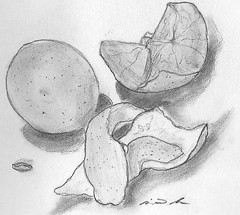 The seed of a clementine is on my tongue, the window's chill a medium between the cold and I, with my lips, closed up around it as a tomb, hoarfrost on a stone, creaks open along the seam. The seed is on my tongue--this seed, no other--its close seeming, a seam between myself and latent orchards, the sun inside its own skin, a rind, scales away, breaks away in this piece and that, the flesh stripped, void of frozen air knocks against my lips as if listening for a pulse, echoed response, pulp of each membrane burst, from my tongue--this seed, no other--in the dark, warm tomb of my mouth, begins a tree.
Sunday, December 2, 2007
To Love a God: Struggling with Morality in Polytheism
 In my continued attempts to explore polytheism and the various pantheons of the ancients, I recently read both R. J. Stewart's Celtic Gods, Celtic Goddesses, and Goddess: Myths of the Female Divine, coauthored by David Leeming and Jake Page. In some ways, polytheism continues to have a certain appeal or attraction for me as, perhaps, a final, definitive embrace of my Druid path. Devoting myself to wild, colorful deities of my ancestors carries the same kind of tantalizing mystique and fresh spiritual intrigue as dancing with faeries, seeing auras, singing with the river stones or treading moonlit wooded paths in the evening, seeking contemplative solitude or poetic coincidence in the world. The fulfillment of this imagined "magical self" that I have been crafting and cultivating over the past several years--first through witchcraft, and now through Druidry and other occult studies--seems always to have been the kind of devoted, ecstatic priestess who was only naturally polytheistic or, at the very least, more interesting than a plain, familiar Christian.
Still, though I continue to explore polytheism--in particular, the loose conglomeration of deities one could call the Celtic pantheon--I'm reminded again and again of certain things that don't quite sit well with me. Leeming's and Page's Goddess brought this unease home to me once again as I read the book over the Thanksgiving holiday.
Putting the Double-D in Goddess
The least problematic issue I run aground on is the ancient forms of Goddess-worship, those associated with the deep caverns of the earth painted with symbolic vulvas and protective, procreative wombs. While beautifully ecstatic, creative and sensual--celebrating the power of both womanhood and nature to give and sustain life, and transforming death into a return to generative darkness--it has always struck me as, well, a bit lop-sided (might I even say, top-heavy?). In its purest form, perhaps, in which Goddess is conceived as almost androgynous or trans-gendered, all-embracing in her presence, it echoes and affirms the kind of pan(en)theism with which I find myself most comfortable. Goddess not as anthropomorphic deity, but as life-force, Spirit and ground of creative being, transcends the male-female divide in the same way the God of my childhood Catholicism embraced all existence and paradox when the priest called upon the Divine as loving Mother (for now, I'll not spend time explaining that not all Christians are patriarchal misogynists--just trust me on that one ;).
But it seems, far from this aspiration towards pan-gendered unity reflected in certain pantheist and monotheist traditions today, many ancient Goddess myths take for granted the secondary, disposable nature of the male counterpart. This has always felt, to me, just as unbalanced and short-sighted as a spirituality that takes for granted the female side of Spirit as secondary or non-essential. Not only does it seem to reduce men to either amusing pets or convenient sacrifices, but it puts forward a view of the feminine with an exaggerated sense of sensuality, fecundity and receptivity. Perhaps the truth is, in being female, I personally look for the animus or male energy in my conception of a personified (that is to say, in some sense, an "external") conception of deity, while feminine aspects of the Divine I experience more directly as imminent, an animating breath or Life-force within me. This has made it difficult for me to feel comfortable worshipping a Goddess, but it has not stopped me from experiencing the Goddess-nature of myself and the larger Divine that suffuses reality.
Gods Behaving Badly
Another stumbling block I find within many polytheistic traditions is when the balance so clearly swings in the other direction, away from Goddess-worship and towards the repression and distortion of the feminine archetype of Spirit. Though Christianity has become an easy scapegoat to blame for rampant, repressive patriarchy among the world's religions and spiritual traditions, the myths explored by Leeming and Page often illustrate repressive, misogynistic and downright immoral behavior within plenty of purely polytheistic pantheons. Zeus's many rapes of women, both mortal and divine; the early Epic of Gilgamesh and his rejection of Ishtar as an untrustworthy seductress; even a late Apache myth about the toothed "vagina" goddesses, progeny of the Kicking Monster, who must be tamed, literally de-fanged and taught the pleasure of submissive "swallowing"!
Certainly the sexist mythology of Eve and the Fall, as well as of Lilith, Adam's first wife who dared to believe herself an equal, have their place within the Christian tradition, but it is also important to note that these are Jewish myths in origin. As far as new contributions to the misogyny of past and contemporary traditions, Christianity seems to have added very little, at least if we consider its mythology rather than its socio-political structures. Indeed, within the Gospels, women are often treated as equals, as worthy and devoted disciples, and as the most powerful of divine instruments (from creative vessels of new life, to sacred witnesses to the grief and mystery of death). The fact that the socio-political institution of Christianity as a religion has not always reflected the feminist lessons of its own mythology is no surprise; consider, after all, how rarely the gods and goddesses of various polytheistic pantheons seem actually to embrace the ideals of diversity and humanism that have become a cornerstone for the Neopagan movement. Although the modern Pagan religion as a socio-political counterculture encourages equality, personal will and tolerance, polytheistic pantheons seem full of deities with no qualms about unequal favoritism, fickle wrath or even seemingly manipulative impositions onto the human personal will.
Worship & Love
If I find polytheistic deities a bit fickle or inexplicable, however, this is partly because they are much more closely related to the mysterious forces of nature, which themselves are often highly indifferent to the whims or will of men. Oddly enough, I have no trouble appreciating, praising and even loving these forces of nature when I experience them within the context of a more unifying, interwoven, infinitely-living whole--when I experience the fierceness of a thunderstorm, the brutal cold and blinding purity of snow, the persistence and continuity of a wide river and the stolid starkness of the hills that loom over it. I can appreciate and experience the way in which Spirit manifests itself in each of these particulars, to create a tension and conflict out of which beauty and transformation arise through struggle. Yet, can I call these particular beings--these nature spirits and animating forces--gods and goddesses? And can I really worship them as such?
There is no question that I respect, admire and sometimes even fear the various particulars and manifestations of the world--but the quirk of having been raised Catholic is that, for me, these feelings are not enough. I grew up believing that the proper attitude towards one's god(s)--that is, the proper relationship between oneself and the Divine--is that of love. The Law of Love, which trumps everything else according to the "Good" Book, is to love God, and to love others and oneself as one loves God--creatively, freely and unconditionally. Jesus Christ, as portrayed as a deity incarnate in the Gospels, engages in the small, daily activity of creative, unconditional loving--he acts morally within the human sphere of experience in order to blow open and transform that sphere, transfusing it with Divinity. He is not only a poet-prophet, magician, philosopher-teacher and political radical--he's just a damned good guy, really. In the theology of Christianity, humanity is not simply incidental to the indifferent glories of a Divine natural world; Jesus, as deity, not only acknowledges and celebrates a sense of sacredness in nature (through parables and acts of natural magic) but elevates human beings themselves as deserving of respect, as worthy of Divine love. To me, he is not only a deity to be praised or feared (i.e. to be worshipped), but to be loved, intimately and fully.
Yet the mythology of Christ is not simply that of love, light and warm-fuzzies. Other, more scholarly Pagans than I have noted the parallels between the Christ myth of death and rebirth/resurrection and those of other polytheistic cultures. The Sacrificial God-King who dies to redeem and bless the land is a common mythological figure, particularly among agricultural-based societies. The deaths of these gods, however, are usually portrayed as brought about by those very same inexplicable and larger-than-life forces of nature--the God-King sacrificed to the Goddess-Mother/-Lover/-Land--and require of human beings either mere ritual witness, or the requisite personal sacrifices. The sacrificial death of Christ, on the other hand, is deeply human; indeed, it is not the inexplicable and sometimes tragically indifferent mysteries of nature which demand it, but the inexplicable and equally tragic community of humanity itself. Jesus, as historical figure, goes to his death at the hands of his fellow man, while Christ, as deity, inverts and subverts the vast gulf of power usually assumed to exist between all-powerful God- and Goddess-forces and a humanity buffeted about by their winds. Christ then becomes not only a deity of love and moral commitment, but a dark god of death, destruction, tragedy and the shadows of the underworld--not merely the ugly or incomprehensible fears of nature, but those within humanity itself. With humanity so intimately involved in the mythology of this deity, it also lends new responsibility (some ex-Catholics would probably be accurate in even saying "guilt" to some extent, though I have always understood it as response-ability) to the relationship one has with the Divine. We see that we are not powerless and ineffectual, that we are indeed capable of killing a god, and that this becomes yet another reason why love of Divinity and for Divinity, as both manifest within and transcendent beyond humanity, is possible.
The Disconnected Line
All that said, I have no doubt that my friendly neighborhood Pagans and polytheists out there have intimate, inspiring, even loving relationships with their gods and goddesses, which move way beyond simple worship in terms of praise and fear. I see these relationships expressed daily in indirect ways, as other bloggers talk about their spiritual practices and experiences. What I find frustrating is, well, akin to the frustration a person might have when trying to start dating again after years of being "out of the game." How do you meet the "right god"? How do you go about beginning the process of learning about one another and establishing a connection?
I'm still puzzled about this process. I read the books on mythology and ancient tales that people recommend, but I often feel as though these are out-of-date phonebooks and I'm looking up numbers for deities who have grown and moved on. Or, perhaps a more apt metaphor, it feels a bit like stalking someone on Facebook or MySpace, where the worst and the best of a person (or deity, as the case may be) are splayed for public view out of all context, hardly reflective of the real experience of knowing and working with him or her. Even among the Celtic deities, many of whom I find intriguing and potentially powerful patrons, I find myself coming up against silence, the dialtone of a disconnected line. Perhaps if I were part of a working group of local Druids, rather than a solitary practitioner, making that connection might be easier. I've even contemplated the more indirect route--meditating, for instance, on my apparent connection with frogs, hares/rabbits, pigs and even horses as recurring totem animals, researching which deities in which pantheons are associated with them, almost as if they were mutual friends who might be able to introduce us.
The question I always come back to, though, is: is all this really necessary, anyway? Am I, perhaps, just a naturally monogamous lover and, spiritually speaking, worshipper? Did I get lucky and meet the "right god" when I was very young, growing up with a Christ that is not the judgmental, oppressive or vindictive deity known to so many others? Is it, perhaps, really all right to be a Christian Druid, in the end? I mean, of course it's "all right" in the sense that the OBOD and AODA communities embrace seekers on the Druid path regardless of their religious backgrounds. But my concern is really about internal consistency and the integrity of a personal spiritual tradition. Is there something inherently polytheistic about Druidry? If there is, I am bound to confront it one of these days. Still, I wonder, who are these Gods and Goddesses of the Neopagan pantheons, and how do modern practitioners reconcile the sometimes less than admirable and moral mythologies from which they seem to evolve?
For those of you readers who are polytheists, I really would love to hear your views on this. Over the past few years, I've come to understand and even experience the nature of spirit guides, ancestors, "elementals" and group thought-forms (for which I can never remember the gosh-darn name--it starts with an 'e', right?)... but deities, Gods and Goddesses... they remain beyond me.
Subscribe to:
Posts (Atom)