
I've been studying the ancient Celtic pantheon, trying to teach myself to believe. I would like to be able to more fully enter this world that connects my ancestral roots back to a belief in the beauty and glory of the gods and goddesses of old. I want them to come alive for me, the way faeries and tree nymphs have always seemed at least possible, if elusive. Still, as much as I might read, they're just stories to me. It's strange that the figure of Jesus Christ, just as implausible a god and perhaps even more so, seems so very real to me--the Trinity itself is very real to me, in an experiential way. Even the obscurer saints and archangels are real and when I journey the graypaths during meditation, I may meet them. And yet these other figures from Celtic myth remain elusive and unreal.
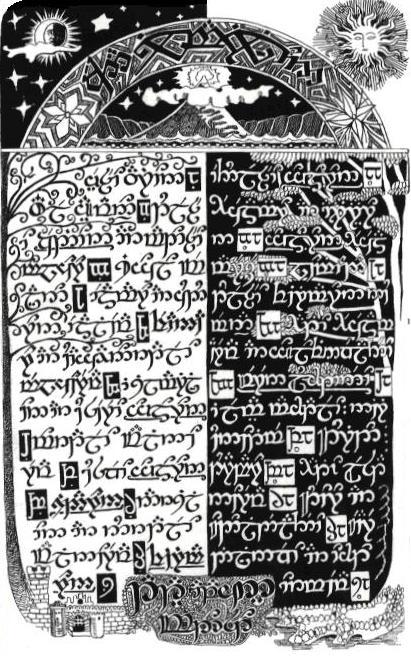
What's also weird is that I've started Tolkein's The Silmarillion, and even those fictional characters, the Valar, the "gods" of Middle-earth who are more akin to seraphim and powers and archangels--even they seem more real than the old stories of gods that people once actually worshipped. Perhaps it's because they have a shared cosmogony, a genesis story that is intricate and beautiful--that tells of the first harmonies of on-going creation. A world is created through them which I can imagine to be my world, and so they seem to be a believable, if forgotten, part of that world... of my world. And yet, they are fictitious. The children of one man's imagination and his obsession with linguistics. They aren't "real."
I almost wish they were. I can almost feel them, shimmering on the edges of possibility... if only just enough people took them seriously. After all, how else are gods made, if not by the momentum of belief? But then, are these truly gods, or merely collective fantasies? The organ of my belief functions in such a way that I can only bring myself to believe in that which existed "in the beginning"--Jesus as historical figure may be a wonderful teacher, but it is Christ as the Word, the first note in the song of creation, in whom I truly believe as part of the Trinity. And perhaps this is why I find it difficult to believe in the deities of the Celtic pantheon. They are not cosmogonic--they are, in some way, incidental, only players across the stage of myth. I may find inspiration and connection in the green hills, the ineffable mists and the rolling oceans of Celtic myth, but its gods are only casual visitors upon a sacred landscape. The Trinity of Godhead, Manifest Spirit and the Bridge between the two walked that landscape long before the Celtic gods and goddesses were named.
Still you never know. Perhaps in some distant future, Tolkein's manuscript, forgotten and faded, will be unearthed and mistaken for actual lore instead of a work of fiction. Someday there may be Neopagans learning how to believe in and relate to the Divine through Ulmo, Manwe and Aule, Varda and Yavanna, instead of through Brigid, Bile, the Dagda or Lugh.

 On another occasion, I was sitting in a local park, reading Ursula K. LeGuin's Tales from Earthsea, when a very similar event occurred. Minding my own business, enjoying a story about young love and the difficulties of romance, suddenly into my lap fell a pear! All right, I was sitting under a pear tree, so I suppose this wasn't all that unexpected--still, it interrupted my reading and gave me pause. I picked the pear up and examined it, feeling its texture, experiencing its smell and feel and, yes, even its quiet song... Eventually, I placed the pear on the open page, then sat quietly and meditated for a while, rolling around ideas about the nature of love, attraction, and self-sacrifice. The pear became, for me, a sacred symbol of how the seed of life and creative generation often surrounds itself in appealing forms, offering itself up to be consumed and digested, literally or figuratively, and providing nourishment and pleasure so that it might also find the nourishing and moist earthiness it needs in order to take root. It also struck me how human relationships, far from being simple and mutually-supportive, are instead confusing, difficult and often painful, as in the story I was reading. After my contemplation was over, I offered the pear back to the grasses, with a larger gratitude.
