Tuesday, September 25, 2007

Unfocused Pieces.

I'm currently on sabbatical--an enforced period of rest from overuse of the computer and too much pressure (entirely my own fault, admittedly) to read and write at an enormous pace. There is some need to feel useful and self-motivated, to justify my current circumstances as an unemployed writer and a rather timid, exhausted waitress. This need has pushed me to a point of exhaustion lately, especially during a week-long illness mid-September, during which ideas and themes for writing backlogged, creating a kind of bottlenecked writer's block. Now they are grinding their gears and honking their horns, and all the noise in my brain is keeping me from concentrating with my usual furious, unmitigated enthusiasm. Indeed, I find it rather difficult to concentrate much at all on linear thinking at the moment, retreating into the flowing narratives of novels and the visual focus on my new handicrafts project: pencil sketching.

Things continue to happen. I continue to attend and to remember. Life is not lost on me. But I sit down at the computer desk, and the soggy-cotton-ball headache in my brain fogs up the glass with the breath of my thinking--I can't see clearly into the landscape of ideas, hopping from one spot to another with an imagining architect's eye. I don't have the patience. Now is, perhaps, a time for gathering in and hoarding. There will be months of winter in which to recall, from within the darkness, that moment last night when I wandered from room to room in my apartment, seeking to touch the brick bones of the building; or the walk through the park without my glasses, when space was rendered physical, a visual dimension, and distant leaves hung in silhouette against the afternoon sunlight, blurry, glistening, radiating orbs of gold and green; or a thousand other impressions and moments. I'm harvesting them, I am making the effort to anchor myself in the here-now. The brain, like the heart, is a muscle, which must be rested in order to be properly maintained.

With that in mind, here are a few random bits of journaling and letter-writing from over the past week or so, to tide you over, and to promise more to come.


The Vase

After all, there was the vase--I could see it. I could make a line on paper, I could compare this line with the image of the vase. I had eye enough to recognize when they did not match, and yet erase and redraw as I might, I somehow couldn't much improve, I couldn't bring the sketch to reflect the actual image I saw before me. Why not? What fluke of the brain was impeding the hand? This was a matter of seeing, not of doing. I was convinced that if I could "see better" I would be able to draw better. Somehow, I had to figure this out.

Sketching a small, deep blue, hand-painted Brazilian vase had become an exercise in memory and perception. What I perceived (and thus drew immediately, eye to paper) was fragmented, a marriage of ill-matched angles and proportions, a shifting visual mirage where this moment's shadow was tacked onto last moment's curved neck, which sprang precariously from the rounded angles of a base and belly drawn to different moments' scales. But when I gave up, frustrated, and sat back to sketch the damn, simple thing from memory--there it was. The form of it, the completeness of the thing, compressed into a sudden whole by the integrating, effacing processes of recall. Perspective and subtle change forgotten, memory proved the more realistic guide.
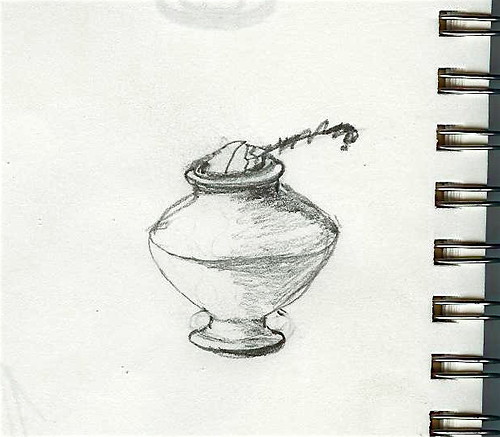
Somewhere in my sunconscious, imaginative brain, there exists an artist who knows what she is doing and might, with practice, make passable sketches of, say, birds and trees and things. Apparently, my conscious attempts at art have stalled at the ten-year-old level, unable to make the leap into cubism and the modern, playful but skilful abandonment of perspective. We must investigate this discrepancy further.


A Philosophical Opinion of Pleasure

Perhaps pleasure is a mechanism of the real, to which we should attend with as much seriousness as we attend to questions of morality, purpose, will, art, religion... What is the function of pleasure? And by this, I mean not only physical pleasure--though, perhaps, all pleasure is to some extent physical. Another strangeness. Aesthetic pleasure, utilized carefully to thrill or disgust, excites the faculty of attention. There is a bridge between body and mind, and that bridge is sensation. If we attend carefully to sensation, how can we avoid pleasure? How could we possibly shun it? How could we claim that we do not, to some extent, seek it out?

Pleasure circulates, it corrodes the easy categorical walls that the mind makes. The eyelid, the shoulder, the useless skin of the earlobe--these are not extraneous to the beloved, not ignored by the lover. They are representative of the whole, they communicate to the rest. A lover, dazed in pleasure, makes no distinctions, kisses anything.

We mistake convenience, addiction, lust for pleasure. We've forgotten what real pleasure feels like, the pleasure of health, the thrill of simplicity, balance and the sounding of a single, pure tone in the rising chord of creative coexistence. This is sacred pleasure, that of gratitude and grace.

Listen.


Evening Solitude & Sadness

I tried for a moment to get a view of my sadness, a feel for it, maybe. A shift in perspective. Am I actually sad? Is any of it real, or are these simply useless, irrelevant emotions (and wouldn't that, anyway, be somehow just as awful, to be so subject to such useless, meaningless feelings and for feelings themselves to be useless, meaningless)? I stepped back and saw my sad little self sitting in this dark, empty space of a living room--and I felt: there I am, still sad and lonely and small, inside a great, beautiful night that is so full of grace and potential and quietness. They both exist. I am content and sad at once. Maybe it's selfish to want to be happy, to want relief from always feeling a sneaking loneliness underscoring everything. Maybe everyone feels this way, all the time, and that's how it is--moments of perspective in which the world and life are utterly beautiful, and the surrounding void in which the very same world and life, unchanged, seem superfluous and stupid. But then, I am back to faith--how can love and hope mean anything if this is just how reality is? In what way do they function, what is the purpose? I do not want to deceive myself, I do not want to color everything in with hearts and roses and pretend love will save the day. But how can I live without it? Why should I be expected to? It's all just noise and nonsense otherwise. Can I reject it--a loveless life and a world in which love falters and fails--on principle, even if it means rejecting what actually is? I want to hold both things--love, and the actual world--and cherish both, believe in both. I don't know if that's possible.

I'm afraid I'm going backwards, devolving. I'm afraid I'm losing the way, that I'm worse than I used to be, that I do not love as well or as boldly, and that I can't get it back. Having lunch with a friend, I'm okay and happy and peaceful, except of course that I am becoming an awful person who laughs and has no hope. With a friend, I am not so bothered by my awfulness, my apparent disability. It's only when I'm alone that I can't justify it. I should not let the sadness of my solitude prevent me from being useful to the community of creation. But I feel so weighed down by it. They--the mysterious Other--demand that I be happy on my own, be completed and whole as an isolated being; but if I am, there is no reason to seek the Other in the first place. Which is worse: to feel, painfully, a kind of isolation; or to actually be isolated, so cut off that you no longer even desire connection?

Tuesday, September 11, 2007

Grief, Dissolved.

Deep within the still center of my being,
May I find peace.
Silently within the quiet of the Grove,
May I share peace.
Gently within the greater circle of humankind,
May I radiate peace.
Awen.

I am not sad today. I woke up early this morning with a searing throat and the sniffles, but I am not sad. Though the morning grows late, the rain is unstoppable and each room in my apartment remains dark, as if in a kind of unlikely and ever-lasting twilight. I make my green tea, and I am not sad.


My friend, Freddy, died a little over a month ago, of heart failure. He was young, healthy, strong--and one night, his heart gave out.

A week before he died, before I left for my family vacation, he gave me a hug, only to pull back and ask, "Why is your heart beating like that?" A combination of caffeine and nerves at the time had it pounding palpably in my chest. I shrugged and replied, "It always does that."

When I came home, he was dead. For a month, each night I went to bed secretly wondering if my heart would just stop beating as I slept. I wasn't as healthy or as strong as he had been, my heart was out of shape, a bit of caffeine and some stress could set it rocking back and forth beneath my flimsy ribs. Each time it began to beat too hard or too quickly, I began to be afraid for it, frightened by it. Each night, I fell asleep casting one last untrusting eye at the little unnatural jostling within my breast. Why does my heart beat like that, and why does my body take the beating, and for how much longer?


Six years ago, the rain did not pour down into the morning. The rooms were all lit through with the steady eastern slant of sunlight, all the glass windows of the high-rises in New York City blinked back like a thousand bright blue eyes. Students were learning French and chemistry in classrooms across the country, some children were being read to, others reciting their multiplication tables. Their parents were in conference rooms and offices, moving about in a million hallways, sipping plastic-tasting water in a million breakrooms. In the east coast cities, the pigeons and morning doves were out, scratching for crumbs, balanced on the telephone wires and the window ledges of old brick buildings. In the suburbs, squirrels wrestled the first few acorns of autumn from one another, while all the houses lay quietly in a row, block after block. Life was beautiful and teeming and gathering itself in for harvest.

Then death reached in, and ever since, we've been a little suspicious.


But today I am not sad. Which is maybe a little strange. Last year at this time, I spent days oscillating between sobs and moments of quiet frustration and depression. Last year, nothing seemed to last. Now, this year, I know nothing does. But I am not so sad. Last night, I fell asleep reading, without a second thought to my untrustworthy heart, and I woke up listening to the rain, nested between pillows, slowly swallowing, and swallowing again.

But I mark the day. There are some things which put on the cloak of duty, and this is one: to remember. One day, everyone who lived through that day in September six years ago will be dead, even those too young to remember it. Freddy lived through that moment of overwhelming, impossible death--and now he has lived through his own. My heart is still beating, as unlikely as it is, and as long as I am alive, I must remember that I am, that I have been alive while others were dying, that others will live through the moment of my death and come out the other side, come through with a million hearts still beating, the morning doves still swinging on the wires, the oaks still loosing their tiny green acorns into the grass.

This morning, I read the thoughts I wrote last year on this day, as I always do. I want to preserve that movement, from year to year, to set aside and make sacred the memory, and the change. This is what I wrote last year, on the fifth anniversary of September 11, 2001.


The Measure of Grief: On Loss, Suffering and Sacred Confusion

What I feel today is not grief. Regret, an ache of sadness and frustration, a kind of depression, perhaps. Though the local paper told me yesterday that "time fits neatly into pre-9/11 and post-9/11 compartments," I cannot help but think this is wrong, or that it is only true insofar as people have some sense now that life could be different--should be different... and yet we know that, fundamentally, things are the same as they ever were. For five years, we have waited for that shift to be resolved, to feel some new order establish itself. For five years, we have searched for the appropriate memorial, the appropriate response to that moment of grief and unimaginable loss. But what we feel today is not grief. It is, if anything, the dwindling madness of a grief unfelt and unrealized.

I remember the day, five years ago this morning, when grief came swift and beautiful under a bright sky. Think back--you felt this too. What is grief, but that sudden sense of an incomprehensible and overwhelming loss? It is not fear or loneliness or regret, though these things may blend and heighten it. But that day, you felt pure and unmixed grief, grief alone. You might have been young, just a girl with no delusions about what you could have done to stop it, with a naive faith in God's plan for you and no fear of death, with a family and friends who called immediately from the safety of their homes to comfort you and reassure you. You might have been safe and loved and untouched by personal threat or fear--and yet, there it was, that grief so strong and pure that it seemed at times to push you utterly out of yourself. And in that purity of grief, you began to understand.

What is grief, but a loss that cannot be withstood? The hard, quick knowledge that something--some part of the real--is gone, that what was here, present to us just a moment ago, is now absent, withdrawn into the dark flux of the Void. Grief is Reality, shot dead. What it leaves in its place is confusion--yet this confusion is sacred, a holy bewilderment, a place where everything that was once certain and well-defined has been pulled suddenly back into the realm of mere potential, of infinite possibility.

Think back--you felt this, too. While the President still hid in a classroom of children, while the newscasters stuttered and stared in horror, while the phonelines were jammed and the firemen and police and doctors were gathering their strength and forgetting themselves in their immediate heroism--there opened up a chasm of wild possibility and, dare you name it, hope. In the days and weeks to follow, people gathered spontaneously, they lit candles and decorated public places with flowers and ribbons and small works of art. Don't call this the American Spirit, as if to bolster some trite nationalism. This was humanity, pure and stripped bare. This was humanity responding openly and creatively to unfathomable loss, humanity discovering that the core of grief is, in fact, nothing else but love--that we suffer loss because we love creation, and that we embrace grief because it teaches us about God in the beginning, without form or void, moving over the face of the waters.

So quickly, our grief and its sacred chaos, which had opened in us a common glimpse of a world shaped by creativity and connection, closed down again. Usurped by those with a story to sell, yoked to the agenda of American Pride, American Faith, American Power in the face of Evil. Grief--our sense of loss--was shallowed and drained. What had been lost? They told us everything had changed, and yet the story they sold was essentially the same, only louder. When once we had been great, we were now unquestionably the Greatest; when once we'd had foreign enemies who protested our political and cultural influences, we now had an Evil with an irrational hatred of Freedom and a strategy of Terror. Everything was capitalized, but the vocabulary was consistent. What we had lost, they seemed to tell us, was only a matter of perspective, a matter of degree. The structure of the world--which had seemed, on that day, so flimsy and in doubt--remained hopelessly solid beneath our wailing and the pounding of our fists.

Five years. For five years, we have carried with us this denial of our loss, this secret knowledge that there is another story we could have told, another world we could have made out of the ashes and fire of that morning. "Post-9/11" is the name we give to our impotence, our failure to change.

One day, this "post-9/11" depression, this story of choked and aborted potential, will unravel itself... We will again know grief, if only as a slowly creeping self-awareness; we will experience, again, that awe-full and unbearable sense of loss, the ripping away of our understanding of reality. On that day, what will we do? How will we respond? Will we turn fearfully and mindlessly to the old, unsatisfying stories of military might and cultural supremacy? Or will we cherish our grief as the shadow cast by creative love, defending it against the sick insistence that nothing should (or could) ever change?

Sunday, September 9, 2007

No Touching

I never thought I'd be happier for rain. I adore rain--I love how it moves, what it does, where it goes. I love its sounds, its persistence and variation. I love how it falls from so high up, and everyone just accepts this as part of the deal, like it isn't something amazing that the surface tension of water can somehow hold each drop together all that long way down and we're not, instead, just walking through a constant, thick, steamy fog that sinks or rises with the air currents and condenses when it brushes against something solid. But today is one of those days when the heat has been so unbearable, oppressive, that the rain is practically the only thing that cures it. The heat hasn't broken, it has been lifted--but lifted by something falling, by water dripping down from its heaven. So in my mind, two opposite motions are made by a single act, and a swirling yin-yang of relief slowly opens. And I feel good. I just got out of the shower and my body is having one of those moments in which it needs nothing--it is perfectly comfortable and perfectly clean and perfectly sated. And what with the rain, it's like being suspended or rocked by the gray afternoon. I have space and quiet in which to think, and to write.

The truth is, I cannot imagine resigning myself to a life in which I barely touch other human beings. But that is the life I am living now.

The nature of my waitressing work means that I sometimes have to actively encourage or enforce this sense of distance, of "hands off," because we do have a few lonely, male, regular customers who have that lurking stalker-potential. A friend of mine actually had quite a scare last winter, when an older man waited for her in the grocery store parking lot across the street in order to offer her a ride home at the end of her shift, hours after she'd waited on him during the dinner rush. And of course, when the customers aren't mistaking professional cheerfulness for personal interest, male coworkers often step uncomfortably close to the line between innocent flirting and sexual harassment. About the same time I began to realize that other people considered me attractive, I began to discover that there were guys who, quite apart from getting along with me socially, "wanted to f--k" me. And some of them were not shy about saying so. What's worse, female coworkers seemed to expect me to take this as a compliment, and to encourage the idea. Anyone who thinks women can't be predators is simply fooling himself. I know enough women to know at least a few who remind me unflinchingly of the female praying mantis, who bites off the male mantis's head in order to minimize the conflicting "run" versus "procreate" signals its receiving. There is this kind of girl, who would prefer that men not think, because she doesn't think enough of herself to believe she could possibly attract them if they did.

All of this starts to feel somewhat like living kept locked in a dark basement by some conspiracy of society, with the only occasional light harsh, glaring, right in the face. The only physical interaction between human beings that is available begins to feel degraded and dirty, and you learn not to appear to enjoy any kind of contact at all, just on the off chance that it could be misconstrued. Perhaps if I had been a truly ugly girl, I wouldn't have learned this intentional recoiling petrification, the way a piece of iron seems to recoil by the very nature of its utter lack of response. If I were really ugly, perhaps I'd go around giving everyone bearhugs. As it is, there are a few people whom I occasionally touch gently on the arm or back to express affection--otherwise, I slip through life with a startling untouchability. I do not pull away from the casual brushes of others, but there is a layer of vacuum that I keep just under my skin, swept clean every time I breathe out, and no touch or feeling is communicated across it unless I allow it to be. If I did not maintain this kind of vacuum, I would be reduced to neurosis by the amount of presumed intimacy and callous familiarity with which I am treated daily. I am not a prude by choice; I'm a prude because I just cannot be a whore. I don't have it in me.

Things might be different. In fact, on my days off, when I am alone with myself, they often are. When I walk, I do not hesitate to reach out and touch the flowers, the leaves, the vibrating lines of a chain-link fence as I pass. Sometimes I spread my arms out wide to either side and stretch, just to feel the wind and sun. When I walk through a field, I can feel the dark heat of the grass, the sun that all day the dirt has been gathering into itself and holding onto; so that the earth under my toes is warm, even when the breeze at my ankles is cooling along with the evening. Through my meditation and attentive work over the past several years, I've learned a kind of mindfulness that puts me in intimate touch with the whole world. Or at least, it seems that way sometimes. When Freddy died and no one in my family offered a hug in consolation, I sat out on the rocky shore by the vacation house and, slowly, it felt like God Itself was bending down to hold me, to catch the weight of my grief when it might otherwise have borne me all the way down.

Mindfulness. Being mindful and attentive is what makes this real, and the energy and relations of the world express themselves in distinct physical sensations. Even at work, sometimes, in a moment of safety or when I am feeling alone, I slip into this receptive mindfulness. Then I will hear the quiet plop of an ice cream scoop into water from several yards away as if I were standing right beside it. Or the muzak in the dining room, drifting slowly down from the ceiling, will make me tremble or carve out dance steps that I accidentally trace as I walk, while no one's watching. This is the material world, the very definition of innocence, of open intention, of sensations that do not force their way into your skin or eyes or ears, but that open outward and invite you to slip in sideways.

But this is the world, not people. I am not afraid of anything as much as I'm afraid of other people, sometimes. The world is too big and I am nothing to it. There is no mutual intimacy here, even when there is sensuality. It could be different, and physical intimacy with other human beings could be easier. Mindfulness could redeem sex and sexuality. Attentiveness could restore the innocence of sensual affection. But only within the context of a respectful and trusting relationship. For me, this is the only way I can cease to be untouchable and come back from the realm of unfeeling. That is why the thing that scares me most about a potential future relationship is not differing political opinions or a distraction from philosophical discovery, but the possibility that the two of us won't "click" physically. It scares me to think that, despite all the work I do to connect to the world, to sew myself into the realness of time and space--that I might again fail to touch and become touchable to another singular human being.

That I cannot touch humanity, that I might never touch it and know it from the outside in--that is what scares me.

Friday, September 7, 2007

The Horror of Insects

With my usual obsessive compulsiveness, I've gone out and bought three more books by Annie Dillard (luckily for me, all three have been collected into a single volume, so I do not have to be as embarrassed by my indulgence as I could have been). Almost seventy pages into Pilgrim at Tinker Creek, which is a kind of morose and sublime Walden for a generation even less familiar with the actual natural world, I come across Dillard's exploration of insects. It's hard for me to read about bugs. Of all the things I'm afraid of--and there aren't so many these days--I have an irrational squeamishness and horror of insects that I can never overcome. I've learned not to flinch when the occasional bony wasp or tubby fly wanders by me as I sit out on my bedroom balcony, and I've overcome my fear of butterflies by paying closer attention to their flight paths and the shadows they cast across the ground, and less attention to the terrible needle of a mouth they slide sickeningly into the innocent dark recesses of the blossoms on which they feed like seductive daylight vampires clothed in the deceptive remnants of a once luxurious living. God, am I afraid of butterflies!

Of all the insects I know, I am least afraid of bees. I could watch a bee for hours, sorting carefully through the thousand miniature petals of a single clover bud, as if tuning the strings on a silent, orbed instrument. Or nestling down into a flower, bustling about like a toddler looking for a candy at the bottom of a box full of those white Styrofoam packaging peanuts, bits clinging to hair and eyelashes with crackling static. Walking to work at the beginning of this summer, I passed the corner of Wightman and Beacon, where every morning a fat, heavy bumblebee hung lazing in the air as if it were waiting for a bus. Of course I couldn't know for sure that it was the same bee every day, but that's what the mind naturally assumes, until the tiny, unlikely thing floating there was as friendly a sight as the gray-mustached crossing guard on my walk home past the local Yeshiva school, who always smiled hello and asked what new book I'd bought recently and if my father liked the bird-watching guides I bought him for Father's Day.

I'm writing like Annie Dillard now, letting my mind wander over old memories, free-associating on all the things I've noticed about the natural world living in the city the past few years. Today, while eating lunch at the local sub shop between the bank and the grocery store, I realized I love this city. If I had the chance to leave, to go live with a friend or a significant other in a real house, with a garden and a driveway, in some other state... I'm not sure I could. But then, I've loved all the places I've lived--my hometown, Lancaster, with its rolling fields and farms set just across the street from happy suburbia scattered with unexpected parks and some neighborhoods so old they still have sidewalks on both sides of the street and houses that were built to pass onto the kids; and the tiny town of Collegeville, whose welcoming sign on Main St. says, "So named because Ursinus College is located here," as if there could be any other reason, as if the town itself wasn't almost entirely a college campus, with a Dairy Queen at one end and a WaWa at the other. I love all of the places I've lived, most likely because I follow my intuition before I move on to a new place. I fall in love with the vibe, I groove on it, I make it my home, and so I swing from one home into another without losing my footing.

But (I digress) every place has insects, and somehow I can never seem to manage to learn to love them. There is something uncompromisingly horrid about them--horrid, horrible, horrifying, all such adjectives. I can't put my finger on it--frankly, I wouldn't want to and the thought makes me squirm a little. Of all things that move and eat and reproduce in this world, insects seem dangerously oblivious to us. They have no sense that I am larger, that this body is a living landscape not to be colonized, its secret places not to be planted with their awful, bubbling eggsacks, its hot veins not to be sucked dry or injected with poisons. I have no trust in insects, I do not know what they will do. It might be that deadly bites and cocoons hatching inside a person's ear or eye socket only happen in scary movies, but that irrational part of me believes these things are possible. I am all too aware that I am edible, that I am warm, that I might make a good home. Insects intrude, they trespass. If not in fact, than at least in possibility.

And then, I came across this passage in Dillard's book, during her discussion about the stubborn stupidity of the insect world, which I'm going to quote in full:

Although the new studies show that some insects can on occasion strike out into new territory, leaving instinct behind, still a blindered and blinkered enslavement to instinct is the rule, as the pine processionaries show. Pine processionaries are moth caterpillars with shiny black heads, who travel about at night in pine trees along a silken road of their own making. They straddle the road in a tight file, head to rear touching, and each caterpillar adds its thread to the original track first laid by the one who happens to lead the procession. Fabre interferes; he catches them on a daytime exploration approaching a circular track, the rim of a wide palm vase in his greenhouse. When the leader of the insect train completes a full circle, Fabre removes the caterpillars still climbing the vase and brushes away all extraneous silken tracks. Now he has a closed circuit of caterpillars, leaderless, trudging round his vase on a never-ending track. He wants to see how long it will take them to catch on. To his horror, they march not just an hour or so, but all day. When Fabre leaves the greenhouse at night, they are still tracing that wearying circle, although night is the time they usually feed.

In the chill of the next morning they are deadly still; when they rouse themselves, however, they resume what Fabre calls their "imbecility." They slog along all day, head to tail. The next night is bitterly cold; in the morning Fabre finds them slumped on the vase rim in two distinct clumps. When they line up again, they have two leaders, and the leaders in nature often explore to the sides of an already laid track. But the two ranks meet, and the entranced circle winds on. Fabre can't believe his eyes. The creatures have had neither water nor food nor rest; they are shelterless all day and all night long. Again the next night a hard frost numbs the caterpillars, who huddle in heaps. By chance the first one to wake is off the track; it strikes out in a new direction, and encounters the soil in the pot. Six others follow his track. Now the ones on the vase have a leader, because there is a gap in the rim. But they drag on stubbornly around their circle of hell. Soon the seven rebels, unable to eat the palm in the vase, follow their trail back to the rim of the pot and join the doomed march. The circle often breaks as starved or exhausted caterpillars stagger to a halt; but they soon breach the gap they leave, and no leaders emerge.

The next day a heat spell hits. The caterpillars lean far over the rim of the vase, exploring. At last one veers from the track. Followed by four others, it explores down the long side of the vase; there, next to the vase, Fabre has placed some pine needles for them to feed on. They ramble within nine inches of the pine needles, but, incredibly, wander upward to the rim and rejoin the dismal parade. For two more days the processionaries stagger on; at last they try the path laid down the vase by the last group. They venture out to new ground; they straggle at last to their nest. It has been seven days. Fabre himself, "already familiar with the abysmal stupidity of insects as a class whenever the least accident occurs," is nevertheless clearly oppressed by this new confirmation that the caterpillars lack "any gleam of intelligence in their benighted minds." "The caterpillars in distress," he concludes, "starved, shelterless, chilled with cold at night, cling obstinately to the silk ribbon covered hundreds of times, because they lack the rudimentary glimmers of reason which would advise them to abandon it."

Upon finishing this passage, I can't help but suddenly feel struck by the notion that perhaps the gods, if there are gods, must be horrified by us as we are horrified by insects. If there are "advanced races" of extraterrestrial origins, if there are Watchers or ascended Masters, how awful we must appear, squirming our way into the sacred places of the earth, oblivious and stupid, trudging in our hopeless, self-paved paths when we are long past weary. How eerie and disturbing the mantic, praying monks of the world's religions who must seem, for a moment, to have a look almost familiar to the angels, before turning abruptly to commit an act of ravenous violence against our own kind in the name of life and creation.

Yet maybe there is something beautiful and alien in us, too, that greater beings, if there are greater beings, might embrace; a love that is not borne of kinship but of necessity, a connection held firmly in the grasp of the larger Divine that is otherwise so hard to recognize. Insects abound, and they are strange and beautiful and awful. I try to appreciate them, but my unease undercuts simple enjoyment every time. The best I can do is reach a kind of sublime adoration, a tension between praise and repulsion. Still, I make the effort. I restrain my hand from the death blow, I wait patiently for the buzzing to pass, for the legs to carry the hard, spiny bodies away out of sight, into the corners, up the dusty curtains, along the crack between window and sill... back into the world in which they belong, to which they are adapted and suited. It is the insects' business what kind of world that will be. But I can watch, at least, occasionally escorting the lost moth or the exposed spider back into freedom, and I can try to get a feel for it. I can reach for understanding, feeling cautiously this way and that on the silk line of my own well-tread humanity.

Wednesday, September 5, 2007

Divine Digital Art

Many thanks to Mahud, who featured this piece of beautiful artwork on his mythology blog, Between Old & New Moons.


Click here to read my somewhat-flippant but utterly-sincere version of this Celtic wonder tale.

Tuesday, September 4, 2007

Attention & The Sacredness of Things

Having lunch with my best friend, Raymond, today, I mentioned that I'm reading Annie Dillard's book, Holy the Firm. I tried to describe what the book is about by saying it's a kind of long, poetic meditation on "the sacredness of things." At which Raymond, with his typical sharpness, scoffed a little and said that he doesn't like when people say something is something--that a thing is sacred, or someone is disgusting, or even that God is love. They're "loaded words," he said, less a statement about the things themselves as they are devices designed to evoke an immediate emotional reaction in the listener. Raymond likes to be precise and detached with his language. He says, for instance, that God is potentially always all-loving, but that, at any given minute, it is perfectly possible for God not to be loving--this is something that, in potentia, is also true. It is a paradox. Simply because, at any given moment, we encounter an all-loving Divine does not speak to the nature of the Divine itself. So when I tried to explain that part of Dillard's theme for the book seems to be that "every thing is sacred," he said he hoped she meant "every thing is potentially sacred."

So I asked him what is the difference, then, between something that is potentially sacred, and something that is actually sacred? I had a particular concept in mind that I was, at the time, struggling to articulate, and to ask this question was the best I could do. When does an object move from being potentially sacred to being actually sacred, what is the process by which this occurs? At one point, Raymond mentioned how, for instance, this tree we were walking past was a real and sacred object, but that he passes trees every day without giving them a moment's thought. Sacredness, then, is an attitude--but an attitude directly related to attention.

With much food for thought, what follows is a letter I wrote to him, having pondered these ideas on my walk home.

So, here's what I think is a great quote, and somewhat typical so far of Annie Dillard's writing:

Here is the fringey edge where elements meet and realms mingle, where time and eternity spatter each other with foam. The salt sea and the islands, molding and molding, row upon rolling row, don't quit, nor do winds end nor skies cease from spreading in curves. The actual percentage of land mass to sea in the Sound equals that of the rest of the planet: we have less time than we knew. Time is eternity's pale interlinear, as the islands are the sea's. We have less time than we knew and that time buoyant, and cloven, lucent, and missile, and wild.

The room where I live is plain as a skull, a firm setting for windows. A nun lives in the fires of the spirit, a thinker lives in the bright wick of the mind, an artist lives jammed in the pool of materials. (Or, a nun lives, thoughtful and tough, in the mind, a nun lives, with that special poignancy peculiar to religious, in the exile of materials; and a thinker, who would think of something, lives in the clash of materials, and in the world of spirit where all long thoughts must lead; and an artist lives in the mind, that warehouse of forms, and an artist lives, of course, in the spirit. So.) But this room is a skull, a fire tower, wooden, and empty. Of itself it is nothing, but the view, as they say, is good.

I especially like her tangent about the nun, the thinker and the artist, as it seems to me that she's trying to evoke that same sense of "mingled realms," as if the sea-and-island landscape is not merely physically present as scenery, but enters into the definition of her own sense of being, somehow. It is not her thought that lends "meaning" to the landscape, but the concreteness and realness (and the feeling of time and eternity and their difference) that lends a more firm reality to her. She almost seems to be poking fun at the idea, like you were saying, that things are something. She doesn't say simply "the view is good," but she describes the view and its effect on her, and then undermines or subverts all that by saying it is in itself nothing, ascribing the simple statement "the view is good" to a "them," to an other. The room is like her, in that way, empty and only definite in relation to the immediacy of the surrounding landscape. "Firmness" exists outside of her activity of attributing meaning, the room exists mostly as a window to the outside, an emptiness inside of which she can be present to the firmness of external things. Later, she writes:

There is, in short, one country, one room, one enormous window, one cat, one spider, and one person: but I am hollow. And, for now, there are the many gods of mornings and the many things to give them for their work--lungs and heart, muscle, nerve, and bone--and there is the no man's land of many things wherein they dwell, and from which I seek to call them, in work that's mine.

I'm still struggling to grasp exactly what she means by all this, but again, I think it's a kind of exploration, in solitude, of how the self is itself in flux, is somehow ill-defined compared to "rock" and "water" and even more ephemeral things like sunlight, morning, "work," etc. Perhaps, even, that the "work" is that of attending to what is solid, of moving out of oneself and one's personal emotional descriptives (beyond "loaded words," as you called them) and simply paying attention to solid things.

For instance, she talks about the various insect corpses scattered beneath the spider's web in the corner, and how she recognizes some of the hollowed stubbed shells as the remains of moths. She goes on to tell a story about watching a moth actually fly into a candle flame one night, its abdomen getting stuck in the wet wax and its whole body going up in flame, eventually leaving only the hollowed stubbed shell burning cleanly like a second wick. After telling this story, she says:

And that is why I believe those hollow crisps on the bathroom floor are moths. I think I know moths, and fragments of moths, and chips and tatters of utterly empty moths, in any state. How many of you, I asked the people in my class, which of you want to give your lives and be writers? I was trembling from coffee, or cigarettes, or the closeness of faces all around me. (Is this what we live for? I thought; is this the only final beauty: the color of any skin in any light, and living, human eyes?) All hands rose to the question. (You, Nick? Will you? Margaret? Randy? Why do I want them to mean it?) And then I tried to tell them what the choice must mean: you can't be anything else. You must go at your life with a broadax.... They had no idea what I was saying. (I have two hands, don't I? And all this energy, for as long as I can remember. I'll do it in the evenings, after skiing, or on the way home from the bank, or after the children are asleep....) They thought I was raving again. It's just as well.

She doesn't say, "Being a writer is like being a moth throwing yourself into the flame." Not directly, anyway. And she doesn't say it, in part I think, because that is not the only thing she means. What she says, instead, is that she thinks she knows about moths, and she knows about them because she has paid attention to moths and what happens to them. She has attended to these kinds of details. It's not that she knows what it's like to be a writer, and the moth-flame idea happens to be a good metaphor for it. Again, as with the realness of the landscape earlier, it's almost as if she's implying that her sense of self is defined and shaped by the things that she has witnessed--that, as a writer, she attends to the firmness or realness of actual things, and so she cannot help but be filled by those things. Quite literally, she "can't be anything else"--she has to be empty, to be the act of listening and attending and remembering. To be a writer is to be like the moth burning like a wick, except that the flame, in this metaphor, is the moth, the details about moths, the islands, the spider, the morning... What she seems to be describing ("raving" with too many similes leading back in on themselves--the writer is like the moth which is like the wick which is like the moth--which is why I think she avoids such circuitous language and allows the reader to make the connection), what she is articulating, even demonstrating is the process of being consumed by the reality of things other than herself, through the process of noticing them, of paying them attention.

That is just what I am getting, slowly and haltingly, from reading her work so far. Maybe because that is partly how I already see my own life. But, as you said just before I walked home, it's as though these things are sacred because she is doing the work of noticing them. As if the difference between something being potentially sacred and being actually sacred, is that we attend to its sacredness, acknowledge it. Maybe sacredness is not an attribute we give to things, but something that we allow things to impart to and impress upon us. In which case, the firmness of things is itself an aspect of their sacredness.

Just my thoughts, anyway, and I'm only thirty or so pages into the book (to be fair, the book is only seventy-five pages long, anyway).