As you may have noticed, astute reader that you are, I've been experimenting recently with audio/mobile posts to this blog. I'm curious for feedback about how you--yes you, dear reader--feel about these posts. Are you more or less likely to spend time listening to an audio post than reading a more traditional blog post? How do you respond to the visual format of the audio posts? How do you find the more spontaneous rambling contents of the audio posts, versus the nature of textual posts? Which do you prefer, and why?
I would really love feedback from anyone on these questions, if you have anything at all to share.

Wednesday, November 28, 2007

Friday, November 16, 2007

Thursday, November 15, 2007
Publication: Two Poems (EAP, November 2007)
Number 18: Other Points of View

The Naming of Prophecy and Wild Pear, by Alison Shaffer
(click here)
Tuesday, November 13, 2007
The Many & The One : A Look at the Common Purposes of Polytheism & Monotheism
The following is my response to Ule (a.k.a. Robin Artisson), who left an interesting comment to a recent post of mine (which was, in retrospect, a bit whiney of me, for which I apologize). Please take the time to read his comment (second to last) before reading this post, if you can.
Ule, Believe it or not, I agree with much of what you say in principle. I agree that religion should not be "a free or easy thing," that through it we should strive for spiritual integrity and growth, and that intolerance for or marginalization of a person's spiritual life, beliefs and practice and her or his relationship with the Divine (however it is presented or perceived, in whatever deities or non-deities, etc.) is a kind of violence against that person. (I've even used the metaphor of unique personal love to talk about the idea of "accepting Jesus" when I was confronted by a belligerent costumer my first month working as a waitress.) I think we can agree that, all other things set aside, we both want the same thing for the future.
Where we differ, I think, is our view of the past and how it shapes our reactions to the present, to the circumstances and people of today. Clearly, you believe strongly in a pre-monotheistic past that embraced tolerance and respect for all deities of all traditions, while affirming the unifying themes, struggles, joys and sorrows underlying the human condition throughout the world's diverse cultures and times. You see monotheism as a perversion of this ideal form of tolerance, a denial of how others experience the spiritual realm and a marginalization of an individual's personal experiences with their gods--all of which is, as you said, a very insidious and harsh form of violence. (If I'm getting any of this wrong, please correct me.)
If you'll bear with me, I think that we disagree partly because, though I agree that these forms of denial, marginalization and violence have all become a tragic part of the modern religious life, I do not happen to blame monotheism alone for the situation. One reason is that, no matter what anyone else says, monotheism itself has simply never had that effect on me. It may be that I am an exception (which, by and large, I don't think I am) or that I'm just lucky (which I know for sure I am), but I was raised in a loving, tolerant Christian family--one in which I was encouraged to explore other religious traditions, to ask questions and challenge "received ideas" from the Church, to admire and find value in the literature and arts inspired by other spiritual traditions, and to always explore my own personal relationship with deity. The very first Sunday school lesson I can remember learning was about the nature of paradox (the one-in-many/many-in-one, no-where/now-here nature that the term 'God' implies, and how it was a failure of imagination and a lack of the hard work required of religion to simply sit back and accept 'God' as some jealous tyrant in the sky).
I no longer really consider myself a monotheist, preferring the term "panentheism," the immanent within the transcendent and the transcendent through the immanent--which, according to my strict, Catholic father, is a perfectly acceptable belief within the dogma of the Catholic Church, in any case. But even when I did still consider myself a monotheist, I too experienced the frustration of having my beliefs dismissed and attacked as "fake" or "demonic" or a psychological failure of an uneducated mind. These attacks came from materialist/atheist rationalists, of course, but the experience was much the same as the one you describe as the conflict between polytheism and monotheism. And my reaction, for a long time, had the same bitterness and anger that you express. (Unfortunately for me, I loved math and science, and I was pretty good at them, too. I couldn't just turn my back and declare them uniformly bigoted and ignorant of "what really matters" in the spiritual life. For better or worse, they had already proved themselves to have some usefulness and insight to offer.)
My point, in all this rambling, is that you and I have shared a common experience--it just happens to have been at the hands of two different abusers. I have no doubt that there are monotheists out there who would still persist in the ignorant intolerance of accusing your spiritual life of being a sick aberration of the mind, or even of soul. Simply because I have not had that same experience with other Christians (admittedly because perhaps many of them hear the label and assume I agree with them, and so they stop listening) does not mean that your experiences are not valid and have some truth. My personal experiences, on the other hand, and the time I spent in college researching comparative world religions and, in particular, the origination patterns of counterculture religious groups (both modern and ancient), lead me to suspect that the real culprit is Cartesian duality and the modern rationalist trend that, for the first time in history, distinguished "religion" as a separate category, to be analyzed, criticized and eventually discarded by the "educated" person. Before this point, I do not think human beings consciously treated religions as "entities" (or even emergent systems) in their own right, distinct from the people who practiced them. The idea that religion itself can have a kind of consciousness, with intentions and ulterior motives, able to conquer and manipulate its "believers," is mostly a post-Enlightenment notion. I am hesitant to draw a stark line between the corruption of monotheism and an idyllic polytheistic time before it, projecting all the problems and frustrations of our current cultural intolerances onto a single Religion from the past (especially if the concept of Religion-capital-R wasn't even prevalent at the time).
In the end, perhaps monotheism is just a quirk in the spiritual development of the human species. After all, Hinduism and Buddhism are centuries older than the oldest monotheistic tradition, and yet they have continued to thrive and evolve uninterrupted. Indeed, they have developed to a point where postulating the Brahman, the "unchanging, infinite, immanent and transcendent reality" is not seen as conflicting with an experiential and practical polytheism (even though this conception of the Brahman is remarkably close to what I was taught, growing up Catholic, was the nature of the monotheistic 'God' as the ground of being and creation).
The conflict between polytheism and monotheism is, to me, just the ancient paradox of the many versus the one, the value of the unique individual versus the value of the unifying transcendent. Polytheists accuse monotheists of intolerance for denying all other gods and spiritual experiences, while monotheists accuse polytheists of short-sightedness for not recognizing the basic unity of divinity. The truth is, neither accusation is really accurate, nor are they fair. Monotheists--except for the most fundamentalist/extremists among them--do recognize the importance of individual experience in the spiritual life (I've heard plenty of monotheists say that there as many versions of God/Jesus as there are believers, since each person's relationship with the Divine is unique). Meanwhile, polytheists--except for the most fundamentalist/extremist among them--do appreciate and value the unifying sense of Spirit that underlies all human spiritual experiences no matter how diverse or different.
The question for me, really (and I would like to think, in the end, for you as well) is not so much who's to blame for the current spiritual and personal violence we commit against each other on a daily basis, but how do we overcome it and work towards a better future? Even if monotheism is a 'mistake,' the history of Christianity itself should serve as an example of how dangerous and self-defeating angry, forced and fearful conversion can be. The fact is, like it or not, monotheism happened. Where do we go from here, how do we work with the people who are sharing the world with us today, speaking strongly for our personal ideals and experiences while preserving their right to be thinking, engaged spiritual beings who, for their own reasons, may not always agree with us? How do we provoke a dialogue that will bridge the separation between monotheism and polytheism, recognizing them not as intrinsic, entrenched enemies, but as uneasy partners in the grasping, slow evolution of the human spirit?
Those are questions for which I don't have simple, final answers. But they are the questions I'm most interested in answering, much more so than whose fault is it and how should they be punished or pitied.
Whew, that was a long one! You might be relieved to know I'll be taking a short break from the obsessive blogging fairly soon in order to go visit my folks for Thanksgiving (and then book it back here to work on Black Friday (I shudder in anticipation)). If you've been feeling a bit overwhelmed by all the heady, ridiculous rambling (both textual and auditory now, huzzah!) on this blog as of late, hopefully now you'll have a chance to catch up, or perhaps just throw your hands in the air, declare, "I'm done with this!" and go have a nice conversation with the nearest tree. Either way, thanks as always for reading.
Monday, November 12, 2007
Satyagraha & Nonviolence on Veteran's Day
Gandhi's Ode
("The only tyrant I accept in this world is the 'still small voice'
within me. And even though I have to face the prospect of being
a minority of one, I humbly believe I have the courage to be in
such a hopeless minority." -- Mahatma Gandhi)
"What do you know of the world?" he accuses
me, voice fluctuating over the idle-engine murmur.
"I've been to the end of the earth
and back; I've seen people die, good people,
and I've heard heartless men laugh;
I've worked for more capitalistic slobs
than you've lived years
and I've been one of them, too. You don't know
anything but idealistic prattle. Nobody cares anymore,"
-- the light turns green and he leaves
angry burning rubber behind him in the night --
"and Gandhi's dead."
I don't say anything. (Satyagraha.)
I wonder who'd been dead for Gandhi
and why that matters.
Mobile post sent by skiegazer using Utterz.
Debate & Gratitude: An Interlude
I get really annoyed at bloggers who censor comments and only allow posts praising or agreeing with them. One blog in particular (I won't say which, as it would be unfair and this isn't a platform for tirades, anyway) has censored me several times when I've attempted to reply thoughtfully to posts that included ideas with which I disagreed (usually these ideas were along the lines of "all Christians are ignorant bigots who are destroying the world"--and I try to point out that I consider myself a Christian, I see the theological value in forms of spirituality other than pure polytheism, and I'm not bigoted; furthermore, I know plenty of Christians who are also loving, open-minded people). I just needed to express my frustration because, in response to a post for which my comment had been blocked, I recently discovered another person's comment (posted anonymously) that proclaimed the blogger a man of amazing wisdom and (what really shocked me) said: "You are a wonderful, wonderful teacher, sir!! I'm sure I speak for a very large number of people who usually remain silent." O, if only this anonymous commenter knew what some of these supposedly silent readers had really tried to say. I wonder how many others have tried to express disagreement with this blogger's posts and simply never got their comments through his self-interested filter.
This is not to say that this particular blog doesn't often contain some very interesting facts about paganism. But I've finally removed it from my feed-reader because, in the end, I'm not so interested in mere facts, especially when they're mixed with intolerant language and ignorant assumptions about vast, stereotyped groups of people. Instead, I enjoy writers, artists and thinkers who seek to deal openly and lovingly with other human beings as valuable, unique individuals who each have something to contribute, even when they disagree. I'm sure plenty of people would ask me why I continued to read and respond to this blog for so long if I so often found myself disagreeing with it or finding its message offensive. It is precisely because I want to challenge myself to consider more carefully my own ideas, to be forced to articulate them and ground them in thoughtfulness so that I can better know my own mind and beliefs, and respond more effectively to those who disagree or who simply want to understand. It is, perhaps, a flaw of the internet and Web 2.0 that it is so easy to avoid confrontation with ideas or systems of belief with which you don't already agree. It's so easy to subscribe only to blogs that reiterate your own worldview, your own assumptions about how things "really are." Likewise, it is easy to bombard blogs with generic partisan comments, without taking the time to think honestly about what the bloggers are trying to say.
This is why I wanted to reiterate my policy about commenting: I will never censor a comment for any reason other than that it uses intentionally hateful or inflammatory language (or if it's obviously irrelevant spam, though the CAPTCHA helps cut down on that), and I will always indicate publicly when I have chosen to remove a post for this reason, giving the reader a chance to respond with an explanation of the original post if she or he feels it has been removed unjustly. I believe that communication must be based on openness, honesty and trust, and that any philosophical or spiritual theory that cannot rise to the challenge of politely-given criticism is probably on shaky footing, anyway.
I also wanted to express my gratitude, again, for those of you who continue to read and respond to my most recent posts, especially those about "the meaning of 'God.'" Just today, for instance, someone added a new comment to this post, quoting Epicurus about the nature of God in relation to "evil." Though I do not really agree with this commenter's point, he sent me on a whole new line of inquiry--about the nature of evil, suffering and goodness--which has given me a lot more to think about, to write about, and to learn from. I'm so thankful to be able to have this kind of dialogue with people, and I only hope that my writings can provide the same kind of food-for-thought that my readers provide me with in return.
In any case, thanks as always for indulging my rambling. I hope you return, as I'll probably be writing something of substance (or not! ;) again soon. And keep the comments and the disagreements coming!
This is not to say that this particular blog doesn't often contain some very interesting facts about paganism. But I've finally removed it from my feed-reader because, in the end, I'm not so interested in mere facts, especially when they're mixed with intolerant language and ignorant assumptions about vast, stereotyped groups of people. Instead, I enjoy writers, artists and thinkers who seek to deal openly and lovingly with other human beings as valuable, unique individuals who each have something to contribute, even when they disagree. I'm sure plenty of people would ask me why I continued to read and respond to this blog for so long if I so often found myself disagreeing with it or finding its message offensive. It is precisely because I want to challenge myself to consider more carefully my own ideas, to be forced to articulate them and ground them in thoughtfulness so that I can better know my own mind and beliefs, and respond more effectively to those who disagree or who simply want to understand. It is, perhaps, a flaw of the internet and Web 2.0 that it is so easy to avoid confrontation with ideas or systems of belief with which you don't already agree. It's so easy to subscribe only to blogs that reiterate your own worldview, your own assumptions about how things "really are." Likewise, it is easy to bombard blogs with generic partisan comments, without taking the time to think honestly about what the bloggers are trying to say.
This is why I wanted to reiterate my policy about commenting: I will never censor a comment for any reason other than that it uses intentionally hateful or inflammatory language (or if it's obviously irrelevant spam, though the CAPTCHA helps cut down on that), and I will always indicate publicly when I have chosen to remove a post for this reason, giving the reader a chance to respond with an explanation of the original post if she or he feels it has been removed unjustly. I believe that communication must be based on openness, honesty and trust, and that any philosophical or spiritual theory that cannot rise to the challenge of politely-given criticism is probably on shaky footing, anyway.
I also wanted to express my gratitude, again, for those of you who continue to read and respond to my most recent posts, especially those about "the meaning of 'God.'" Just today, for instance, someone added a new comment to this post, quoting Epicurus about the nature of God in relation to "evil." Though I do not really agree with this commenter's point, he sent me on a whole new line of inquiry--about the nature of evil, suffering and goodness--which has given me a lot more to think about, to write about, and to learn from. I'm so thankful to be able to have this kind of dialogue with people, and I only hope that my writings can provide the same kind of food-for-thought that my readers provide me with in return.
In any case, thanks as always for indulging my rambling. I hope you return, as I'll probably be writing something of substance (or not! ;) again soon. And keep the comments and the disagreements coming!
Sunday, November 11, 2007

Thursday, November 8, 2007
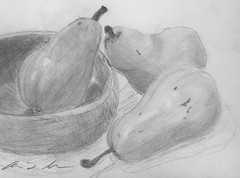
The Bored Inhuman Falls in Love with Pears, Again
One day common people, endowed with common sense, are going to get bored with being inhuman or, rather, with being continually dehumanized by wealth. And they will get rid of it, even if philosophers and producers of the superfluous swear that they are wrong.
- Alberto Moravia
It's strange to me that anyone could ever claim to be bored when there is so much beauty in the world, so many small things with which we might engage, become enchanted and fascinated. Sometimes I rail, secretly and only to myself so as not to hurt anyone's feelings, the lyrics from that Harvey Dangerfield song, "I hear the voices in my head, I swear to god it sounds like they're snoring, but if you're bored than you're boring!" Or perhaps, Ani's melodious, "What makes you so lavish that you can afford to spend every sober moment feeling angry and bored?"
Tonight, I spent an hour contemplating pears. I have a love affair with pears that began last fall when, while sitting under a pear tree, one fell *plop!* right into my lap as I was reading a short story by Ursula K. Le Guin about young love. The juxtaposition inspired a poem, and the poem didn't just articulate a passion for the fruit that I hadn't known, but created an appreciation that I hadn't had, until that moment. Ever since, my brain seems hard-wired to adore pears, their soft green color, their subtle scent, the grainy, juicy texture when I bite into one. I find myself longing to collect paintings and photographs of pears, to delay beside them a little while, running my fingertips along their sides and stems in the produce aisle. Pears are beautiful, simple and strange.
So this is what I suspect: boredom is not a boredom with the world, but with ourselves. We are tired of doing and thinking the same things, of being always the same. But more than this, we are bored with being inhuman. For, indeed, being truly human means we are never really the same from moment to moment, if we engage the present fully and with enthusiasm. The simplest life lived in poverty, humility and attentive experience can offer an endless unfolding of insight and potential even within the repetition of daily tasks. Heidegger calls humanity "the shepherds of being." It is through our attention, our experiences and perceptions, that reality discloses itself, that being itself comes to be known. No manifestation or moment is the same. We view the sycamore from the bottom of the hill, and then we climb that hill and sit beneath it and this, yes, is the same sycamore, but a new experience. Even when we climb back down the hill and look again from where we stood before, our view is enlarged, our experience expanded to include that moment of deeper intimacy that now fades into the absence of memory.
What I mean is that boredom is a failure of attention, as well as of curiosity and imagination, but we are not just its victims. Boredom is not only the mistake of believing the world is pretty much the same as it ever was--and that, given its sameness, systems of wealth accumulation or stimulating entertainment can or should replace a direct engagement with the real--but it is the tragic belief that we are the same, that we do not change in response to our experiences and that, if we do, those changes are incidental, irrelevant and not worth noting or contemplating. Boredom is believing ourselves to be less than human. It is not merely a laziness on our part, but a symptom. We want to be human, we want to be "shepherds of being," to actively participate in the unfolding of the world before the self-conscious inquiring mind. Video games and television, pot and dirty jokes, can only distract us for so long from this deeper need for engagement with the "things" of the world which, through their continuing disclosures, allow us to experience and act like human beings.
What is the way out of boredom? One has to fall in love with the actual, and with the mystery of absence and mere-potential that surround it like swaddling clothes. It might be out of date to compare it to the way a lover never grows bored with the beloved, since all too easily these days romantic relationships fall apart for just that reason. What can I compare it to, then? This fascination with simple experience--touching the neck of a pear, again; watching the shivering sliver of light that splits the tea from the teacup, again; noticing the tall man and his short companion walk by the cafe window, again; licking my lips after eating garlic bread, looking all the way up past the buildings to the dark November clouds, removing the pillows and folding back the bed comforter, again... What beauty and pleasure there is in that word: again, again, again, but never twice the same.
Simplicity satisfies; in fact, sometimes it overwhelms, and luxury and wealth feel heavy with dis-ease, too much to take in or to bear. Nothing is superfluous except that which cannot be experienced and appreciated to the fullest, but when we resign ourselves to the bored inhuman, all the world might as well be superfluous.
What is the way out of boredom? I would start by eating a pear.
Tuesday, November 6, 2007
Dreaming of Beauty & Meaning
This morning I awoke from a dream, the last sentence of which I almost spoke aloud as I opened my eyes, "The difference between what Sarah does with words, which is the epitome of incoherence, and what a poet does with incoherence, which is the evocation of beauty, is the difference between a person who rejects the importance of meaning and one who creates new meanings by confronting the unknown."
Yes, sometimes I talk this way in dreams. Usually only when I've been drinking rum and coke (or in this case, hot spiced cider and rum) the night before. What can I say? If I'm careful, rum is my shiny, bronze, rubber-pencil kind of key to insight. Easy to lose, difficult to use, but every once in a while effective. The trick is keeping the brain amused and the mind awake. (Of course, sometimes my dreaming mind needs no help from rum, and I have dreams like the one about not-corn that led to revelations about creative, loving freedom.)
I know exactly what sparked the dream: two statements I recently read in Sokolowski's Introduction to Phenomenology, put in marvelous juxtaposition.
In the first, during a discussion of the three levels of meaning in language (syntax, coherence and consistency), Sokolowski explores the nature of incoherence, when "there is nothing wrong with the syntax of a proposition, but its contents are wrongly forced together." Following a few examples (my favorite being: "My cat is a filibuster."), Sokolowski says: "All such statements, incidentally, could be given a meaning, if they were to be taken metaphorically, but we are presuming that they are being stated literally. Indeed, the nature of metaphor is to bring together terms from different regions of discourse in order to articulate new aspects in the things we are talking about. A metaphor flaunts its incoherence in order to make a point [emphasis added]."
At the time, this statement put me in mind of the recent conversations I've been having about 'the meaning of "God"' and various attempts to meet this demand for meaning with thorough philosophical analysis. Accusations of incoherence and 'meaninglessness' abound, of course, whenever average people do their best to explain experiences and ideas that reside largely in the realm of metaphor and paradox. If we acknowledge both the responsibility to be intellectually honest and the possibility that paradox can itself be a threshold to meaning, the question that slunk about, unconsciously unresolved, in my mind was, how do we distinguish poetry (especially spiritual poetry) from mere nonsense?
 The second statement that fed my dream-revelation was in Sokolowski's later discussion of the idea of "beauty," which he ties (without justification or explanation, I noticed) to the inherent curiosity of the human mind. He writes, "We are continually astonished to see what a thing is and also what else it can be, what 'other sides' it can offer us." And again, "Everything--a garden or a tree, a piece of jewelry or a favorite walk--has its kalon and is beautiful or admirable after its own fashion."
Now, to insist that everything is beautiful in its own way is, I think, a fundamentally controversial, even (r)evolutionary statement to make. Socrates, in discussing the concept of beauty as caught up in the notion of "the fitting", implies that something can be beautiful without being perceived or known as beautiful, but Sokolowski takes this to the next level, suggesting that it is our very inability to know everything about a given object that actually makes it beautiful. "It generates new appearances, to a dative that will appreciate them, with greater and greater intensity, not with diminishing strength. It is inexhaustible, an endless reservoir of surprising disclosures. [...] Any truth that we achieve is always surrounded by absence and hiddenness, by mystery, since the thing we know is always more than we can know, the reference is always more than the sense."
Here again, I hear echoes of the continuing conversation about 'God'. "It generates new appearances to a dative that will appreciate them;" "the thing we know is always more than we can know"--these sound remarkably similar to the 'cop-outs' of 'believers' in describing 'God' as beyond definition or imagery, as tied up in the personal revelations to and experiences of those willing to believe. Yet they are also simple, practical statements about knowledge, about the startlingly rich nature, not only of some deity in some religious tradition, but of everything in the world, every manifest particular that we, as reasoning and self-aware beings, seek out, experience and perceive.
In my dream, a girl named Sarah spouted off nonsense and people called it poetry. But what is the difference between poetry that uses incoherence as metaphor to push the boundaries of conventional thought and break open new possibilities of meaning, and simple incoherence for the sake of obfuscation and confusion? The people in my dream called Sarah's stuff 'poetry' because it meant nothing--they were under the impression that poetry was synonymous with incoherence and, therefore, meaninglessness. This is a fairly common modern opinion of poetry and its worth to the ordinary reading public, even for plenty of poets themselves who seek to make their work impressive in its obscurity and aural acrobatics. Likewise, plenty of religious people, average 'believers,' show disdain for reason and philosophy, refusing to say what their simply stated creeds 'really mean', clinging to vagueness and incoherence as if these were, in themselves, antidotes to reductionism.
But then, poetry is not merely pretty, confusing words--poetry has to do with the beautiful. If Socrates and Sokolowski are on the right track, the beautiful is an experience that grows out of curiosity, the paradox of knowledge and the infinite ability of the particular to continue to reveal itself in continuously new and interesting ways. To shut down the work of beauty, one need only claim to know everything about a given particular--either that one knows definitively what it is, or that one knows it is most definitely nonsense. Either way, it ceases to hold our attention or to reveal new meanings and truths to us. What makes something poetry, rather than ordinary nonsense, is the trust readers have that the poet intends meaning even if that meaning is not immediately obvious or unfamiliar, and, out of that trust, the reader pursues the work of seeking out and creating that meaning for herself.
The same can be said for the spiritual life. Here again, the purpose of belief is not to shut down the process of meaning-making by declaring to have definitively arrived at all the answers, but to insist that even things that are literally incoherent can still have a metaphorical meaning, that each particular--whether those particulars be physical, material objects or personal emotional or mental experiences--can be related to all other particulars in infinitely new, insightful, meaningful ways. Belief in the Divine is akin to the belief that the world is beautiful and curious precisely because its meaning is inexhaustible, even a bit chaotic. But to communicate this meaning, to talk about what these meanings might be, we have to enter a space of trust. We have to accept that religious 'believers' with whom we might not agree are still sincere in their attempts to describe the meaningfulness of their beliefs, just as we trust that the poet is not merely trying to confuse or impress us but really does have something meaningful to say. On the other hand, we must also do the hard work of seeking meaning for ourselves, and acknowledge honestly when we suspect others of intentional nonsense.
As usual, I have so much more to say on this topic (the title of this post has changed at least a half-dozen times as I've had to scale back my ambitions--the afternoon, and now evening, wears on and for now discussions of the "meaningful particular" and the spiritual use of metaphor, paradox, mystery and attention remain too large and elusive--like pterodactyls. For now, then, perhaps I'll have to be content with the half-subconscious dream-processing. After all, there will always be more to write than there will be time to write it.
Yes, sometimes I talk this way in dreams. Usually only when I've been drinking rum and coke (or in this case, hot spiced cider and rum) the night before. What can I say? If I'm careful, rum is my shiny, bronze, rubber-pencil kind of key to insight. Easy to lose, difficult to use, but every once in a while effective. The trick is keeping the brain amused and the mind awake. (Of course, sometimes my dreaming mind needs no help from rum, and I have dreams like the one about not-corn that led to revelations about creative, loving freedom.)
I know exactly what sparked the dream: two statements I recently read in Sokolowski's Introduction to Phenomenology, put in marvelous juxtaposition.
In the first, during a discussion of the three levels of meaning in language (syntax, coherence and consistency), Sokolowski explores the nature of incoherence, when "there is nothing wrong with the syntax of a proposition, but its contents are wrongly forced together." Following a few examples (my favorite being: "My cat is a filibuster."), Sokolowski says: "All such statements, incidentally, could be given a meaning, if they were to be taken metaphorically, but we are presuming that they are being stated literally. Indeed, the nature of metaphor is to bring together terms from different regions of discourse in order to articulate new aspects in the things we are talking about. A metaphor flaunts its incoherence in order to make a point [emphasis added]."
At the time, this statement put me in mind of the recent conversations I've been having about 'the meaning of "God"' and various attempts to meet this demand for meaning with thorough philosophical analysis. Accusations of incoherence and 'meaninglessness' abound, of course, whenever average people do their best to explain experiences and ideas that reside largely in the realm of metaphor and paradox. If we acknowledge both the responsibility to be intellectually honest and the possibility that paradox can itself be a threshold to meaning, the question that slunk about, unconsciously unresolved, in my mind was, how do we distinguish poetry (especially spiritual poetry) from mere nonsense?
The second statement that fed my dream-revelation was in Sokolowski's later discussion of the idea of "beauty," which he ties (without justification or explanation, I noticed) to the inherent curiosity of the human mind. He writes, "We are continually astonished to see what a thing is and also what else it can be, what 'other sides' it can offer us." And again, "Everything--a garden or a tree, a piece of jewelry or a favorite walk--has its kalon and is beautiful or admirable after its own fashion."Now, to insist that everything is beautiful in its own way is, I think, a fundamentally controversial, even (r)evolutionary statement to make. Socrates, in discussing the concept of beauty as caught up in the notion of "the fitting", implies that something can be beautiful without being perceived or known as beautiful, but Sokolowski takes this to the next level, suggesting that it is our very inability to know everything about a given object that actually makes it beautiful. "It generates new appearances, to a dative that will appreciate them, with greater and greater intensity, not with diminishing strength. It is inexhaustible, an endless reservoir of surprising disclosures. [...] Any truth that we achieve is always surrounded by absence and hiddenness, by mystery, since the thing we know is always more than we can know, the reference is always more than the sense."
Here again, I hear echoes of the continuing conversation about 'God'. "It generates new appearances to a dative that will appreciate them;" "the thing we know is always more than we can know"--these sound remarkably similar to the 'cop-outs' of 'believers' in describing 'God' as beyond definition or imagery, as tied up in the personal revelations to and experiences of those willing to believe. Yet they are also simple, practical statements about knowledge, about the startlingly rich nature, not only of some deity in some religious tradition, but of everything in the world, every manifest particular that we, as reasoning and self-aware beings, seek out, experience and perceive.
In my dream, a girl named Sarah spouted off nonsense and people called it poetry. But what is the difference between poetry that uses incoherence as metaphor to push the boundaries of conventional thought and break open new possibilities of meaning, and simple incoherence for the sake of obfuscation and confusion? The people in my dream called Sarah's stuff 'poetry' because it meant nothing--they were under the impression that poetry was synonymous with incoherence and, therefore, meaninglessness. This is a fairly common modern opinion of poetry and its worth to the ordinary reading public, even for plenty of poets themselves who seek to make their work impressive in its obscurity and aural acrobatics. Likewise, plenty of religious people, average 'believers,' show disdain for reason and philosophy, refusing to say what their simply stated creeds 'really mean', clinging to vagueness and incoherence as if these were, in themselves, antidotes to reductionism.
But then, poetry is not merely pretty, confusing words--poetry has to do with the beautiful. If Socrates and Sokolowski are on the right track, the beautiful is an experience that grows out of curiosity, the paradox of knowledge and the infinite ability of the particular to continue to reveal itself in continuously new and interesting ways. To shut down the work of beauty, one need only claim to know everything about a given particular--either that one knows definitively what it is, or that one knows it is most definitely nonsense. Either way, it ceases to hold our attention or to reveal new meanings and truths to us. What makes something poetry, rather than ordinary nonsense, is the trust readers have that the poet intends meaning even if that meaning is not immediately obvious or unfamiliar, and, out of that trust, the reader pursues the work of seeking out and creating that meaning for herself.
The same can be said for the spiritual life. Here again, the purpose of belief is not to shut down the process of meaning-making by declaring to have definitively arrived at all the answers, but to insist that even things that are literally incoherent can still have a metaphorical meaning, that each particular--whether those particulars be physical, material objects or personal emotional or mental experiences--can be related to all other particulars in infinitely new, insightful, meaningful ways. Belief in the Divine is akin to the belief that the world is beautiful and curious precisely because its meaning is inexhaustible, even a bit chaotic. But to communicate this meaning, to talk about what these meanings might be, we have to enter a space of trust. We have to accept that religious 'believers' with whom we might not agree are still sincere in their attempts to describe the meaningfulness of their beliefs, just as we trust that the poet is not merely trying to confuse or impress us but really does have something meaningful to say. On the other hand, we must also do the hard work of seeking meaning for ourselves, and acknowledge honestly when we suspect others of intentional nonsense.
As usual, I have so much more to say on this topic (the title of this post has changed at least a half-dozen times as I've had to scale back my ambitions--the afternoon, and now evening, wears on and for now discussions of the "meaningful particular" and the spiritual use of metaphor, paradox, mystery and attention remain too large and elusive--like pterodactyls. For now, then, perhaps I'll have to be content with the half-subconscious dream-processing. After all, there will always be more to write than there will be time to write it.
Thursday, November 1, 2007
Cheating Samhain.
I've been too drained and distracted to come up with the appropriate Halloween/Samhain post, which seems obligatory among the Pagan community these days. My solution? Cheat a bit.
And so I present to you, dear readers, a belated Halloween message from one of my favorite bands, Tool, which I've happily gone through, bit by bit, citing (almost) all their obscure references. Think of this as the twisted-mystic version of Billy Joel's "We Didn't Start the Fire." Have fun. (Check out my particular favorite, the story about the Elizabeth Templeton photograph.)
And so I present to you, dear readers, a belated Halloween message from one of my favorite bands, Tool, which I've happily gone through, bit by bit, citing (almost) all their obscure references. Think of this as the twisted-mystic version of Billy Joel's "We Didn't Start the Fire." Have fun. (Check out my particular favorite, the story about the Elizabeth Templeton photograph.)
HAPPY HALLOWEEN/SAMHAIN
(TOOL NEWSLETTER
OCTOBER 2007 E.V.)
Despite the fact that Mercury's still retrograde (?), I just can't get into Halloween/Samhain this year. Even so, I feel obligated to offer something (Tool) newsworthy to those out on this fantastic night. Endure then my ramblings, lest one finds a nugget of Chocopologie by Knipschildt amongst the Brach's candy corn in this brown paper sack. Under the spell of the L.A. Vast Active Living Intelligence System (yes, V. A. L. I. S.), I'm fairly certain that the entity known as "Merch" will have some goodies for you in the coming black months, but exactly what these are, is difficult to discern, as there are currently toads breeding in the stagnant water of the psychomantium. Alas, but no bats flitting in the gloaming. No fragrances of autumn. No bewildered grey spirits shuffling about. Knowing well of the Binary Soul Doctrine, I am unable to exhume even my own dead past-life self (therefore, no baptism for the dead!). Even the Mass of Saint Secaire went unanswered (Raiders [?]). Desperate to get into the spirit of things, I astral projected into the Spaghetti Warehouse in downtown Houston, but there were no ghosts knocking over salt & pepper shakers, not even Anna Nicole Smith looking for... Perhaps I should try the hallway of the 3rd floor of the Driskell in Austin, where a painting of a little girl holding flowers seems to freak out so many visitors (curiously, a reflex of sorts of Elizabeth Templeton in the Solway Firth/Burgh Marsh photo from the 1960s). Be careful not to stare at this for too long, or else the MIW (or MIBs, as was the case with the Templeton photo) will take you away. If not the Driskell, then Le Pavilion Hotel in NOLA might do. Where are the grimacing masks and pumpkin ales I was hoping for? I've not even any pear schnapps to make a Brain Hemorrhage! The dancing flame on my Hand of Glory has guttered out, and all the Dr. Phil/Mr. Potato Head masks were sold out at Target. Kenneth Grant's "Outside the Circles of Time" has been delayed, and there are no VHS copies of Fredrick Skellig's "The Devil's Lantern" to be found at Amoeba Records. The 24 windows of my trapezohedron are clouded (so all those blackbirds baked into a pie can't begin to sing), and my copy of Wendy Carlos "Tales of Heaven and Hell" is scratched. What god did I offend? Hell, even David Copafeel's sleigh-of-hand isn't working too well (and O.J. appears to be mellowing with age). And what's this - Dumbledore's gay? Even the girl that went missing in Aruba knows that. Oh, but the "trick or treat" that I mentioned earlier: Well, if not Chocopologie by Knipschildt, then how about Delafee (for those who'd rather eat 24-karat gold instead of carnauba wax). Come to think of it, it might be best just to mix up a pitcher of orange Kool-Aid (electric or not), and watch MST3000's witty critique of "Hobgoblins." That or read a copy of "Darklore Vol. 1"... if it arrives today from amazon.com (fingers are crossed)... Got to get those toads out of my psychomantium!
Subscribe to:
Posts (Atom)