Thursday, October 25, 2007

Whirling

Yesterday's personal journal entry about "The Whirling Dervishes of Rumi" performance at Carnegie Music Hall in Pittsburgh on Tuesday, October 23, 2007:

Today I was sad, so I worked really hard.

The performance was amazing, but it wasn't enjoyable exactly, nor was it entertaining. I'd had my doubts, initially, that I could sustain my attention for very long on just a bunch of men spinning and spinning around in wide white skirts. Oddly enough, my experience of the performance--which began with a very interesting lecture on Rumi's life, followed by half an hour of music and recitations from the Qur'an, and concluded, after an intermission, with an hour-long Sufi religious ceremony, the Sema--had an effect exactly opposite what I expected. Rather than feeling fidgety and distracted by the monotony of rhythmic whirling, I found myself stilled almost beyond comprehension. Although I had been sniffling and coughing all day, I found my breathing steady and slight; my body seemed to solidify around me. I'd wanted to feel moved, but instead I felt unnaturally deadened. The tombstone-like caps of the dervishes, and the stilled silence of the guide who wandered, draped in black, in and out of the whirling white-clad dancers--these things seemed to penetrate me in the same way matter penetrates a stone, but rain doesn't.

As the evening progressed, dullness transformed into appropriate emptiness, as if it had a lightness of being that, of course, was attractive and lovable. I, on the other hand, felt increasingly heavy with being, weighed down. The few times I felt engaged in conversation--discussing with friends the 'meaning of "God"'--began to seem obscene in their gravity. There was nothing to me, really, so I had to fill myself up with other things, more important things. Here were girls loved just for being girls, and I'm no good to anyone unless I'm talking about something interesting.

I realized then that, as much as I've loved others, I've always wanted something that they didn't. I think most want relationships that float lightly on the surface of other things, whereas I've always wanted relationships that were full to bursting of those things. I don't want to be buoyed up by love, I want to swim in it. Swimming, to someone trying to breathe, might as well be drowning. So of course: here were people light and well-framed, who can hold things outside of themselves. I don't have a frame. I'm nothing at all except a center of gravity. How can you go about loving a center of gravity?

The men on the stage just kept turning and turning around the stationary toes of their left feet, their hands and arms frozen, their eyes always on their thumbs, and for all their whirling, they barely moved. Once in a while, when they stopped to bow with their arms folded across their chest, signifying One, I saw one of them or another scratch a nose or wipe a brow. But when they whirled, they barely moved at all.

Every year. This is going to happen every year. Will there ever be an October that doesn't find me in tears again? The ceremony ended--someone began to clap prematurely and the hushers jumped in to hush her, and I couldn't dislike either of them for it--and the whirling, which had exposed me in my stillness like death, ended. I didn't feel like applauding, I wasn't moved to applaud, I wasn't moved. I was stilled, I had been killed by stillness. All I wanted to do was go home. But that was impossible. Home is not home. What I have is a place where I can be still.

So I went there. And I was very sad, and the sadness didn't matter. The sadness, like thought and desire, was just so much motionless movement.

Today, I woke up and it was still raining and I was still sad. I wish I could have remained there, within the nothingness--maybe this is one of those times when "the only way out is through." But I was sad, and I had things to think about and to write about, so I did. Just more whirling. It accomplishes nothing except that it is the only thing I know how to do. If I knew how to dissolve, maybe I would do that. But I don't. All I know how to do is to keep being, with all my strength, throwing all my weight into being until I sink into the ground and weeds grow up from out of me and maybe some of those weeds cast white fluffs of seedpods into the wind where someone might catch a glimpse and make a wish.


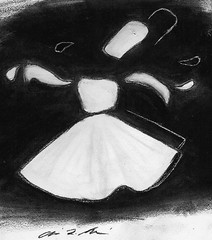
The Semazen

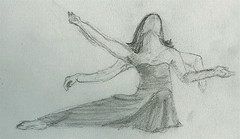
The Semazens


The white, whirling, does not. The dance is a dance of stillness, the arms in the same pose, the hands--one open to catch what falls, one bent as if to receive the kiss of the lover finally arrived in good time--unmoving, inexpressive, the feet the only things that turn, little pieces of machinery rotating on a bolt through the left foot's sole, obscured by the unchanging ripples of the skirt's folds. All this turning, movement beneath the cold stone of the tomb. White absorbs nothing into it. Light moves like a black-draped guide among the dancers, saying nothing. They move to his movement, change position, but never look his way. I am that witness. They lay themselves open to the dance, perfectly empty like prayer. I, too, am laid bare, but there is nothing left. The dancers turn--if they were to let go of anything, it would spin away, but they have already relinquished even muscle, intention. They loose the world, and the world does not return. I am slain by stillness, watching them. I cannot move. Everything is emptied. When Love enters, it is too late.


Regular readers might be interested in contrasting this post, "Whirling," to a previous post, "Turning."
Wednesday, October 24, 2007

The Purpose and Process of Belief

In my recent post about intellectual honesty in the quest for a 'meaning of "God,"' I explored the preconditions for any such discussion as the ability to accept personal experiences as relevant disclosures of truth, and from this condition, the acknowledgment that, therefore, any attempted discussion will be necessarily complex, even messy and confusing. The post provoked some very interesting responses from readers, and as the discussion continued, my own thoughts in response to Carroll's initial question "What does 'God' mean to the 'sophisticated believer'?" have continued to coalesce and clarify.

In particular, a beautifully phrased response by 'Sinthetic Aesthetic,' put me on, once again, to the metaphor of the 'work of art' in discussing the spiritual experience of 'God'. He writes:

To search for truth, though, one need only learn to develop ideas on their own with as little influence from tradition as possible. In my opinion this will eventually allow someone to be able to even approach the question “How do you define ‘God’?” For this question has no actual answer that can be given in terms of language, so to ask it in that form, to actually ask of it that it be defined so is, as Ali mentions, the wrong question to be asking. It would be as if I were to ask you what a musical piece says when there are no words to describe things. Perhaps the song is beyond words and can only be expressed by experience of the song itself. To try and explain them directly in terms of a few sentences would then destroy that which the song itself intends to create in the person. So it is with the “Divine.”


I completely agree that, as with a song, poem or any other work of art, the attempt to reduce an explanation of the Divine into a few prosaic, precise sentences will always fall short of its goal. I have often heard writers, myself included, say that, if they could have said everything they'd meant in prose, they wouldn't have bothered writing the poem. The fact of it being a poem is an essential part of the work's meaning. Likewise, I think, the experiential quality of the Divine is an essential part of the meaning of 'God', and the function of aesthetic 'framing' in the creation of a work of art is a useful metaphor for the process and purpose of 'belief' in the spiritual life.

'Belief' as Beginning: A New Way of Attending

Indeed, I think it is a mistake to talk about 'belief in God' as if belief were the goal of the spiritual life, the end result of religiousness. Rather, belief in the possibility of the existence of 'God' is really the belief that the human beings have the real potential for spiritual experience, that such experiences are not illusions or bio-psychological misunderstandings to be explained away. This belief is the beginning of the spiritual life, which makes the experiential relationship with the Divine possible. Belief is the frame--the edge of the canvas--which presents a particular idea or image as distinct from the casual, familiar everyday. It calls our attention to the 'work of art' and says, "This. Pay attention to this. This is special. This is set-apart, consecrated, made sacred." Here, within a framework of belief, the ordinary is made holy, the particular elevated to become a bridge to the universal. Religious belief says: in this man or deity, the image of humanity is made godly, whether in creation or in sacrifice; in this garden, the fecundity of nature is made paradisiacal, then painful and obscene; in this fall, the imperfections and limitations of living beings are made mythic and essential.

The most simplistic of 'believers' begin here, attending to just these stories and images. Through these particular beliefs, they allow for the possibility of spiritual experience of the 'mundane,' material, present world.

Breaking Down 'Belief': The Dark Night

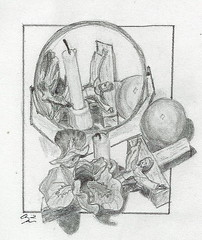
But the mystics and seers, those who have begun the journey into experiential relationship with the Divine that belief initially makes possible, eventually abandon the framework of belief. The spiritual growth of the journey towards 'God' demands it, for in the end any name, word, image or idea falls short of the whole. For some, this step away from belief is painful; it presents itself as a crisis of faith, the long dark night of the soul. The mystic Sufi poet, Rumi, writes, "You cannot know your self and God’s Self; either die before God, or God will die before you, so that duality will not remain." In The Gay Science, Nietzsche writes, "God is dead. And we have killed him. How shall we comfort ourselves, the murderers of all murderers?" The straw-man belief in a simplistic, anthropomorphic 'God' cannot withstand the reasoning mind; but more than this, neither can it withstand the honest search for experience of the spiritual.Reflection: Crucifix, Candle, Iris & Globe

Even for an atheist or a materialist, the inadequacy of a simple belief in 'God' to satisfy the spiritual and intellectual needs of the self-aware creature can be cause for anger, and even grief. This secret anger, I think, is behind demands such as Carroll's for 'believers' to explain themselves, to justify their seemingly easy faith. These educated thinkers and scientists must certainly have noticed all manner of ignorance rampant in the world, and yet it is this supposed religious ignorance that galls them, that provokes attack. C.S. Lewis said of his atheistic youth that he lived "in a whirl of contradictions. I maintained that God did not exist. I was also very angry with God for not existing. I was equally angry with him for creating a world. Why should creatures have the burden of existence forced on them without their consent?" It is this contradiction--that self-aware creatures seem to possess an inherent need for a 'meaningful' existence, and yet mere belief in meaning, mere belief in a 'God' which might bestow meaning, quickly ceases to satisfy--that incites the loss of faith, the loss of that simplistic belief.

Beyond 'Belief': The Persistence of Spiritual Experience

But that same self-awareness, the sense of longing and dissatisfaction itself, can also become the vehicle by which the mystic, the spiritual seeker, emerges from this dark night. One begins to realize that spiritual experiences--experiences of loss, longing and grief regarding the meaningful nonmaterial--persist even in the face of lost faith, even when we no longer have confidence in or use for the words and images we once used to describe and provoke such experiences. The mystic has abandoned 'belief,' and yet the life of the spirit continues. The frame has broken, and the workings of art spill over, off the canvas and into everything, everywhere. The line between observer and observed is erased. The Divine is no longer something 'out there' to be carefully packed away into definitions of 'belief' and carried around like a small worry-stone in the pocket of the faithful.

To the mystic, all things are consecrated, everything is holy--divinity no longer means duality, separating out the sacred from the profane; it means union, the encompassing of all creation and creativity, all potential and activity, within the Divine. To speak of 'God' as the 'ground of being' and the 'ultimate reality' is to speak of spirituality beyond the framework of belief itself. Rumi, who knows that the risk of self-conscious belief is the death of 'God', continues, "But as for God’s dying, that is both impossible and inconceivable, for God is the Living, the Immortal. So gracious is He that if it were at all possible He would die for your sake. Since that is not possible, then you must die so that God can reveal Itself to you." For we are not merely aware of the self, we believe in it. We see others and ourselves as defined creatures, defined by bodies and ideas, emotions and memories--we see "the burden of existence" as something thrust upon us, as if we were something else besides, and our first, simplistic 'belief in God' is our clumsy attempt at absolving us of the burden. This belief, too, must be broken open, so that the Divine that is existence, including our own, might be made manifest and experienced fully.

'Belief' and Non-belief: The Difference

Perhaps, then, the most honest response to the question posed by Carroll and others like him is that there is no difference between a universe full of 'God' and a universe empty of it. Though Buddhists conceive of 'enlightenment' as an escape from samsara, the cycle of life, death and rebirth in the world, the Buddha is recorded as saying that, upon reaching nirvana, the enlightened one recognizes it not only as the here-now, fully present within this world, but as having always been present, even within the suffering of samsara. This paradox is akin to the paradox of 'sophisticated belief' for which Carroll demands explanation. For in the end, any description of complex spiritual life that extends beyond the straw-man belief is not simply a new and better definition of 'belief', but a description of spiritual process itself. When we talk about 'the meaning of God,' what we are really talking about is the relationship between ourselves, as self-aware, creative beings, and the world, as both the work of art we create with our awareness, and the work of art of anOther, in which the Other is manifest and made present and which inspires in us new ways of being.

The difference between the mystic's perspective and the materialist's perspective is the difference between object qua work of art, and object qua incidental machine--but this is not a description of the external reality. It is a description of our attitude towards reality. The world itself simply is as it is. It is not belief in 'God' that makes a difference to the world, but the world that makes a difference to us. The 'belief' of a complex understanding of the Divine is, more accurately, a suspension of disbelief and cynicism, a release of conviction that the universe "has to be" only one thing or another. The same kind of suspension allows the experience of beauty to move a man to tears; allows the fretting and strutting of actors upon the stage to coalesce into meaningful drama, while still being only the movements of actors; allows, in short, the work of art to become the work of art, to reveal itself as such in response to the perception and experience of the self-aware viewer.

A New Purpose for 'Belief': Story-Telling as Sacred Activity

Yet to say that 'belief in God' is, in some ways, irrelevant to the spiritual experience is not to reduce all mystics to atheists and, by some strange extension, materialists. Firstly, not all atheists are materialists (Buddhists, here, being a case in point). Secondly, after all atheism is, like 'God' itself, "just another story that we tell." It is in choosing those stories that we actively participate in the nature of our spiritual experiences.

What is the purpose of 'belief' to the religious mystic? As an artist might consciously choose the composition of the still life, the light and shadows of the portrait, so the mystic recognizes the particulars of 'belief' as functional, ways in which this truth of the Divine is highlighted, or that experience of 'God' is inspired and invoked. The artist sees the world and says, "I will show this to others, and even though it is in some ways only a copy, it will also become something in itself, something else within the world to which I am a witness." The mystic sees the world and says, "I will show this to others, I will teach them to see the Divine within the very world itself, but I must begin somewhere, so I will begin here, with this metaphor, with this story, with this belief. I will give others a taste of what it means to feel 'God' and only trust that they will take up the search on their own from there."

For some, the defining experience of the spiritual life is that of loss and longing, the dark night, and so these atheistic mystics turn to stories, images and ideas that break open and destroy the 'belief in God,' in order to instigate a greater awareness and engagement with the present world. This is the insight offered by Nietzsche when he declares that "God is dead," for he continues (in the Prologue of Thus Spoke Zarathustra):

What is great in man is that he is a bridge and not an end: what can be loved in man is that he is an overture and a going under. [...] I love him who does not hold back one drop of spirit for himself, but wants to be entirely the spirit of his virtue: thus he strides over the bridge of spirit. I love him who makes his virtue his addiction and his catastrophe: for his virtue's sake he wants to live on and to live no longer. [...] I love him whose soul is deep, even in being wounded, and who can perish of a small experience: thus he goes gladly over the bridge. I love him whose soul is overfull so that he forgets himself, and all things are in him: thus all things spell his going under. I love him who has a free spirit and a free heart: thus his head is only the entrails of his heart, but his heart drives him to go under.


Yet for others, the dark night is flimsy inspiration compared to the glory and joy of the experiential union with--and the creative love of--the Divine. And so we have Rumi, who writes:

Look how desire has changed in you,
how light and colorless it is,

with the world growing new marvels
because of your changing. Your soul

has become an invisible bee. We
don't see it working, but there's

the full honeycomb!


And Mechtild of Magdeburg sings:

Effortlessly,
Love flows from God into man,
Like a bird
Who rivers the air
Without moving her wings.
Thus we move in His world,
One in body and soul,
Though outwardly separate in form.
As the Source strikes the note,
Humanity sings--
The Holy Spirit is our harpist,
And all strings
Which are touched in Love
Must sound.


'Belief' & Art: Th Full Circle

It is no wonder that the mystics, whatever the religious tradition, seem to inevitably resort to the language of poetry, expressing the 'meaning' of the Divine not in prosaic logic, but with the artistic techniques of metaphor, striking imagery and musicality. Here again we see how the aesthetic experience can be a model for and evocation of the spiritual experience, and the creation of a work of art--whether poetry, music, dance, sculpture, drama, etc.--is akin to the spiritual experience of participating in union with the Divine in the becoming of the world, and the becoming of oneself and of 'God' in the world.

Now, dear reader, you might find that we have come full circle again. But before anyone begins throwing despaired accusations of vacuous 'circular logic,' perhaps we would do well to remember that in cultures all across the world, the circle has always been a symbol of the completed, the Whole, the One, the perfected.

Tuesday, October 23, 2007

Poem: Always in Autumn

Always in Autumn

I.
A man sells his small windows and his door,
set in the walls of the small house where he lives;
he sells his oils and bags of grain, his horse
and his dog and his plow, his unborn daughter's
dowry and his only winter cloak; he sells his field and
the low, gnarled olive tree on the hill. The last memory
of the place he leaves is his body illuminated
and dark and illuminated and dark as he walks
past each small window, broken by morning.

II.
A man buries a pearl in a field because its worth
is greater even than his life, and a thief would know it.
He buries the pearl and buys the field.
He builds a small house with small windows and a door.
The winter is long, and frost obscures the grave.
He buys a plow and a dog. He has a wife, and then a child.
Each spring, he works the earth, he sows a bag or two of grain.
At the end of every summer, he walks along the rows of wheat,
and waits for some accident
of autumn harvest to push up the pearl again.

III.
In autumn, I make the right decision,
I steal back the ring
and throw it into the river. The days are
illuminated and dark and illuminated and dark,
and the winter comes on, though the river will not freeze.
My grief, like the river, moves and moves despite the cold.

Monday, October 22, 2007

The God Question & Intellectual Honesty

The post "Please Tell Me What 'God' Means," at Cosmic Variance (a blog run by a group of physicists and astrophysicists), was fascinating for me to read and has sparked a great deal of personal journaling over the past few days. Not surprising, considering that the journey towards insight into the Divine is, in the end, one that takes lifetimes--a journey past the veils, a process by which we slowly prepare ourselves to perceive spiritual truths as they manifest and disclose themselves to our ever-seeking and reasoning self-awareness.

Yet, Sean Carroll's challenge is a fair one:

The trouble is not that such sophisticated formulations make our eyes glaze over; the trouble is that they don’t mean anything. And I will tell you precisely what I mean by that. Consider two possible views of reality. One view, “atheism,” is completely materialistic -- it describes reality as just a bunch of stuff obeying some equations, for as long as the universe exists, and that’s absolutely all there is. In the other view, God exists. What I would like to know is: what is the difference? What is the meaningful, operational, this-is-why-I-should-care difference between being a sophisticated believer and just being an atheist?

What does it mean, really, to say that "God is ultimate reality," that "God is the ground of our being" or, my personal mantra, that "God is (the freely-willed, creative activity of) love"? As seekers along a spiritual path--whatever our religion or spirituality, or lack thereof, might be--we have an obligation to consider this question, and to try at least to articulate a firm ground on which to begin a 'good-faith' discussion of opposing arguments. When Carroll asks for an intellectually honest, "sophisticated" and non-vacuous attempt to describe 'God' (or, I assume, any conception of deity or deities), we owe it not only to him, but to ourselves to give the best answer we can. If only because, with the work to continually articulate and clarify, we may stumble upon new ideas and new metaphors that carry us along in our own journeys.

On the other hand, sometimes it can be frustrating trying to convince a strict materialist that the idea of a spiritual reality actually matters, that a "ground of being" transcendent of the purely material really does "mean something" more than mere rhetorical poetry. It helps, in this case, to seek first for insight into the various assumptions on which the materialist-rationalist philosophy functions. So this is where my response to Carroll's challenge begins, with a passage in Sokolowski's Introduction to Phenomenology that I stumbled upon just today.

In this passage, Sokolowski is discussing the idea of "evidencing," our activity as reasoning beings to allow the truth of things to disclose themselves to us. As he writes, "This activity is our achievement as transcendental egos, not simply our behavior as animals or our reaction as bodies embedded in a network of material causes. [...] We do something when intelligible objects present themselves to us; we are not mere recipients." Obviously, for strict materialists, the idea of anything being 'transcendent' of material causes is suspect, although it is important to note that here is a philosophy which appeals to such a concept without any need to resort to a straw-man conception of deity (or any deity at all) and yet remains non-vacuous. Perhaps in the search for a 'definition of "God,"' it would be easiest to explain to a materialist/atheist (noting that materialism and atheism are not synonymous) starting from this philosophical ground and working towards the spiritual, rather than trying to begin by debunking the straw-man theory and undertaking the difficult task of qualifying and 'waffling' from there. But I digress. Sokolowski proceeds to discuss two common ways of "trying to escape evidence." The following quote is part of his discussion of the second:

The second way of trying to evade evidence is to claim that the presentation itself is not enough to establish truth. We might think that a presentation gives us only an appearance or an opinion. We would then have to go on to prove the truth of what has been presented, and we would do so by giving reasons for it. We have to explain it; that is, we have to derive it from other, more certain premises, even from axioms, to show why it has to be the way it is. In this view, we do not know anything until we have proved it; we demand a proof for everything. [...]

This claim reflects the belief [my emphasis] that truth is reached by means of methodic procedures. Nothing is directly presented to us, but we can reach truths by reasoning to them. Descartes appealed to such method at the beginning of modernity, and he thought that method could replace insight. Even perception requires proof, he thought, because it involves an inference from the ideas we have to the putative causes 'outside' us that must have brought the ideas about. This confidence in method is part of the rationalism of modernity. [...] Such trust in method and proof is an attempt to master truth. It is an attempt to get disclosure under control and to subject it to our wills. If we can get the right method in place, and if our methodical procedures can be helped by computers, we will be able to solve many important problems. We will get a hammerlock on the truth of things, coercing consent in ourselves and in others.

[...] The rationalist may find the contingency of evidence unsettling and may reject the fact that we cannot master truth, but such is indeed the case.

This may be the heart of why Carroll, and others of his philosophical convictions, find any view of God more complicated than the straw-man approach to be vacuous and nonsensical. If a person's underlying assumption is that spiritual reality, like the material reality according to Cartesian duality, lies 'out there,' outside of the mind--then appeals to the "evidencing" of the Divine, the disclosure of spiritual truths as well as logical and material truths to a reasoning being, may seem impossible. No! one might insist, Of course if there were a God, we should be able to "prove" it, to arrive methodically at a complete and satisfying definition based on previously established premises... The down side of the conviction that truth can be mastered by method is that anything too slippery and fluid for method is utterly beyond one's grasp--not merely beyond the ability to understand, but even to conceive as being possible.

However, we might instead keep two things in mind as we consider the question of how to talk about God with intellectual honesty and rigor.

(a) Descartes dualism is founded in the notorious cogito ergo sum, "I think, therefore I am." But this is the mind affirming its own existence. If it is reasonable to believe the mind exists because we, as self-aware creatures, experience the activity of the mind (i.e. thinking), then is it not also possible that we can know of the existence of a spiritual reality because we experience the activity of this spirit within ourselves? Just as Descartes ran up against the thinking 'I' as an ultimate end to categorical doubt, so to do 'believers' of all spiritual ilks find that they cannot escape this basic truth as it discloses itself: there is a spiritual 'world,' and it is this very world. This is what it means to say, non-vacuously, that "God [or the Divine, or Gaia, or the Universe, or whatever] is the ground of being," and for some it holds even when the transcendental ego, the 'thinking I,' dissolves in the ocean of pure existence.

(b) Whatever the conception one has of the spiritual world, it is inevitably one that is not just 'out there.' It penetrates us, it saturates and overflows the individual herself, it is intimate as well as public--and, like each of us, it is never simple, nor easily defined and mastered. How could we define any person who has not completed the on-going process of living? And yet, what good is it to worry about mastering the truth of the dead? This is the paradox of the fluid, living truth of things. At this point we return, once again, to my obsession with attention--attending to the reality of things, to the way in which the world manifests itself, and to the process by which we prepare ourselves to receive and perceive this disclosure.

Intellectual honesty must involve careful observation and attention to our own inner lives as well as to the world around us, and a certain fundamental respect for the capacity for attention, experience and perception to discover truth. This is what I suspect Richard Skinner meant when, much to Carroll's frustration, he wrote that we must be careful "to sit light to definitions, hypotheses and images, and allow God to be God" [my emphasis]. This is not a scheme to escape honest discussion; it is a simple nod to the complex, subtle and often elusive processes by which truth is disclosed. When a scientist tests a hypothesis by performing an experiment, does he rig the experiment to confirm the results he desires? No, he allows the world to be the world, to act and respond according to its own truths, and he carefully observes this activity and tries to talk about it accurately and honestly, without presuming more than what he has truly witnessed or claiming to have once and for all defined the entire system in one fell swoop. What Skinner is saying is that the same must apply to our engagement in the spiritual life. We cannot seek easy answers, even if we feel bombarded by demands that we 'prove' the validity of our experiences and the relevance of our insight.

We must allow the Divine to be Divine. If we are looking for a reason why God "has to be the way it is," we will be disappointed. The glory and joy of the Divine world is that it doesn't have to be the way it is, that it holds paradox within it. Can we accept that, even if things don't have to be true, that doesn't mean they aren't? This is where we might have a place to start.

Update:

Now that I am a little more awake and refreshed than I was when writing this post last night, I would like to step back and explain. No, there is no time, let me sum up. Carroll's question was, in short, how does a world in which there is a (sophisticated conception of) God differ from a purely materialist world?

The beginning of my answer is that, in a world in which the "nonmaterial" has a non-vacuous, possible reality, the self-aware being has the potential to directly experience the disclosure of the truth of the existence of "God" in the same way it has the potential to experience the disclosure of, say, a funny-shaped rock which comes into view as that self-aware being rounds the bend of a wooded path. That is, if there is a "Divine," it can actually be experienced; one's "sense of the spiritual" is taken seriously as a possible perception to be explored further. In the materialist worldview, any "sense" of the nonmaterial is reduced to a fluke of body chemistry or other physical cause, and so it is dismissed as incapable of disclosing actual truth about the world. I feel like a cheater saying this, since I did not even have to think of it: it is presented clearly in the continuing reply and response in the comment thread to Carroll's post. To every nuanced philosophy of the nonmaterial, Carroll replies that it all amounts to the same (or perhaps, reduces to the same). In short, it does not matter because it is not matter. Differences in philosophical perspective and personal experience are dismissed as vacuous and non-meaningful in any "operational" sense, presumably because when the world is run by equations, our experience of those equations is irrelevant.

Sum 1: The difference between a strictly materialist view, and a non-vacuous view of the world as also nonmaterial, is that in the former, philosophy, perspective and experience are irrelevant, and in the latter, they are themselves potential vehicles of truth.

This summation is dedicated to Mr. Rude Anonymous, who I have no doubt remains unconvinced. It is accompanied with a reminder that this post's theme was largely about intellectual honesty, and whether or not being honest with ourselves includes acknowledging the validity of personal experience, perspective and philosophy.

Sunday, October 21, 2007

Stephen Colbert for President

(Courage + Hope = A Rare Political Post)

Make no mistake, I don't expect him to win, and I have my qualms about Colbert's television persona insofar as I worry sometimes that fans lose sight of the subtle satire of his comedy in their mob-like enthusiasm... BUT.

I still feel more whole-heartedly invested in Stephen Colbert's 2008 presidential campaign than I do in that of any other actual candidate. Simply the idea of Colbert running for office fills me with a strange, tense feeling. At first, I wasn't sure what this feeling was. Then it began to dawn on me: maybe it's hope. It has been so long since something happened in the world of politics that didn't seem painfully predictable and tragically disappointing. It seems at every opporunity, the true and simple goodness of the average human being falters under the weight of corporate interest, religious zealotry, and hate-mongering. The war drags on, bigotry and greed play tetherball on the D.C. green, and, as Ani put it, "the Democrans and the Republicrats are flashing their toothy smiles."

But now, here is something new. For once, I have no idea what will happen, I have no idea what Colbert will say or do next. But I am not afraid. There is, instead, this odd warmth in my heart that he will at least do some good along the way. Which is more than I could hope for anyone with a prayer of actually winning the race (or should we call it a clusterf**k?) to the White House, anyone who would inherit the morally and literally bankrupt system already thriving under the noses and behind the blinders of American citizenry.

So that's what it comes down to: hope. For so long I have been trying to survive on, and face the future with, courage alone. Pushing forward on every front because, in the end, I have no real choice. I must work to "be the change I wish to see in the world," or compromise and lose myself to the undertow of cynicism and fatigue. But to have hope! What a luxury, what a respite. I had almost forgotten what hope felt like. I'd almost forgotten what it was like to wonder.... what new good thing might happen tomorrow.


(And yes, I would've preferred a Stewart/Colbert '08 campaign... but the day is still young, my friends.)

Monday, October 15, 2007

Integrity, Nonaction & Living Green

(Part of the Blog Action Day initiative.)

Through nonaction
No action is left undone.

It may seem strange, writing about "nonaction" on a day when bloggers worldwide are dedicating their posts to environmental action and awareness. On the Blog Action Day website, however, they offer this advice: "What works best is to keep writing as you normally would. Your audience reads your blog for a reason, you don't need to suddenly change your voice, style or emphasis. Simply find an angle on your regular postings which relates to the environment."

As you know, dear readers, this blog is devoted mostly to spiritual and philosophical explorations, often with a poetic flare and, every once in a while, with politics sneaking in just under the radar. It would be easy to write about the Druidic respect for and adoration of nature, about the sacredness of Mom Earth and the responsibility we each have, as her children, to care for and appreciate her; or perhaps to discuss the political nuances of the environmental and conservation "green" movements, the mythos of endless resources and a modern culture obsessed with consumerism... But then, I never do take the easy way in this little blog, do I?

Dryad, Posed FigureAs I sat last night considering what I wanted most to say about the environment, and how to relate it back to my spiritual life, I began to ask myself what truly effective, daily action would look like. What does it mean to "live green," not only with the products and services one buys and the political groups one supports, but within the depths of one's being? As I pondered this question, a paper I had written years ago came to mind--an essay on the nature of "integrity" from the Taoist perspective on nonaction.

Integrity, Two Perspectives

For many Western minds, the word "integrity" evokes an idea of respectability, self-determination and stability; someone cool, calm and in control, unaffected by petty problems and well above slander and defamation. Such a conception stems originally from the word’s etymological roots in Latin, which mean “entire” or “whole.” The common Western view seems to suggest that a person with integrity--that is, a “whole” human being--is upright and incorruptible, one who faces the world already complete and is, thus, reliable and consistent. In short, integrity means having an unchanging character despite a challenging, changing and potentially harmful world.

Quite at odds with this understanding of integrity is that which is discovered in Victor H. Mair’s translation of the Chuang Tzu (Wandering on the Way, from which all the following quotes are taken). The very use of the word "integrity" in this context might seem counterintuitive when one considers the emphasis the text continually places on personal evolution, ever-changing transformation and the ineffable existence of the sage with(in) the Way. Certainly, the Taoist conception of what Mair translates as "integrity" is far from the Western view of being a complete, composed individual separate from the shifting (and often harmful) conditions of the surrounding environment. The distinction lies in the subtle difference between the Western and Taoist approaches to the key feature of integrity--wholeness.

The Chuang Tzu says simply: “Integrity is the cultivation of complete harmony.” A person has integrity when “she is indispensable to all things.” Important to note is that being "indispensable" is clearly not synonymous with being "useful." The Chuang Tzu text is full of memorable anecdotes about worthless trees peacefully living out their days, tales which depict with striking clarity the real "utility of uselessness." To the Taoist, being useful suggests a negative relationship of manipulation (and often subservience) that is detrimental to both parties--harmful not only to those being used, but to those doing the using who lose touch with the fundamentals of living, relying upon and imposing themselves on others instead.

On the other hand, to be "indispensable" implies a kind of harmonious existence within a complex, greater whole. Air, for example, is indispensable to lunged creatures; however, it neither strives to be "useful" nor attempts to avoid being broken down and drawn into the blood stream. Similarly, the sage of integrity does not over-extend himself or attempt to impose himself on others, nor does he attempt to be useful to them. Rather, “he goes along with the world but does not substitute himself for it.” He exists simply as he is, according to his nature and destiny, neither striving to be more nor attempting to be less. Thus is the sage open to transformation, recognizing the inherent evolution and change of all things, and this very openness is the source of his integrity, the root of his spiritual wholeness.

Integrated Nonaction & The Environmental Movement

This distinction between an integrity that elevates (but isolates) an individual from his surroundings, and one that emphasizes a harmonic wholeness within which the individual functions fluidly and dynamically, is an essential difference when we come to ask ourselves what it means to "live green."

It is clear already that the reigning can-do mythos of an entrepreneurial modern Western culture runs the risk of overlooking the heart of our current environmental crisis. Pollution, global warming, even organized violence and war, with their devastating effects on infrastructure, landscape and natural resources--these are not problems that we can "fix" from an external, morally superior viewpoint. If we mistake this new line of "eco-friendly" products or that innovative "green" approach to business as permanent solutions, we are likely to find ourselves frustrated quickly. If we seek only for new, environmentally-conscious ways to do the things we want to do, to act the way we have always acted--we will just find ourselves facing a new form of the same crisis a generation from now. No single new technology or industrial blueprint will resolve the multifaceted and ever-shifting tensions between a natural world and a human society that has grown so distant from it. In other words, before we can take effective action in the world, we must cease to substitute ourselves for it.

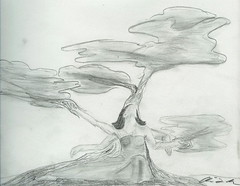
Knarled Tree's Dryad (Graphite)The Taoist conception of "nonaction" provides great insight into how to accomplish such a radical shift of mind. Importantly, nonaction is not synonymous with "inaction," in which an individual intentionally refrains from acting. Rather, the idea of nonaction evokes a state of spontaneous openness to the immediate presence of all things as they manifest and move with(in) the Way (that is, the Tao, the Divine, the World/Universe, or Nature Herself). Action and inaction represent a duality of intention, in which the actor is viewed as an autonomous power; when we embrace nonaction, we acknowledge not only intention, but attention--an essential attending to the Way in which things exist and interact harmoniously, and how we ourselves are already a vital part of this harmony. I imagine that it is very similar to the Druidic idea of the "song" of the world. We do not impose our song on others, we listen for the song--both the worlds' and our own--its progression, its crescendo, and we blend our unique notes into that music.

Because the sage does not “detract from the Way with the mind,” nor with deliberate action, she is able to live casually and harmoniously within it. Instead of futilely exerting herself in trying to preserve that which is naturally transient, she “unifies her nature, nurtures her vital breath, and consolidates her integrity so as to communicate with that which creates things.” In this way, even the inaction of daily life becomes an integral part of "environmental action." Choosing to sit quietly in meditation instead of turning on the energy-sucking television, spending our time cultivating attention and creativity rather than on banking that overtime pay so we can buy more things, even retiring to bed at a reasonable hour so that we awake refreshed and energized rather than lethargic, crabby and burdensome to others--each of these "inactivities" are ways in which we participate effectively in the recuperation and restoration of the natural world. By transforming along with the world, we are also able to maintain what is essential, a unity which does not transform. This kind of unity is what Taoists might refer to as our integrity, although it is, on second glance, vastly different from the Western conception of individual ‘wholeness.’

One person cannot do it all--but each person can do exactly what is appropriate and harmonious for the whole.

Sunday, October 14, 2007

Sobriety

Sometimes I feel like sobriety is extremely undervalued these days.

One should be, I think, sober and fully present. Out of respect.

Is this a weird idea, that it is important to respect the world? I seem to have found myself with an overwhelming sense of the world being very real, a presence--maybe because my sense of "God" has slowly grown and expanded to include and transcend "the world." The Divine is not just some external bearded entity in the sky or the afterlife or located wherever. The world is not "His" gift to us. The world is. I have a relationship with the world, even when I am alone. Even when I am lonely, I am lonely with(in) the world. The world is always present, fully present. To waste time being inebriated seems... ungrateful.

There are so many tiny things going on--and each tiny thing is part of the world, and also the whole world and the way in which the world manifests--and what if you're too stoned to notice? Then your stress and anxiety float in a void of not-world, isolated and seemingly without resolution or perspective or escape. So you smoke more pot to relieve the stress. And you miss out on even more, and so you feel even more "out of it" and can't keep up. You try to escape stress, but you escape into a void in which only the stress is real, or nothing is.

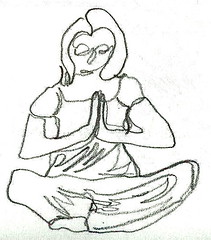
MeditationEscape, instead, into the world. Sit outside and listen. There are birds and a wind. There is a field, into which tress slowly migrate over hundreds of years. There is a pond, and then there is not a pond, only a dry bed and rotting wood and toads buried in the mud. There are weeds more beautiful than flowers, and there are also flowers. This has nothing to do with you, and everything to do with you. There are countless tiny things being and becoming and becoming beautiful: and you are one of them. Even when you are stressed, even when you are lonely or tired.

A friend recently wrote about the idea that "Godde doesn't exist yet":

But there is an Arising. The universe and its inhabitants are becoming more conscious, more compassionate, more empathic, with the arising of the universal Mind. As we interact socially with the Universe, we increase its consciousness.

Rilke, in his Letters to a Young Poet, wrote:

As the bees bring in the honey, so do we fetch the sweetest out of everything and build Him. With the trivial even, with the insignificant (if it but happens out of love) we make a start, with work and with rest after it, with a silence or with a small solitary joy, with everything we do alone, without supporters and participants, we begin him.

Who will build the beauty of the world, if we won't? With infinite attention, the world expands, the universe groans and stretches and wakes from sleep. Without attention, respect, love--the world grows anxious and dull, inhospitable, repetitive. What will you do on a Sunday afternoon? The sun is bright, the leaves are creeping towards death like millions of monarch butterflies, the wind moves, or doesn't--and where are you? Hiding inside with the windows shut, squandering your precious attention on smoke and mirrors.

And if you feel your life is too stressful or too boring to withstand sobriety for long, then there it is: change your life. The world is waiting to relieve you, to refresh you. It owes you nothing, but everywhere offers itself up selflessly. Accept it. Welcome in the world. Sobriety is literally the least you can do.

Sunday, October 7, 2007

Space to Live Fully

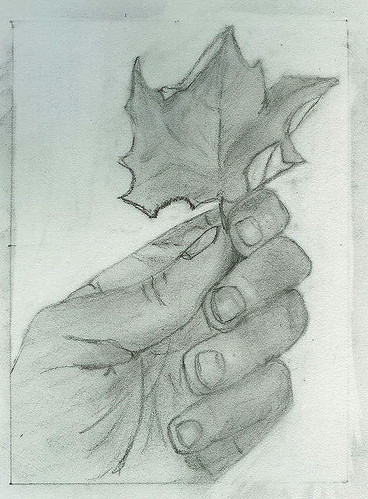
Still enjoying my sabbatical from blogging and pursuing my newly sparked interest in drawing, so you'll have to hold on for just a bit longer, dear readers. But meanwhile, I wanted to share an excerpt from a letter I recently wrote to a friend about the nature of stress. Perhaps it will help shed some light on my reasons for this little break.


My friend explained the extended lag in correspondence on his end in the elegant metaphors of computer technology:

I'm reminded of a term from the arena of computer software, as example.  As load on a PC's memory increases, pages of the computer's high-speed memory are swapped out to the larger but much slower hard disk memory.  For a while this helps the computer do more because the lesser-used pages are moved to a slower memory, freeing the scarce high speed memories for the task at hand.  There is a threshold, though, at which each page retrieved from the disk requires another page to be swapped out to the disk, which itself is still required and very soon needs to be brought back from the disk, perpetuating the cycle.  At this threshold, the computer spends more time just shuffling memory around than doing actual work, and performance can plunge to a near stand-still.  They call this "thrashing," and sometimes I feel like it happens to me too.

The following is what I wrote in response, as I thought of my own stress recently and the vital difference between our two approaches.

You don't have to apologize. I've been sick recently, which brings its own kind of stress, though a different kind. I'm also (as I'm sure I've mentioned) learning how to draw, and like everything I do, I'm doing it intensely and passionately and devoting most of my free time to it (I've started dreaming about it, too--last night, I dreamt about how to draw the corners of walls, and then later that little glimmer of light that runs along the upper edge of lips and pools in the corner of the mouth, rubbing elbows (to mix bodily metaphors) with that most expressive shadow that so greatly influences how we perceive a person's mood). So while I've missed your letters, it's not like I don't have plenty to do.

Your talk about stress and the computer analogy is interesting, but it reminds me of what many mystics and philosopher-poets have spoken of, which is that functioning in the realm of categories and conventions (e.g. work versus leisure versus transit versus social life, all of which are shuffled and rearranged to suit what "needs to be dealt with at the moment") is really like living only half a life. At least, that's how it strikes me, like there is always a part of yourself sitting idly by like a secretary, keeping tabs on all the things you're busy not doing. The seekers and thinkers talk about emptying oneself of distraction and clearing space within oneself not simply so something "more important" can move in and take that space over, but because space, emptiness itself is valuable, necessary even. It allows you to live your life fully in the present, to be completely here-now, without wasting any time shuffling and rearranging--to live intensely and completely, without the needless distraction of "thrashing." Or, at least, when the mystics thrash, out of pain or frustration or grief, their thrashing is actual thrashing--it is movement, bodily momentum, personal expression, and it can be fully experienced and felt, almost like a dance or a song. It's not simply a crash, a shutting down of the self, but a new way for the individual to be, and to continue to become. The stress of being sick is, for me, like this kind of thrashing--not an overload, but a new kind of sensation in itself. Far from a pleasant one, of course, but one to which I try to be fully present anyway (if only because insisting on being fully alive is the best, maybe the only, way to get well again).

I hope you don't take offense, but it saddens me that your days are so full of stress and the shuffling and prioritizing of segregated aspects of your life that you only ever get to have a little dose of it at a time. It seems a great waste of energy. I'm sure there's much to be said for accomplishing many things, of "getting a lot done." But I've always felt that it is more important to do each thing completely and with your whole self, than to do many things without understanding them or being fully present to their processes, implications, sensations, etc. After all, it seems like a lot of the ridiculous and difficult things that happen occur mostly because no one was bothering to pay attention and be truly present to their actual reality. Every time a stock market bubble pops, for instance, people suddenly remember that money is not an arbitrary and infinitely flexible thing, but that it is tied to the actual existence of objects and work in the world, that tulips or houses or websites cannot alone sustain the wealth of an entire community of hungry investors. Every time someone loses a son or brother in war, that war ceases to be merely a political strategy in a global game--it is a real thing in which real destruction is caused on a daily basis. If people made the effort to empty themselves out so that they had the stamina and courage to be fully present to each small aspect of their lives and how it ripples out infinitely to touch all other lives, I don't think war or rich men would be so easily made, nor so glorified and applauded. Wealth and violence are two things that are hard to bear unless you shave a bit off the top and shuffle it away into that "slow memory" where it can collect interest unnoticed and unfelt.

But that's all of my lecturing for today. I guess I'm just of the old-fashioned school that believes it doesn't just matter what you do, it matters how you go about doing it (marry that to my radical devotion to whatever "Truth" is, and voila--you have one frustrated, lonely girl who doesn't enjoy everyone rushing about her as if the rushing itself were the important part).