
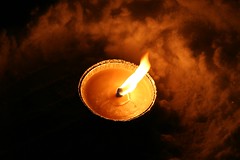
 The world is gray and white and shades of brown, and every inch of me is screaming for spring, restless and aching and urging me to quit, to give it all up, to leave my stupid job and drive south, to keep driving until snow and dark are left behind, to keep driving and burning and thrashing through night until the sun comes up and I'm surrounded by palm trees and blue skies and wide, warm oceans rocking, rocking. But of course, I can't. So instead, I light a homemade candle in a dented, old tin can. I set it out on the front stoop, nestled in the three inches of snow, and I let it burn. And evening settles and the snow continues to drift down from low clouds to cover everything — but that single wild flame is still clawing its way up out of that tin can, bright against the dull, wet brick, melting a tiny circle from around its hot metal sides. Whenever I begin to feel trapped and unfocused, I step outside and spend a moment squinting through the white-darkening cold that falls and bites against my skin, squinting at that candle, and feeling a little bit of triumph.
And I think of my cat, born in late September and abandoned in the gutter, seeking shelter under our car where we found him and brought him home as a tiny, half-starved stray. For him, the world has only ever gotten colder, and darker. I cuddle him in my arms as we look out the window together, and I tell him, "It will get green again — greener than you know. It will be so green, so warm and colorful and lush, and there will be birds for you to watch, and bugs to chase. You have no idea, kitty! You've never known a spring!" He just blinks at me with his cat eyes, and I have to put him down and slip on my shoes and step outside again to look at the candle, burning like a beacon, and tell myself, yes, it will come... it will...
It's been slightly more than a week since I attended the Feast of Lights, and oddly enough, all those ideas and topics jostling around in my head, vying for a good airing, have settled back down into relative calm, smothered by the snow. Which may be an interesting observation in itself: on my own, my spiritual life is about doing Paganism, engaging in embodied spiritual living; around other Pagans (at least in large group settings such as at a festival), my spiritual life becomes about being Pagan, and what exactly that means.
This is not entirely a bad thing, really. One thing I noticed immediately, despite my worries about being too "normal" (in my plain navy-blue long-sleeved shirt and sensible shoes) was that I felt comfortable, at ease and intensely interested in everything going on. These talks about interfaith work and establishing workable definitions that remain inclusive without becoming so vague as to be useless, these discussions of "mainstreaming Paganism" and "Paganizing the mainstream" and what such processes might mean... they were always too short for the subjects they wanted to explore, and they left the voices in my head yammering to have their say, to speak to old assumptions about the nature of community, and language, and archetypes, and political upheaval.
But what impressed me most was the first session that Jeff and I attended that Friday evening, a round-table discussion on sustainable living. Just a few of us in the room, skipping immediately to the question of work, to questions of activity and efficacy, sharing stories about what we did and why. No need to qualify or cite years of expertise, or quibble over definitions. We were not merely Pagans mulling over notions of self-identity, we were more than that, somehow, simply by allowing ourselves to be just folks, trying to live better. Yet we were Pagans, too, no merit badges required. After brief introductions, one moderator led us in a moment of quiet breathing and centering — and for the first time, I knew what it felt like to be a part of a community where no one looked askance at such a suggestion or rolled their eyes or shifted uncomfortably. The same was true when, after an intense discussion of sustainability options (which left me singing the praises of poverty and fungi, bless them both), we circled around a tight cluster of chairs, humming a simple tune I cannot now remember, and then settled down to breathe, hold hands and light that flame within each of us that would guide us in our choices. Nothing fancy, no pretensions — we were practicing the simple: breath, intention, togetherness and flame.
And, as appropriate to a weekend of beginnings and bookends it seems, the final session we attended was equally impressive, an amazing concert and sing-along led by the group Northern Harmony, whose eerie, soaring and guttural vocals sent shivers slipping up and down my spine as they set my soul to wandering. The experience was intense, and set me in mind of the other large-scale festival I have attended with some regularity for the past fifteen years: the Dodge Poetry Festival.
At the Dodge Poetry Festival, there were some panel discussions about the craft of poetry, what it means to be a poet, what the life of a poet is like; and there were some workshops on technique, exercises to experiment with and new approaches to try. But by and large, what makes up the Dodge Festival is folks doing poetry, getting up there on stage and giving voice and life to their work, performing their art in all its power and polished form. The debates about what counts as "real poetry" are left in the dust of this kind of living engagement with the work, and you always know that "something" is there, that poetry is alive and well, when it moves you to dancing, laughing, sighing and silence.
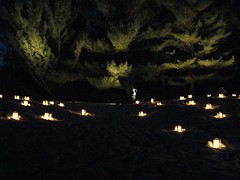 This is what I want from Paganism, and from Pagan festivals: this doing and being with each other, without constant navel-gazing and comparing notes. Knowing ourselves is essential, of course, and it was immensely satisfying to sit and listen to ideas being bandied and concerns being raised. But I also want that community of doing, so that I am not always doing the doing alone. I want to be able to set aside our differences long enough to do the work together, to practice and share that engagement, even if we each go home with our own impressions and interpretations of what just happened. I want our rituals to be full of songs that send shivers down my spine, not just the latest drumming technique imperfectly practiced. I want little candles lit and flickering despite the falling snow outside. And I know it will take a long time to get there, and there is much work to be done in the meantime, each on his or her own. But for now the questions of self- and community-identity that had been stirred up in the muddy waters of last week have all but faded away again, and what I want is to ground myself again in practice, in doing my Druidry as deeply as I can. So that when the opportunity comes to practice with others, I can do my part to make the whole thing move.
 All of these reflections lead me to something about the role of charisma in the Pagan community, but I'm not quite sure what precisely that is. I'm reminded of the book I'm currently reading, The Serpent and the Goddess by Mary Condren, in which she speaks of patriarchal religious institutions passing on through ordination into the priesthood the kind of spiritual leadership and power that individuals once had to earn on their own through charisma, i.e. being valuable to the community.
  Before braving this post, I wrote a ridiculously long and dull account of the Sequence of Events™ for my personal journal, to help organize my thoughts and give me some sense of having already begun (a blank page at this point being the most intimidating thing). But it occurs to me that, in my account of the weekend, I left out one telling detail about my visit with my brother for the two days before.

 She also suggested that a person could learn how to move freely among these various theological notions, depending on circumstance and need, and that being able to enter a Red conceptual space was practically paramount for effective ritual in which the gods were experienced as real, personal entities who could be in meaningful relationships with practitioners. And here was where I ran into trouble. If I had just been content to remain comfortably entrenched in my Blue corner of Spirt-and-Void, then perhaps it wouldn't have mattered so much where Red and Yellow might be found or how you were supposed to get there. But as soon as that whisper in my mind began, the urge to move, Harrow's splendid Triangle of the Gods transformed from a helpful little visual aid to a frustrating graphical quagmire. The problem was that it was a two-dimensional graph, with three axes (and I don't mean the kind with cold metal edges and lumberjacks attached at one end).